
All Saints’ Day in Spain 2026: Traditions, Sweets and What Is Open on the Costa del Sol
If you are on the coast this weekend, All Saints’ Day in Spain may be the part of the calendar that matters most. Halloween falls on Saturday 31 October, and the official mourning ends that day. The holiday itself arrives on Sunday 1 November and extends to Monday in Andalusia. This guide explains the dates, the customs and the practical details, checked on 30 October 2026.
Quick Answer
All Saints’ Day falls on Sunday 1 November 2026. In Andalusia the holiday moves to Monday 2 November, according to the regional decree published in the BOJA on 19 May 2025. Families visit cemeteries with flowers and eat chestnuts and sweets such as huesos de santo. On the Costa del Sol, expect a long weekend, reduced opening hours and busy cemeteries.
The Dates for All Saints’ Day in Spain in 2026
The calendar for All Saints’ Day in Spain is slightly unusual this year. Many people expect a Saturday, but 1 November lands on a Sunday. The table shows the weekend as it stands today.
| Date | What it is | Source or note |
|---|---|---|
| Friday 30 October | Second of three days of official mourning | Government declaration, 29 to 31 October |
| Saturday 31 October | Halloween; mourning ends | Many town events moved to Sunday |
| Sunday 1 November | Todos los Santos, a national holiday | Falls on a Sunday in 2026 |
| Monday 2 November | Regional holiday in Andalusia | BOJA decree, 19 May 2025 |
| Tuesday 3 November | Normal working day | No holiday listed |
The Andalusian decree is the key document. Its preamble says that 1 November and 6 December both fall on Sundays in 2026, so they move to the following Monday. The annex lists “2 de noviembre (lunes), Todos los Santos” among the twelve regional working holidays. It also says each municipality may add up to two local holidays.
That settles a point our earlier guides left open. We had one secondary source for the Monday holiday. The official bulletin now confirms it for Andalusia.
Which Regions Mark All Saints’ Day in Spain on Monday?
Not every region moves the holiday. El Independiente reports that, because 1 November falls on a Sunday, regions may replace the Monday rest with their own celebrations. It says Monday 2 November is a holiday in nine regions.
| Regions with a holiday on Monday 2 November | Source |
|---|---|
| Andalucía, Aragón, Asturias, Canarias, Castilla-La Mancha, Castilla y León, Extremadura, Comunidad de Madrid and Navarra | El Independiente, 30 December 2025 |
This matters for visitors. Friends travelling from other regions may have a normal working Monday. Those from the nine regions above will probably be free. Check the date before you plan a group trip.
Traditions: How Spain Marks the Day
All Saints’ Day in Spain is a day of remembrance. Don Quijote, the language school, says families visit cemeteries with fresh flowers. It adds that this is said to be the day of the year when the most flowers are sold. Churches hold special masses for everyone who has died.
In the north, people also hold a castañada. Friends and family gather to eat roasted chestnuts cooked over a fire or on a portable grill. The same custom, in different forms, appears across the country. El Cronista lists several regional versions.
| Region | Tradition | Note |
|---|---|---|
| Galicia | Samaín | Roasted chestnuts and carved pumpkins at doors; mainly revived in the last 20 years |
| Asturias | Amagüesto de Difuntos | Families roast chestnuts and pray for deceased relatives |
| Aragón | Noche de las Ánimas | Lit pumpkins line a path to the cemetery |
| Cataluña | La Castanyada | Chestnuts, sweets and panellets; dated to the 18th century |
| Canarias | La Noche de Finaos | Families remember the dead; the eldest tells stories |
| Andalucía | Tosantos and chestnut festivities | Huesos de santo, buñuelos and bonfires |
Andalusia has its own version. Happy.Rentals, a rental company blog, describes Tosantos as lasting three days from 1 November. It lists masses, candlelit processions, flowers on headstones and roasted chestnuts. Treat it as a general description, since it is a commercial source.
Sweets for All Saints’ Day in Spain
Food is the easiest way to join in All Saints’ Day in Spain. Bakeries fill their windows with seasonal sweets a few days before 1 November. Most have religious or convent origins.
| Sweet | What it is | Origin note |
|---|---|---|
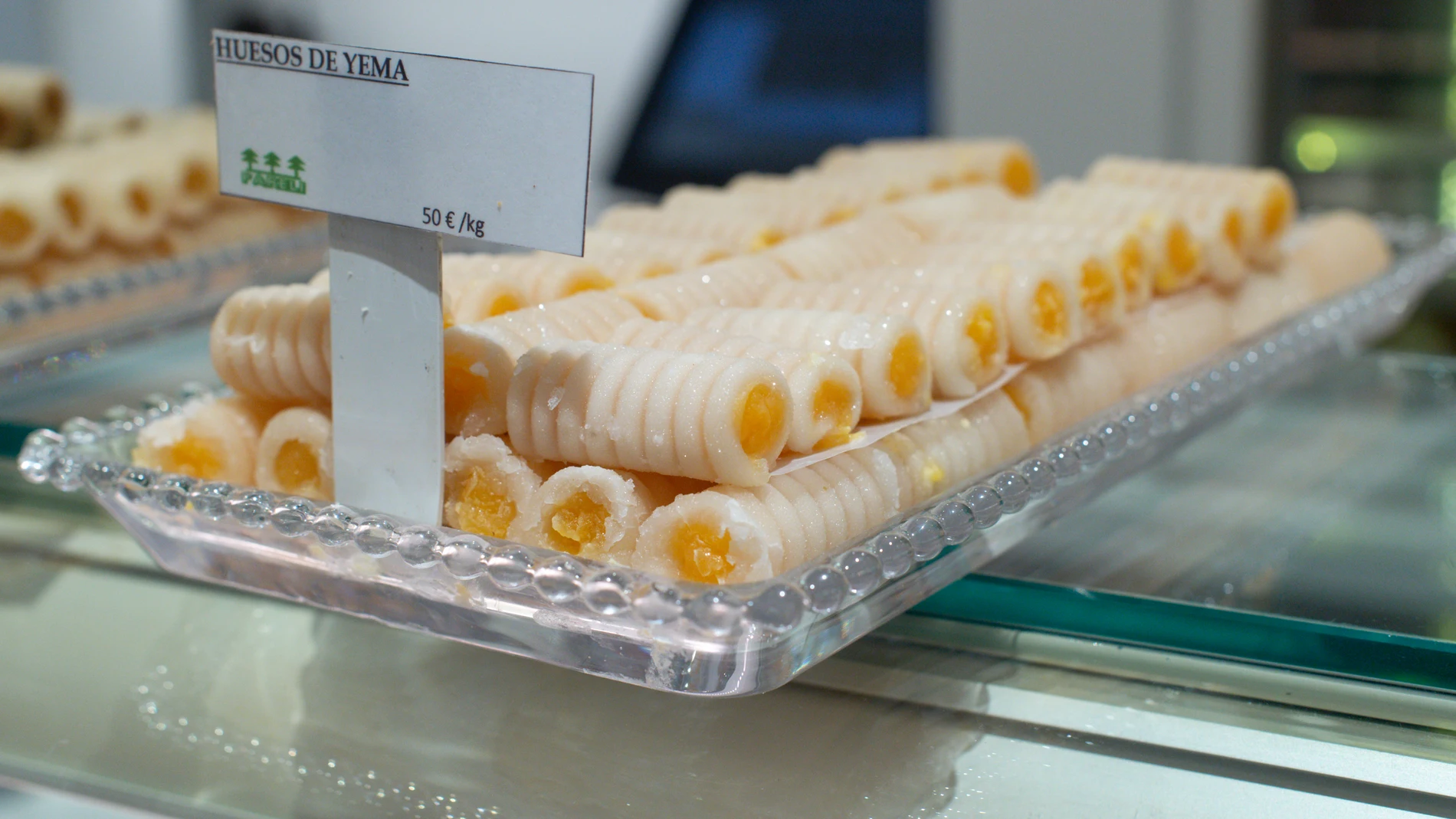
| Huesos de santo | Marzipan tubes filled with sweet egg-yolk cream | El Debate says the origin is uncertain; one belief points to a Benedictine monk in 17th-century Valencia |
| Buñuelos de viento | Light fried dough balls filled with cream | The Objective gives Morisco roots, popularised by convents; Don Quijote says they date to at least the 1600s |
| Panellets | Almond pastries with pine nuts | Catalan; The Objective dates them to the 18th century |
| Pestiños | Fried dough with anise and sesame, coated in sugar or honey | Andalusia and the south; Morisco roots |
| Empiñonados | Marzipan covered in pine nuts | Castilla y León; convent origins |
A folk belief says that each buñuelo you eat helps free a soul from purgatory. It is a charming story, not a rule. Modern huesos de santo come with fillings such as chocolate and marmalade, according to Don Quijote.
We cannot say which Marbella shops stock which sweets this week. Our guides to bakeries in Marbella and artisan sweet shops list places to call. Ask whether you can pre-order.
Don Juan Tenorio: The Play of November
Many Spanish theatres stage Don Juan Tenorio around this date. El Debate columnist Alfonso Ussía wrote in 2022 that November is “the month of Don Juan Tenorio”. He ties the play to the traditional Spanish appointment with All Saints’ Day, and says it survived the Halloween craze. He also calls it one of the most performed plays in Spanish theatre.
The play is by José Zorrilla. We found no 2026 performance in the Marbella area, so we do not list one. In Málaga city, a 2025 cemetery programme included a theatrical tour called “Estampas del Tenorio” at San Miguel Cemetery. Whether it returns in 2026 is unconfirmed.
Cemeteries for All Saints’ Day in Spain: Practical Notes
Cemeteries are the heart of All Saints’ Day in Spain, and they get busy. In Málaga, the council published a programme in October 2025. We could not find the 2026 version, so the table is a guide to what to expect.
| Cemetery (Málaga, 2025 notice) | Hours, 25 October to 2 November 2025 | Activities listed |
|---|---|---|
| San Gabriel and Jardín del Recuerdo | 8:00 to 19:00, continuous | Memorial act on 1 November at 10:00 |
| San Miguel, San Juan, San Antonio, Olías | 9:00 to 18:30 | San Miguel: Réquiem concert on 31 October; mass and procession on 1 November |
| Bus line 23 | Reinforced from the Tuesday before | Runs from Alameda Principal to the cemetery park |
Our advice for any cemetery is simple. Go in the morning, when it is quieter. Bring small change for parking. Keep a respectful tone, as for any place of remembrance. For Marbella and its neighbouring towns, check the town hall’s page for the exact hours.
What Is Open for All Saints’ Day in Spain on 1 and 2 November?
This is the practical question about All Saints’ Day in Spain for visitors, and the honest answer is mixed. We found no confirmed 2026 hours for supermarkets or shops. A 2021 Málaga Secreta article shows that chains and individual stores can differ by day. We therefore avoid giving a list.
Here is what we can say. Sunday is a day when many shops close in Spain. Monday 2 November is a regional holiday in Andalusia. Restaurants in tourist areas usually stay open, but they fill up with families. These are our general observations, not official hours.
- Buy groceries on Saturday if you need them.
- Book restaurant tables for Sunday and Monday in advance.
- Look for the on-duty pharmacy list posted on pharmacy doors.
- Expect public offices, banks and notaries to be closed on Monday.
A Calm Plan for the Long Weekend
This is our own suggestion, not an official programme. It is built for All Saints’ Day in Spain on the Costa del Sol, with a Sunday holiday and a Monday holiday in Andalusia.
| When | Plan | Check first |
|---|---|---|
| Saturday | Shop for food and flowers; walk the old town | Shop hours before you go |
| Sunday morning | Visit a cemetery or attend a mass if you wish | Opening hours and service times |
| Sunday midday | Día del Tostón in Parque de Nagüeles, from 12:00 as listed | Start time and location |
| Sunday evening | Council Halloween programme, 18:00 to midnight | Which district suits you |
| Monday | Slow day; long lunch at a restaurant you already know | Booking and opening hours |
The plan keeps the busiest outing on Sunday, when the council programme runs. It leaves Monday free, because offices are closed and roads may be busy.
Why the Holiday Moves to Monday
The rule behind the move for All Saints’ Day in Spain is simple. When a regional holiday falls on a Sunday, the Andalusian decree transfers it to the next Monday. The decree says so for both 1 November and 6 December in 2026. That is why Constitution Day also moves, to Monday 7 December.
The result is a long weekend, but only in the regions that adopt the move. El Independiente lists nine of them. Others may keep Sunday as the only holiday. If you are organising a trip with people from different regions, confirm everyone’s calendar early.
For employers and residents, the decree adds that regional holidays are paid and non-recoverable. We mention it for completeness. Questions about your own contract belong with your employer or a labour adviser, and we are not providing legal advice.
If You Are Visiting or Moving to Spain
Visitors often meet All Saints’ Day in Spain by surprise. Shops close, streets are quiet and families gather. A few habits make the weekend smoother.
- Buy essentials on Saturday and keep a small stock of water and snacks.
- Book restaurants early, since families eat out on holidays.
- Carry some cash as well as a card for small shops.
- Avoid scheduling property viewings or notary appointments on Sunday or Monday.
The last point is our practical note. Agents and notaries may have reduced hours around a holiday. If you are buying a home, ask for written confirmation of every appointment. Residents who are new to Spain will learn that these holidays are part of the rhythm of the year. Each town also adds its own local days, so check the council calendar in January.
Where the Day Comes From: 1 and 2 November
El Debate explains the basics in a 2022 piece. All Saints’ Day honours saints, well known and unknown, and it is a national public holiday. Pope Gregory IV is said to have set it up in 835. The article says sources do not confirm why he chose 1 November. It may have been meant to replace a Germanic pagan festival with a Christian one.
The next day has a different meaning. 2 November is All Souls’ Day, or Día de los Fieles Difuntos, a day for praying for deceased believers. The same article says requiem masses are typically held that day, unless it falls on a Sunday. That detail does not apply this year, because 2 November is a Monday.
| Date | Name | Meaning |
|---|---|---|
| 31 October | Halloween | A recent import with Celtic roots, according to El Cronista |
| 1 November | Todos los Santos | Honours saints, and the day families visit graves |
| 2 November | Fieles Difuntos | Prayers for the faithful departed; also called Día de las Ánimas |
Andalucía.com, a tourism site, calls the whole period around All Saints’ Day in Spain Allhallowtide. It says the three days run from Halloween through All Saints’ Day to All Souls’ Day. It adds that in Andalusia the day is called Tosantos, a contraction of “todos los santos”, and is observed especially in villages in Cádiz and Málaga.
Chestnuts First: How Málaga Province Marks the Day
Much of Spain eats buñuelos and huesos de santo. Málaga does something a little different. El Debate wrote in November 2024 that another custom dominates, which begins each year with the arrival of autumn: roasted chestnuts. It names the Serranía de Ronda, the Sierra de las Nieves area and the capital.
The article says chestnut stalls opened in Málaga on 1 October and run until the end of the year. It adds that most of the province’s chestnuts come from the Valle del Genal, and that the 2024 harvest was weaker than usual because of drought. Those facts are two years old, so ask a stallholder about this season.
| Village | Custom reported in 2024 | Note for 2026 |
|---|---|---|
| Alaucín | Chestnuts, roasted sweet potatoes and mantecados, with anise, shared in the square | Local event; its origin is door-to-door collecting on the night of the dead; confirm the date |
| Casares | A tostón of chestnuts on 1 November, roasted by fourth-year secondary students at the cemetery gate | Confirm that it runs in 2026 |
| Pujerra | The 21st Fiesta de la Castaña, which also honours the Virgen de Fátima | Edition number will differ in 2026 |
These are 2024 reports. We could not find 2026 programmes for them, and the mourning may have changed some plans. The pattern is still useful. The Tostón that Marbella holds on 1 November belongs to the same family of gatherings.
Flowers for All Saints’ Day in Spain: What to Bring
Flowers are the visible sign of All Saints’ Day in Spain. Qué! reported in 2022, citing the funeral company Interfunerarias, that interest in cemetery flowers rises by up to 800 per cent around 1 November. The same article ranks the options.
| Flower | What the article says |
|---|---|
| Chrysanthemums (crisantemos) | The flower of choice for cemeteries; they last a long time and need little water |
| Calla lilies or lilies (calas, lirios) | Common in Spanish cemeteries but harder to find |
| Lilies (azucenas) | Easier to find and suited to cemeteries |
| Carnations (claveles) | Cheap, easy to keep and colourful |
| White roses | The favourites of customers at funeral florists |
The advice is practical. Choose long-lasting flowers, because graves may have limited water. Florists get busy, so buy on Saturday if you can. We do not have 2026 prices, and we do not quote any.
All Saints’ Day in Spain and Halloween: How They Coexist
Andalucía.com notes that Halloween and All Saints’ Day now coexist in modern Spain. It describes Halloween as widely celebrated, with pumpkin carving, costumes, trick or treat and themed parties in bars and clubs. It also mentions ghost walks in some towns.
The result is a mixed weekend for All Saints’ Day in Spain and Halloween. A family may bring flowers to a cemetery in the morning and take children to a costume event in the evening. Neither is wrong. The two traditions have different moods, and most people keep them apart.
This year the contrast is sharper. The official mourning has toned down the public parties, so the quieter traditions carry more weight. It may be a good year to try the older customs: chestnuts, sweets and a calm walk.
Planning a Chestnut Day Out in the Hills
If the weather is good, a village trip suits All Saints’ Day in Spain. Our guide to the white villages near Marbella covers drives and stops. The table gives our own checklist.
| Step | Why it helps |
|---|---|
| Ask the village council or a local bar whether a tostón is running | 2024 reports may not apply in 2026 |
| Start early and park outside the centre | Small villages fill up on holidays |
| Bring cash for chestnuts and small snacks | Stalls may not take cards |
| Have lunch booked | Restaurants fill up with families on holidays |
| Keep a plan B in town | A cancelled event should not spoil the day |
These steps are suggestions, not official advice. Roads to the Serranía can be winding, so allow extra time.
Etiquette for Visitors on 1 November
For many families, All Saints’ Day in Spain is personal. A few habits show respect.
- Keep your voice low in and near cemeteries.
- Do not photograph other visitors or their graves.
- Do not wear costumes in a cemetery.
- Follow signs, queues and any instructions from staff.
- Leave flowers only on a grave that belongs to your family.
These points come from common courtesy. They are not rules published by the councils. If you are unsure, watch what local families do and follow their lead.
A Short Glossary for All Saints’ Day in Spain
- Todos los Santos: All Saints’ Day, 1 November.
- Tosantos: the Andalusian contraction of the name.
- Fieles Difuntos: All Souls’ Day, 2 November.
- Tostón: a gathering around roasted chestnuts and sweets.
- Castañada: a chestnut-roasting gathering, common in the north.
- Crisantemo: chrysanthemum, the classic cemetery flower.
- Festivo: public holiday.
Andalusian Customs You Will Not See Elsewhere
The Local, an English-language news site, published a list of unusual customs for All Saints’ Day in Spain in 2018. Several are Andalusian. They are older reports, so check whether each one still runs.
| Place | Custom reported in 2018 |
|---|---|
| Cádiz | Animals such as rabbits, pigs, fish and hens are dressed in clothes at the Virgen del Rosario market. Shopkeepers make dolls from fruit, vegetables and nuts that mimic public figures |
| Begíjar, near Jaén | Young people carry a pot of gachas through the village and fill keyholes with it, to keep evil spirits out |
| El Ronquillo, Seville province | Children go door to door and sing for food. The custom traces back to altar boys who collected food while ringing bells for the dead |
| Baños de la Encina, near Jaén | Residents spend two to three days in the countryside, singing, eating and playing games |
None of these is on the Costa del Sol. They show how local the day can be. The Costa del Sol version is closer to the chestnut tradition of the Serranía and to the new Halloween events, because the coast has many international residents.
Gachas Dulces: A Humble Dish for All Saints’ Day in Spain
El Cronista describes gachas dulces as a cheap, filling dessert from Andalucía, Jaén and Castilla. It is a thick, sweet porridge made with flour, milk, sugar and olive oil. It is flavoured with lemon peel, anise and cinnamon, and topped with fried bread and ground cinnamon.
The article says tradition calls for eating gachas on the night of Todos los Santos or the next day, Día de Difuntos. It also lists them among the foods of All Saints’ Day and Semana Santa. It gives no history of the dish, so we do not offer one.
You will rarely see gachas in a restaurant menu on the coast. They are more of a home dish, so ask Spanish friends, a village bar or a traditional bakery. If you want to try them, treat it as a small adventure, not a plan.
Families With Children on 1 November
Children often ask about costumes and sweets. This year Sunday is the main day for the council programme in Marbella, so a simple routine helps.
- Visit the Día del Tostón in the afternoon, when chestnuts are handed out from 16:00 to 18:00 as listed.
- Go to the Halloween programme in the evening, from 18:00, if the children want costumes.
- Keep Monday free, since it is a holiday and traffic can be heavy.
Explain the day in simple words. Some families remember relatives on 1 November, and children may ask questions. A short, calm answer is enough. This is our parenting suggestion, not official guidance. Our Marbella with kids guide has quieter ideas for the days around the holiday.
Mixing Both Traditions at Home
If you live on the coast, you can blend both customs. Our suggestions are modest, and they suit a year of mourning.
- Buy a small bunch of chrysanthemums for a family grave, or for your own table.
- Pick up pastries from a local bakery, and share them with neighbours.
- Roast chestnuts at home, if you have an oven or a grill.
- Keep decorations simple, and avoid anything too gruesome.
Spanish neighbours will notice the effort. A small gesture goes a long way, especially for newcomers who want to feel part of the community.
A One-Page Checklist for All Saints’ Day in Spain 2026
This table pulls the main points together. It is our summary of the sources above.
| Question | Short answer | Confidence |
|---|---|---|
| Is 1 November a holiday? | Yes, Sunday 1 November, nationally | High |
| Is Monday 2 November a holiday in Andalusia? | Yes, per the BOJA decree | High |
| Do all regions get Monday off? | No; nine regions, per El Independiente | Medium; secondary source |
| Are cemeteries open longer? | Málaga did so in 2025; 2026 not found | Low for 2026 |
| Are shops open? | Not confirmed for 2026 | Low |
| Is there a Marbella Tostón? | Yes, on Sunday 1 November, as announced | Medium; council announcement via press |
| Is a village tostón running? | 2024 reports only | Low; ask the village |
Confidence is our own label. It reflects the type and date of the source, not a promise.
What We Could Not Confirm About All Saints’ Day in Spain
A good guide should say what it does not know. We found no 2026 supermarket hours. We found no 2026 cemetery notice for Marbella, San Pedro or Estepona. We found no confirmed Don Juan Tenorio performance near Marbella. We also found no 2026 programme for the village chestnut events in Málaga province.
Some of those gaps may fill in over the weekend. Councils often publish notices at the last minute, especially after a change such as the official mourning. We recommend that you check three things on the day. First, the council’s social media. Second, the venue’s own page. Third, a phone call.
If you find an error or an update, tell us. We revise these guides when the facts change, as we did with the Monday holiday once the official decree was confirmed.
How the Mourning Affected the Weekend
The official mourning from 29 to 31 October touched the Halloween events, not the holiday. Marbella’s council moved its Halloween programme to Sunday 1 November, from 18:00 to midnight. It also kept the Día del Tostón that day, with a gathering in Parque de Nagüeles from 12:00 and chestnuts handed out from 16:00 to 18:00.
Our Marbella and Costa del Sol Halloween guides list the new dates and the towns that cancelled. Some private events may still run, but we could not confirm them. Because 1 November is a holiday, expect busier roads and fuller restaurants.
Confirmed in the sources: 1 November 2026 is a Sunday, Monday 2 November is a regional holiday in Andalusia (BOJA decree), and Marbella’s Tostón is on 1 November.
Not confirmed: shop and supermarket hours, 2026 cemetery hours, any Don Juan Tenorio performance near Marbella, and whether your town has a local holiday near the date.
Frequently Asked Questions About All Saints’ Day in Spain
Is 1 November 2026 a public holiday in Spain?
Yes. All Saints’ Day is a national holiday, and in 2026 it falls on a Sunday. In Andalusia the holiday moves to Monday 2 November, according to the regional decree published in the BOJA on 19 May 2025.
Is Monday 2 November 2026 a holiday on the Costa del Sol?
Yes, in Andalusia. The BOJA decree lists 2 November (Monday) as a regional working holiday. That covers Marbella, Málaga and the rest of the Costa del Sol. Each town may also add local holidays of its own.
What do Spaniards do on All Saints’ Day?
Families visit cemeteries with fresh flowers and attend special masses. In many regions people also eat roasted chestnuts and sweets such as huesos de santo. Don Juan Tenorio is staged in November in many theatres.
Is All Saints’ Day the same as Halloween?
No. Halloween is a recent import from the United States with Celtic roots, according to El Cronista. All Saints’ Day on 1 November is an older Catholic day of remembrance. The two now share the same weekend.
What sweets should I try for All Saints’ Day in Spain?
The classics are huesos de santo, buñuelos de viento and panellets. Pestiños are also common in Andalusia. Bakeries often sell them only around 1 November, so order early.
What is the difference between All Saints’ Day and All Souls’ Day?
All Saints’ Day, on 1 November, honours saints. All Souls’ Day, on 2 November, is a day to pray for the faithful departed. In Spain, families tend to visit cemeteries around both dates.
What flowers do Spaniards bring to cemeteries?
Chrysanthemums are the classic choice, according to Qué!, because they last a long time and need little water. Carnations, lilies and white roses are also common.
Do people eat chestnuts on All Saints’ Day in Málaga?
Yes. El Debate wrote in 2024 that roasted chestnuts are the dominant custom in Málaga province, especially in the Serranía de Ronda and the capital. Casares, for example, held a tostón on 1 November.
Are shops and restaurants open on 1 November 2026?
We could not find confirmed 2026 hours. Because 1 November is a Sunday and 2 November a regional holiday, many shops may keep reduced hours. Check each store or restaurant the day before.
Can tourists visit cemeteries on All Saints’ Day?
Yes, but treat it as a day of remembrance. Keep your voice low, avoid photographing other families and follow the signs. Opening hours change on the day, so check the council’s page.
Did the official mourning change All Saints’ Day plans?
It affected the Halloween events, not the holiday itself. Marbella moved its council events to Sunday 1 November and kept the Día del Tostón that day. Confirm any event with the organiser.
The Bigger Picture
All Saints’ Day in Spain sits between two worlds. One is a quiet remembrance with flowers, masses and chestnuts. The other is a newer, louder Halloween. This year the two meet in a weekend shaped by mourning. For the official text of the Andalusian holiday calendar, see the Junta de Andalucía bulletin.
The older customs are worth meeting at least once. A bunch of chrysanthemums, a paper cone of hot chestnuts and a pastry from a local bakery tell you more about Spanish autumn than any party. They also cost little, and they invite conversation with neighbours.
If you are thinking about living on the coast, a calendar like this is part of daily life. Our team can help you find a home that suits your rhythm.
Looking for a home on the Costa del Sol?
LUXO Estates helps buyers and renters find villas and apartments in Marbella and beyond.