
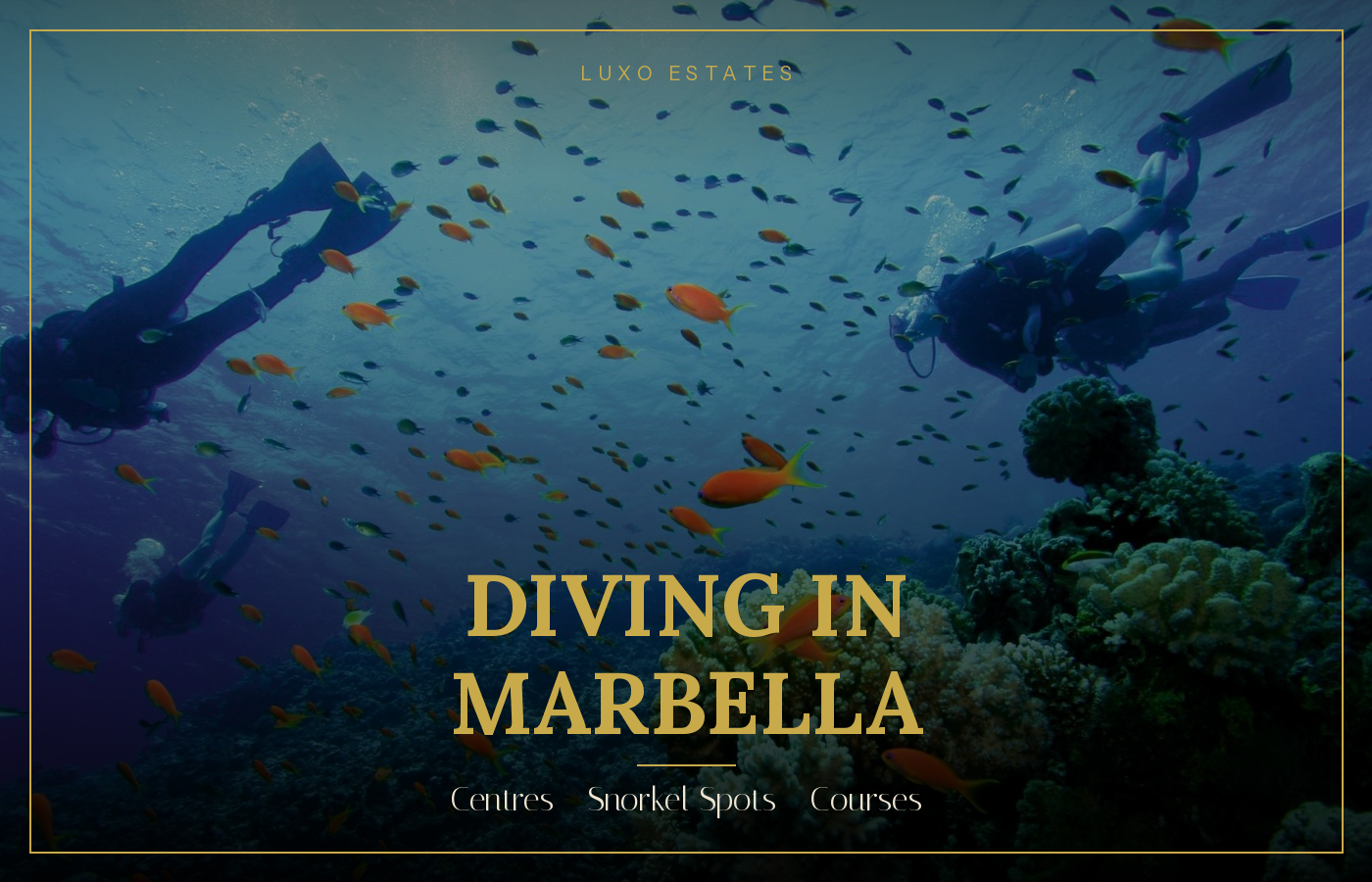
Diving in Marbella: Dive Centres, Snorkel Spots and Protected Areas
Diving in Marbella is mostly a matter of short guided dives from the town’s marina, introductory baptisms for beginners and certification courses, with the best-documented snorkelling on the rocky stretches of coast between Marbella, Benalmádena and Manilva. This guide sets out what the listings offer and what they cost, which snorkel spots a published guide recommends, what you can expect to see, what the rules say and what we could not confirm.
Quick Answer
For a first dive, listings show baptisms in Marbella from about €98. For certified divers, a guided dive is listed at €50 and a bottle-and-weights dive at €95 plus €25 for equipment. For a course, a four-day PADI Open Water is listed from €500. For snorkelling, the one Marbella spot in a published guide runs from the Nagüeles pier to the rocks in front of Puente Romano, and a signalling buoy is recommended because of boat traffic. Dolphins, wrecks and visibility are not promised by any source we found.
Read this first: the prices below come from a booking platform and several listings do not name the operator, the dive site or the certification needed. We found no source describing a marine reserve in Marbella’s own waters, and the only temperature figures are from a 2013 regional article. Confirm every detail with the centre before you pay.

What Is Diving in Marbella Really Like?
Marbella is not a destination known for wrecks or dramatic walls, and none of the sources we read names a famous dive site here. What the listings describe is accessible diving from the marina, with a guide, equipment and a short briefing. The snorkelling guide describes a coast of rocks, fine gravel and seagrass meadows, with fish, octopus and sea urchins and no coral. That suits beginners, families and visitors who want an hour underwater more than a dive-trip holiday.
If you are a keen diver, set expectations accordingly and ask the centre which sites it uses on the day, since the guided-dive listing we found says only that it goes to “some of the best spots” along the coast without naming them.
Dive Experiences and Courses as Listed
A booking platform lists the following offers in and around Marbella. Two Marbella companies, H2O Sports and COISMarbella, appear on the platform, but the pages do not tie them to specific offers, so we do not attribute prices to either.
| Offer (as listed) | Price listed | Details given |
|---|---|---|
| Dive baptism in Marbella | From €98 | Operator, duration and inclusions not stated |
| Guided scuba dive, 3 hours in total | €50 | 45 minutes underwater; guide, equipment and insurance included; meets at the Marbella marina; hotel pick-up in an 8-seat van; prior experience implied |
| Scuba dive with bottle and weights | From €95, plus €25 equipment rental | About 2 hours; 1 to 12 people; bottle, weights and a guide; meets on Calle José Meliá; certification not stated |
| PADI Scuba Diver | From €420 | Duration not stated |
| PADI Rescue Diver | From €425 | Duration not stated |
| PADI Advanced Open Water | From €459 | Duration not stated |
| PADI Open Water Diver | From €500 | 4 days |
The same platform lists baptisms outside Marbella for comparison: in Estepona from €75 in a pool, €85 in the sea and €135 for both, and in Fuengirola from €70 for a three-hour beach baptism. These show that the Marbella baptism price sits at the upper end of the range, though we cannot say what each includes.
How to read these listings
- The €50 and the €95 dives are not the same product. The first includes all equipment, insurance and a briefing and implies previous experience, while the second is a bottle, weights and a guide, with equipment extra.
- Baptism versus guided dive: a baptism is an introduction for people who have never dived, and a guided dive is for people who have. Ask which one you are booking.
- Cancellation: the two dive listings say fixed-date bookings are not refundable except for bad weather or a provider problem, in which case you can postpone or be refunded, and open-date vouchers can be refunded within 14 days of purchase.
- Timing: the guided dive is listed from 9:00 daily, and the bottle-and-weights dive adapts to your schedule, so contact the provider.
Snorkelling Spots on the Costa del Sol
A snorkelling guide published in October 2022 and updated in March 2026 describes seven spots along the Costa del Sol. Only one is in Marbella, and the others are within about an hour’s range of it, so we list them with their town.
| Spot | Town | What the guide says |
|---|---|---|
| Punta Nabules | Marbella | From the Playa de Nagüeles wooden pier to the rocks in front of Puente Romano; large rocks and fine gravel; bars, gear rental, showers and lifeguards; use a signalling buoy because of boat traffic |
| Playa de la Yuca | Benalmádena | Stony cove, less crowded than sandy beaches, especially outside summer |
| Penón del Cura | Mijas | Rocky beach with fish, sponges, algae and possibly octopus; unprotected, so choose calm days |
| La Sal | Casares | Best in front of the Torre Salto de la Mora watchtower, among boulders covered in algae; spearfishers work deeper water |
| Las Conchas de Manilva / Cala de la Sardina | Manilva | Fine gravel, clear water, usually little wind or waves; suits children; dolphins sometimes pass offshore |
| Punta Chullera | Manilva | Inside the Manilva Beaches Ecological Reserve, with artificial reefs and rocky outcrops; crowded June to August |
| Playa de la Alcaidesa | Casares border | Calm, sheltered, rarely crowded but less rewarding; colder water because it is near the Strait of Gibraltar, so a wetsuit is suggested |
The guide gives no visibility measurements and only describes the water as clear in places. It also lists three boat trips with snorkelling or dolphin watching, including a Marbella sailboat cruise with snorkel gear provided. Our guide to boat trips in Marbella covers those in detail.
What You Might See Underwater
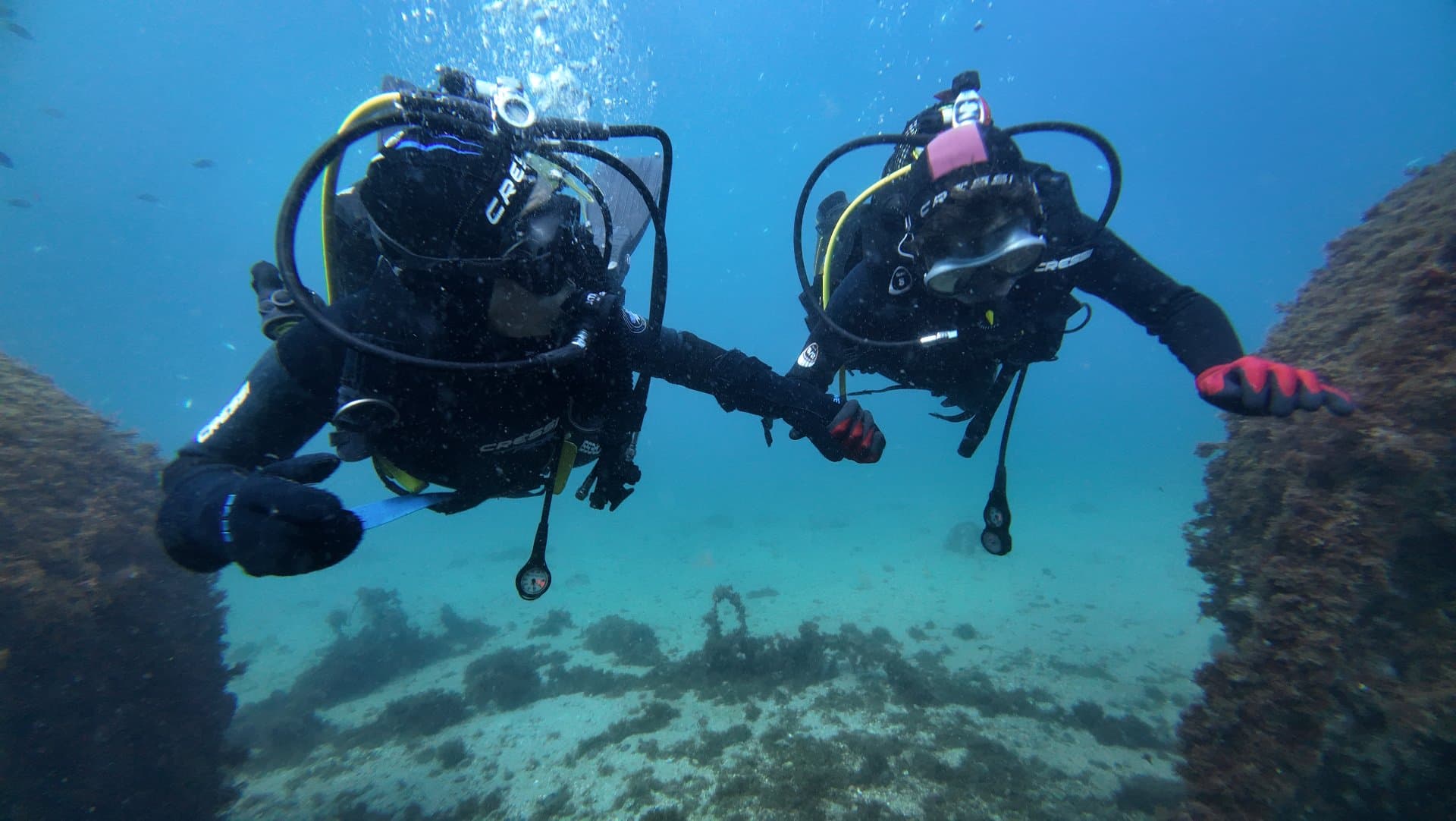
The same guide describes a Mediterranean seabed of Posidonia seagrass meadows, algae, sponges and anemones, with no coral. Common fish include breams, wrasses, damselfish and groupers, and you may also see moray eels, octopus, cuttlefish, sea cucumbers, sea urchins and sea stars.
What to watch out for
- Scorpionfish: they are camouflaged and can bury themselves in sand, so the guide recommends water shoes at rocky spots.
- Jellyfish: the guide says the large Rhizostoma luteum is considered harmless, while the small purple Pelagia noctiluca can cause severe pain and allergic reactions. It says jellyfish are more frequent in summer as the water warms.
- Boat traffic: the guide recommends a signalling buoy at Punta Nabules for this reason.
- Spearfishers: they work some of the deeper water at La Sal and Cala de la Sardina, so stay aware of who else is in the water.
- Waves and wind: unprotected spots such as Penón del Cura are best on calm days.
Protected Areas Near Marbella
Visitors often ask whether there is a marine reserve in Marbella. We did not find a published source describing one in the town’s own waters. The protected places we found are these:
- Dunas de Artola (Cabopino): a natural monument declared by the Andalusian government in 2001, according to a hotel-group guide modified in May 2025. An encyclopedia entry gives the area as 192,715 m² in one place and 19.22 hectares in another, and the hotel guide says more than 20 hectares, so the size differs by source. The sources describe the dunes, vegetation and the Torre Ladrones watchtower, and none mentions a marine component or snorkelling there.
- Manilva Beaches Ecological Reserve: the snorkelling guide places Punta Chullera inside it and mentions artificial reefs. We found no official page describing its rules, so ask locally before you dive or fish there.
The practical rule is simple: take nothing, touch nothing and keep off seagrass and dunes. The hotel guide says wooden walkways let visitors cross the dunes without damaging the ecosystem, and describes activities there as those that are respectful of the environment. For other ways to enjoy the water, see our guide to paddleboard and kayak rental in Marbella.
The Rules for Diving in Spain
A Spanish government press release dated 2 June 2020 says the Council of Ministers approved a royal decree that updates and unifies the safety rules for diving. It covers recreational, sport, professional, scientific and extraction diving, and the page does not mention snorkelling. The page says:
- the general minimum age is 18, but recreational and sport diving can start at 8, with depth limits by age band, though the page gives no depth figures;
- the diver is responsible for their own physical condition and training;
- centres, schools and clubs have safety obligations, and each diving modality has its own minimum equipment;
- weather and sea state must be taken into account;
- diving activity must be signalled, and other vessels must keep a safety distance, though no distance is stated;
- limits can apply to sites of environmental, historical or archaeological value.
The Andalusian official gazette of 25 July 2003 also carries a decree numbered 216/2003 on recreational and sport diving in Andalusia. We could not check whether it is still in force alongside the 2020 decree, so ask the centre which rules it follows. We did not read the decree’s full text, so for buoy specifications, distances, certification and insurance, the official gazette text is the source to check.
Which Option Suits You?
- Never dived: a baptism, listed from €98 in Marbella, with an instructor and a briefing.
- Certified and travelling light: the €50 guided dive, if it matches your certification, or the €95 bottle-and-weights dive if you have your own equipment.
- Want a certificate: a PADI Open Water course, listed from €500 over four days, which is worth booking early if you are on a short trip.
- Not keen on scuba: snorkel at Punta Nabules with a buoy, or at the calmer Manilva coves.
- Travelling with children: the calm coves and the Marbella sailboat cruise with snorkel gear. For the rest of the day, see Marbella with kids.
What to Bring and What to Ask
- Water shoes: recommended at rocky spots because of scorpionfish and urchins.
- A wetsuit: suggested at Alcaidesa, where the water is colder, and worth asking about for any outing outside summer.
- A signalling buoy: recommended at Punta Nabules, and sold by sports shops.
- Proof of certification: bring your card for any guided dive.
- Questions for the centre: which sites it uses, group size, what equipment is included, the cancellation policy, what happens in bad weather and whether it follows the current safety rules.
When Is the Best Time for Diving in Marbella?
We did not find a current, Marbella-specific temperature table. The nearest source is a PADI article on diving in southern Spain, published on 23 April 2013, so it is more than a decade old and covers the region and not the town. It gives these figures, which we quote only as a rough guide:
| Period | Water temperature (2013 article, southern Spain) |
|---|---|
| May to September | 19 to 29°C |
| October to April | 14 to 18°C |
The article describes the region as offering year-round diving, with summer air temperatures averaging about 30°C and winter about 16°C. For the Gibraltar end of the coast it gives visibility of 10 to 25 m and water of 16 to 24°C. The snorkelling guide adds that the water at Alcaidesa is colder because it is near the Strait, and that jellyfish are more frequent in summer, so the warmest months are not automatically the best ones.
In practice, summer suits snorkelling and family outings, and the cooler months suit divers who do not mind a thicker wetsuit and want quieter sites. The snorkelling guide notes that Playa de la Yuca is less crowded outside summer and that Punta Chullera is crowded from June to August. Whichever month you choose, ask the centre what exposure suit it supplies, and see our guide to winter in Marbella if you are thinking of an off-season trip.
Where the More Dramatic Dives Are
If you want wrecks, walls and pinnacles, the same 2013 PADI article points beyond Marbella. We repeat its claims with the date, because dive operators, access and conditions change, and we have not checked any of these sites or the centres that serve them.
- Gibraltar: the article lists the SS Excellent, a steamer that sank after a collision in 1888 and lies upside down at 25 to 28 m; the SS Rosslyn, which sank in 1916 and is called the largest wreck in Gibraltar, at 21 m; the Camp Bay Conservation Site, an artificial reef with 11 wrecks to 19 m; and the 482M, a 30 m Royal Navy mooring vessel sunk in 1990 at 17 m.
- La Costa Tropical, a short drive north of Málaga: the article claims visibility up to 30 m, mentions a marine park and lists Tres Picos, three pinnacles from 6 to 19 m, and Fraggle Rock, a seamount at 16 to 24 m. It lists a freshwater cave for advanced and cavern divers only.
- Tarifa: the article says the Mediterranean and the Atlantic meet there, lists the wreck of the San Andres at 30 m or more and describes Morocco Point, at 30 m, as for advanced divers only because of strong currents and depth.
A Gibraltar dive would also mean crossing a border, so carry your passport. If this is the kind of diving you want, treat Marbella as a base and ask a centre which of these sites it actually runs trips to.
Seagrass: The Meadow You Are Swimming Over
The snorkelling guide describes Posidonia seagrass meadows along this coast, and they are worth understanding because they are easy to damage. A Balearic nautical guide, which is about Ibiza and Formentera and not the Costa del Sol, describes Posidonia oceanica as an underwater plant that grows only in the Mediterranean. It says:
- the plant is one of the oldest living organisms on the planet, with some meadows existing for over 100,000 years;
- more than 1,400 species live in the meadows, which also filter the water and help protect beaches from wave erosion;
- one hectare produces as much oxygen as five hectares of Amazonian forest, and some scientists say up to fifteen;
- anchors and chains can seriously damage it, and dropping anchor near it is prohibited in the Balearics, where it is strictly protected by regional law.
The legal protection described there is Balearic, and we did not find the equivalent rules for Andalusian waters, so we do not claim any. The habits that follow from it apply anywhere: do not anchor on seagrass, do not stand on it and do not collect leaves or animals. If you are on a boat trip, our guide to boat trips in Marbella lists the questions to ask an operator, and where it anchors is a good one.
Jellyfish: What to Do After a Sting
Because the snorkelling guide warns of a stinging jellyfish in summer, it helps to know the first-aid advice. The following comes from a public safety page of the Balearic government, which is a different region, and the page itself says the treatment varies by species, so identify the animal with the help of the lifeguards when you can.
What the page advises
- Leave the water and remove tentacle remains with tweezers, gloves or the edge of a card, without touching them.
- Wash the wound with sea water and apply commercial vinegar.
- Apply cold in a sealed bag for 10 to 15 minutes, never ice directly on the skin.
- Apply an antiseptic, and go to the nearest hospital if you have nausea, vomiting, dizziness, cramps or headache.
- After a Portuguese man o’ war sting, always see a doctor because of the risk of anaphylactic shock.
What the page says not to do
- Do not scratch or rub the area, or use towels or sand.
- Do not use fresh water or shower, which can activate the stinging cells left on the skin.
- Do not use ammonia or alcohol.
- Do not touch dead jellyfish, which can sting for up to 24 hours when dry.
The page also advises sun cream, which helps insulate the skin from tentacles, and protective clothing such as a wetsuit or lycra for people who stay in the water a long time. If there is a bloom of jellyfish, it advises not entering the water even at the shore and telling the nearest lifeguard post or calling 112. Treat this as general guidance and not a medical opinion, and see a doctor if symptoms are serious.
Beaches, Marinas and Where to Start
Blue Flag beaches in Marbella
A local news site reported on 21 May 2026 that Marbella has 8 Blue Flag beaches in 2026 and 10 distinctions when its two marinas, Puerto Banús and Virgen del Carmen, are counted. The beaches named are Cabopino, El Cable, El Faro, La Fontanilla, Nagüeles-Casablanca, Los Monteros-Adelfas, San Pedro de Alcántara-Guadalmina and Venus-Bajadilla. The Blue Flag is an award based on factors such as water quality and services, so it tells you a beach is well kept, not that it is good for snorkelling. The Nagüeles area is the one that overlaps with the Punta Nabules spot in the snorkelling guide.
Cabopino marina
A marina guide lists Cabopino marina at 169 berths for boats of 6 to 15 m, with a 60 m wide entrance channel, a depth of 3 to 4.5 m, fuel, a slipway and nearby restaurants. It is on the N-340 at kilometre 202, about 10 to 12 minutes by car from central Marbella, and the guide gives VHF channel 09. It does not mention diving or snorkelling, but it is next to the Dunas de Artola, and the hotel-group guide says the marina offers paddleboarding, jet skiing and sailing trips to see dolphins. This makes Cabopino a convenient base for a day by the water, though we found no dive centre listed there.
How to Choose a Dive Centre
No source we found ranks or reviews Marbella dive centres, so we cannot recommend one. What we can do is turn the published rules and listings into a checklist you can use with any centre.
- Ask who is responsible for what. The 2020 decree press release says professional diving companies, schools, centres and clubs have safety obligations, and that each diving modality has its own minimum equipment. A good centre explains its equipment and briefing without being pushed.
- Ask about the group size. The bottle-and-weights listing allows 1 to 12 people, and a guide with 12 divers is a very different experience from a small group, so ask how many divers each guide supervises.
- Confirm your level. The €50 guided dive implies previous experience, and the €95 dive does not state a certification, so say clearly whether you are a beginner, a certified diver or a returning diver and when you last dived.
- Ask what is included. The two listings differ on equipment, insurance and transport, which explains much of the price gap.
- Ask about the site. The listing names no site, so ask where you will dive, how deep it is and what the conditions are on the day.
- Check the weather policy. The platform terms say a provider can postpone or refund in bad weather, but a fixed-date booking is otherwise non-refundable.
- Ask about children. The press release gives 8 as the minimum age for recreational and sport diving, with depth limits by age, but each centre sets its own policy and we found none published.
Diving Versus Snorkelling: Which Is for You?
The two activities differ in cost, effort and rules, and the sources let us compare them on those points.
| Point | Snorkelling | Scuba diving |
|---|---|---|
| Cost as listed | Free from the beach if you have gear; gear rental is available at Nagüeles | From €50 to €98 for a single dive or baptism |
| Time underwater | As long as you like, on the surface | 45 minutes in the €50 listing |
| Guide needed | No, but a buoy and a partner are advised | Yes, in all the listings we found |
| What you see | Rocks, seagrass, fish and sometimes octopus in shallow water | The same habitats, with more time and depth |
| Rules | Not covered by the 2020 press release we read | Covered by the 2020 decree, with age limits and signalling |
If you are unsure, a snorkel at Punta Nabules costs little and shows you whether you enjoy being in the water before you pay for a baptism. If you enjoy it, a baptism is a natural next step.
Budgeting for a Dive Trip
Using only the listed figures, a rough budget for a visitor looks like this. These are examples and not quotes.
- One guided dive, equipment included: €50 for the three-hour experience.
- One dive with your own equipment: €95, and with rented equipment €120 (€95 plus €25).
- Two people doing a baptism: from €196 (2 × €98).
- A course: from €500 for a four-day PADI Open Water, from €459 for Advanced Open Water, from €425 for Rescue Diver and from €420 for Scuba Diver.
The arithmetic shows why you should compare like with like: at €120 with rented equipment, the bottle-and-weights dive costs more than twice the €50 guided dive, so the cheaper listing is not necessarily the lesser one. It may simply be a different product, which is why the questions above matter.
Sample Plans
These are suggestions built from the sources above and not tested itineraries.
A first-timer’s morning
Book a baptism that starts at the marina, since the guided-dive listing starts at 9:00, and ask whether hotel pick-up is included. Afterwards, have lunch at a beach bar. Our guide to chiringuitos in Marbella will help you choose.
A snorkelling afternoon at Nagüeles
Take your own mask, snorkel, fins and signalling buoy, or rent gear on the beach, and swim between the wooden pier and the rocks in front of Puente Romano. Bring water shoes, and leave if boats are close.
A family day at the Manilva coves
Choose Cala de la Sardina for calm water, fine gravel and facilities, snorkel to the right of the beach bar the guide names and keep children close because spearfishers may be working further out. Our Marbella with kids guide has more family ideas.
A diver’s long weekend
Combine a guided dive in Marbella with a day trip to Gibraltar or Tarifa for a wreck or a current dive, if a centre there runs one that matches your certification. Plan the journey using our guide on how to get to Marbella.
Safety Habits Worth Keeping
- Never snorkel alone: go with a friend, tell someone where you are going and stay within reach of a lifeguard post where there is one.
- Use a buoy: it makes you visible to boats, as the guide recommends at Punta Nabules.
- Check the sea: the royal decree says weather and sea state must be taken into account, and the snorkelling guide advises calm days at unprotected spots.
- Respect other water users: spearfishers, swimmers and boats share the same stretch of water.
- Do not touch or collect: leave shells, urchins, octopus and seagrass where they are.
- Know your limits: the decree makes divers responsible for their own physical condition and training, so be honest with the instructor about both.
What is confirmed and what is not
Confirmed in published sources: the listed offers and prices with their dates, the seven snorkel spots in the 2022 guide (updated March 2026), the Dunas de Artola’s natural-monument status and the 2020 royal decree’s main points.
Not confirmed: current prices, the operators behind most listings, named dive sites, current water temperature and visibility, any marine reserve in Marbella’s waters, the rules of the Manilva reserve and whether the 2003 Andalusian decree is still in force.
Frequently Asked Questions
How much does diving in Marbella cost?
Listings show a guided dive at €50, a bottle-and-weights dive from €95 plus €25 for equipment and a dive baptism from €98. A four-day PADI Open Water course is listed from €500.
Can beginners try diving in Marbella?
Yes, through a baptism, which is an introductory dive with an instructor. One Marbella baptism is listed from €98, though the listing does not state its duration or inclusions.
Where can I snorkel in Marbella?
A published guide recommends the stretch from the Playa de Nagüeles wooden pier to the rocks in front of Puente Romano, known as Punta Nabules. It suggests a signalling buoy because of boat traffic.
Is there a marine reserve in Marbella?
We found no source describing one in the town’s own waters. The Dunas de Artola are a natural monument, but the sources describe the dunes and not the sea, and a snorkelling guide places Punta Chullera inside the Manilva Beaches Ecological Reserve.
What is the minimum age for diving in Spain?
A 2020 government press release says the general minimum age is 18 and that recreational and sport diving can start at 8, with depth limits by age band. Ask the centre for its own age policy.
Are there dangerous animals when snorkelling on the Costa del Sol?
A snorkelling guide mentions camouflaged scorpionfish and the small purple jellyfish Pelagia noctiluca, which can cause severe pain and allergic reactions, and says jellyfish are more frequent in summer. Water shoes help on rocky seabeds.
When is the best time for diving in Marbella?
A 2013 PADI article on southern Spain gives water of 19 to 29°C from May to September and 14 to 18°C from October to April, and describes year-round diving. It covers the region and not Marbella specifically, so ask your centre for current conditions.
Are there wrecks to dive near Marbella?
We found no wreck in Marbella’s own waters in the sources we read. The same 2013 article lists wrecks at Gibraltar, including the SS Excellent and the SS Rosslyn, and a wreck at Tarifa, but we have not verified current access.
What should I do if a jellyfish stings me?
The Balearic government advises leaving the water, removing tentacles without touching them, washing with sea water, applying vinegar and cold, and never using fresh water. See a doctor for a Portuguese man o’ war sting or if symptoms are serious.
Does a Blue Flag mean a beach is good for snorkelling?
No. Marbella has 8 Blue Flag beaches in 2026, according to a May 2026 report, but the flag reflects factors such as water quality and services and says nothing about the seabed or marine life.
The Bigger Picture
The Marbella seabed is modest by diving standards, but it is easy to reach, and a first dive or a snorkel over seagrass and rocks is a good way to see the coast from a different angle. The sensible approach is to choose a centre that is clear about what it offers, respect the seagrass and the protected places, and treat any promise of wildlife as a bonus. You can read the government press release on the 2020 diving decree for the official summary of the safety rules.
Looking for a home near the sea?
If you dream of living close to the water, from the old town to Cabopino, LUXO Estates can help you find a property with the Mediterranean on its doorstep.