
Liquidity has traditionally been one of the defining limitations of real estate. Unlike financial assets such as equities or bonds, property transactions require time, negotiation, and significant capital commitment. However, this long-standing characteristic is beginning to evolve. In the luxury segment, real estate is gradually becoming more liquid — not in the conventional sense, but through structural and behavioral changes that are reshaping how high-value properties are bought, sold, and utilized.
This transformation is driven by a combination of global demand, technological advancement, and new ownership models. Ultra-high-net-worth individuals are increasingly approaching real estate with the same strategic mindset applied to other asset classes. As a result, liquidity is no longer viewed as a fixed limitation, but as a variable that can be enhanced through market positioning, accessibility, and global reach.
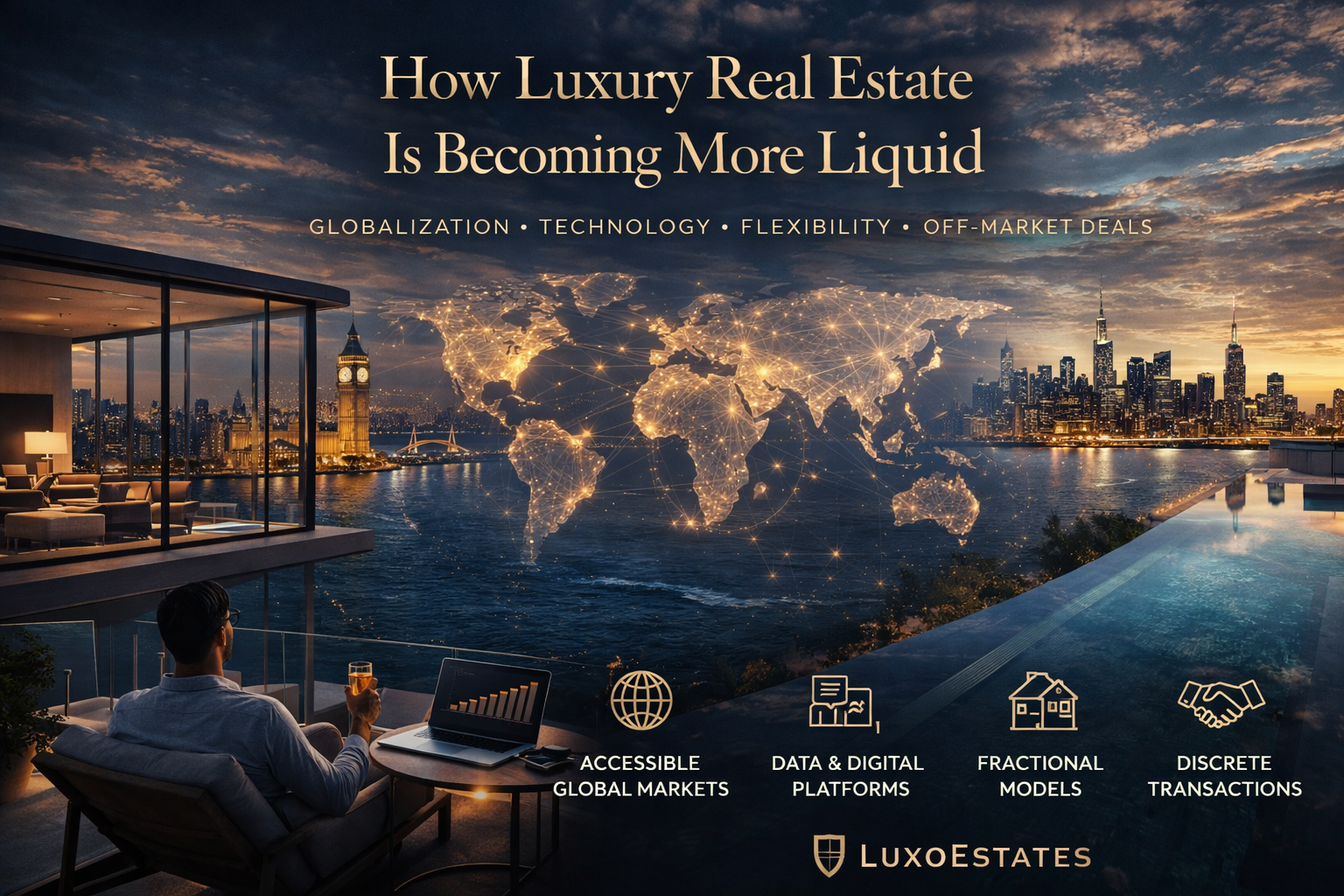
One of the key factors contributing to this shift is the globalization of demand. Prime properties are no longer dependent on local buyers. Instead, they are marketed and transacted on an international stage, attracting capital from multiple regions simultaneously. This expanded buyer pool increases the probability of matching sellers with qualified purchasers, effectively improving transaction fluidity in top-tier markets.
Digital platforms and data transparency are also playing a role. High-end properties now benefit from more sophisticated marketing strategies, targeted exposure, and global networks that connect buyers and sellers more efficiently. While transactions still require due diligence, the process of identifying and engaging potential buyers has become faster and more precise.
New ownership structures are further redefining liquidity. Concepts such as fractional ownership, co-investment platforms, and branded residential portfolios allow investors to participate in luxury real estate with greater flexibility. These models reduce capital barriers and create opportunities for partial entry and exit, introducing a level of fluidity that was previously absent from the sector.
Importantly, liquidity in luxury real estate is closely tied to quality and positioning. Not all properties benefit equally from this evolution. Assets located in globally recognized markets, with strong reputational value and consistent international demand, tend to exhibit higher liquidity. In contrast, properties in secondary locations or with highly personalized characteristics may still face longer transaction cycles.
Buyer behavior is also evolving. High-net-worth individuals increasingly view real estate as part of a broader portfolio strategy. This perspective encourages more active management of property assets, including acquisition, repositioning, and eventual divestment. As a result, properties are not always held indefinitely; they are traded strategically within a global context.
Another important dimension is the rise of off-market transactions. Discreet networks and private deal flows enable properties to change hands efficiently without public exposure. These channels often connect highly qualified buyers and sellers directly, reducing friction and accelerating transactions in the ultra-prime segment.
Despite these changes, luxury real estate will never achieve the instantaneous liquidity of financial markets. However, that is not the objective. Instead, the market is evolving toward a more efficient form of liquidity — one that balances exclusivity with accessibility, and long-term value with strategic flexibility.
Ultimately, this shift reflects a broader transformation in how real estate is perceived. It is no longer a purely static asset held over decades. Instead, it is becoming a more dynamic component of global wealth portfolios, where timing, positioning, and access play increasingly important roles.
In this new landscape, liquidity is not about speed alone. It is about the ability to move capital effectively within a complex and interconnected global market. And in luxury real estate, that ability is becoming more refined than ever before.