
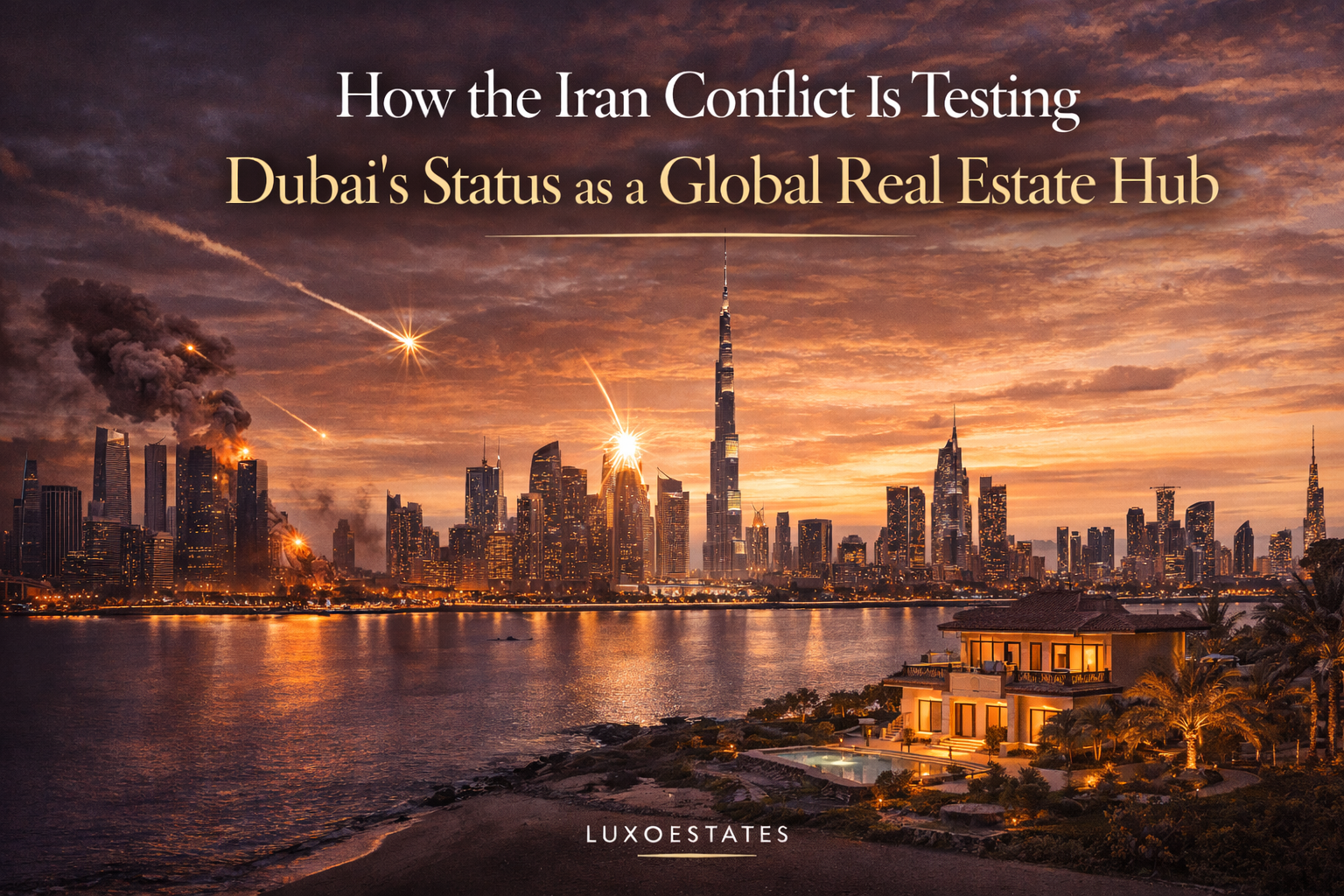
How the Iran Conflict Is Testing Dubai’s Status as a Global Real Estate Hub
Dubai has spent decades building a reputation as one of the world’s most stable and attractive destinations for international capital. Its luxury real estate market, global financial ecosystem, and tax-friendly environment have attracted investors, entrepreneurs, and high-net-worth individuals from across the globe. However, the ongoing conflict involving Iran is placing this model under an unexpected test, raising new questions about how geopolitical risk influences global property markets.
The conflict escalated in early 2026 following military strikes on Iran and subsequent retaliatory attacks across the Gulf region. Since then, Iran has launched hundreds of missiles and drones toward the United Arab Emirates, with some debris damaging buildings and infrastructure in Dubai and Abu Dhabi. Although most projectiles have been intercepted by air defenses, the psychological impact has been significant for businesses and investors operating in the region.
For Dubai’s real estate market, the immediate effect has been caution rather than collapse. Brokers and analysts report that many international investors have adopted a “wait-and-see” approach, pausing large acquisitions until the geopolitical outlook becomes clearer. Real estate markets that rely heavily on global capital often respond quickly to uncertainty, and Dubai is no exception. The emirate’s property boom, which had been fueled largely by offshore investment, now faces its first real geopolitical stress test in years.
Financial markets have reflected this uncertainty. Dubai’s stock index and real estate-related shares have shown volatility as investors react to war risks and regional instability. Real estate stocks are particularly sensitive to geopolitical tension because they depend heavily on international confidence and future demand for property development.
At the same time, the conflict has disrupted sectors closely linked to the property market, including tourism and aviation. Empty tourist areas and declining visitor numbers illustrate how regional tensions can ripple through Dubai’s broader economy. Since tourism, hospitality, and real estate are deeply interconnected in Dubai’s economic model, any slowdown in travel or business activity can influence property demand.
Yet the situation is far from entirely negative for Dubai’s real estate sector. Historically, the city has benefited from instability elsewhere in the region. During previous geopolitical crises—from the Arab Spring to the war in Ukraine—wealthy individuals and companies relocated capital and operations to Dubai in search of stability. This pattern could repeat if investors conclude that Dubai remains safer and more predictable than other regional markets.
Indeed, even amid the current conflict, Dubai’s ultra-luxury segment has continued to record landmark transactions. One recent deal saw an apartment sell for over 422 million dirhams, one of the highest residential sales in the city’s history. Such transactions highlight the resilience of the trophy property market, where ultra-wealthy buyers often prioritize long-term asset positioning over short-term geopolitical concerns.
The long-term outcome for Dubai will depend largely on perception. The emirate’s economic success has always relied on its reputation as a safe, globally connected hub for finance, business, and luxury living. If the conflict remains contained and Dubai continues to demonstrate stability, investor confidence could quickly recover. However, if tensions escalate or persist for an extended period, global capital may begin exploring alternative destinations.
Ultimately, the Iran conflict is not simply a geopolitical event for Dubai—it is a test of the emirate’s core value proposition. Dubai’s rise as a global real estate hub was built on the promise of openness, security, and international connectivity. As the region navigates a period of uncertainty, the ability of the city to maintain that reputation will determine whether its property market continues to thrive in the years ahead.