
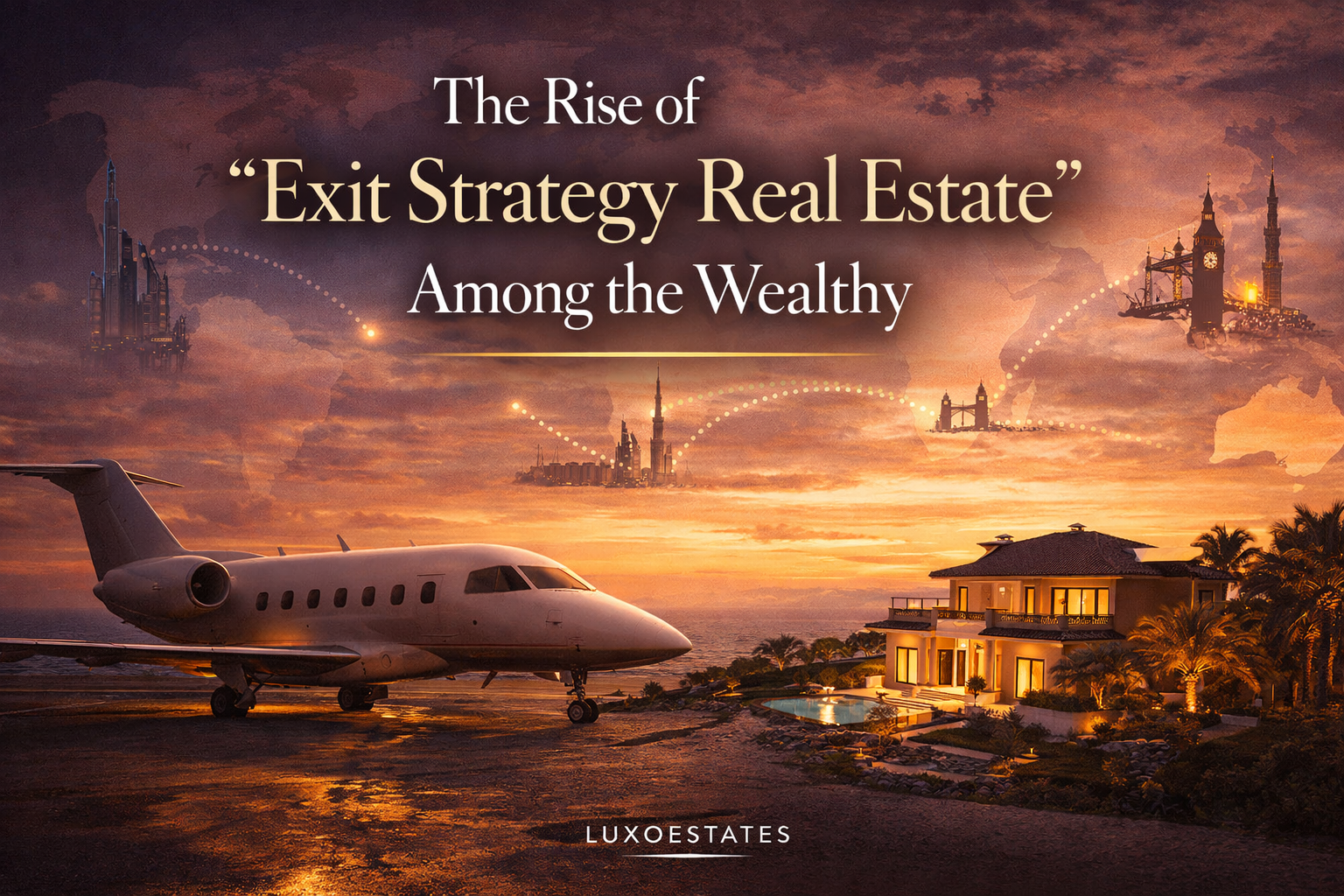
For decades, luxury real estate has been associated with lifestyle, prestige, and long-term investment. Prime residences in global cities or coastal enclaves were traditionally acquired for personal use, status, or portfolio diversification. Today, however, a new layer of strategic thinking is reshaping this dynamic. Increasingly, ultra-high-net-worth individuals are acquiring property not just as an asset — but as an exit strategy.
This shift reflects a deeper transformation in how global wealth perceives risk. In an era defined by geopolitical tensions, economic uncertainty, and rapid regulatory change, location itself has become a strategic variable. For many affluent individuals, real estate is no longer simply about where to live — it is about where they can go.
“Exit strategy real estate” refers to the deliberate acquisition of property in jurisdictions that offer stability, mobility, and optionality. These properties may not serve as primary residences or even regular holiday homes. Instead, they function as strategic footholds — locations that provide access, security, and flexibility in the event of sudden changes in political, economic, or social conditions.
At the core of this trend lies the concept of optionality. Wealthy individuals increasingly value the ability to relocate quickly, access alternative jurisdictions, or shift their personal and financial base when needed. Owning property in a stable country can facilitate residency rights, long-term visas, or even pathways to citizenship. As a result, real estate becomes a gateway to mobility rather than a static investment.
Geopolitical factors are accelerating this behavior. Conflicts, regulatory shifts, and evolving tax environments have highlighted the importance of geographic diversification. Just as investors diversify across asset classes, they now diversify across jurisdictions. Property ownership plays a central role in this strategy because it provides both a physical presence and legal connection to a country.
Importantly, not all locations fulfill this role equally. Markets that attract “exit strategy” buyers typically share certain characteristics: political stability, strong institutions, reliable legal frameworks, and global connectivity. Cities such as Dubai, London, Singapore, and certain European enclaves often emerge as preferred destinations due to their ability to combine lifestyle appeal with strategic security.
This trend is also influencing demand patterns within the luxury real estate sector. Properties that offer privacy, security, and immediate usability are becoming more desirable. Buyers increasingly prioritize discretion, infrastructure quality, and ease of access over purely aesthetic considerations. In this context, functionality becomes as important as design.
Moreover, “exit strategy real estate” reshapes how value is perceived. The worth of a property is no longer measured solely by location or square footage. Instead, it includes intangible factors such as jurisdictional security, mobility benefits, and long-term flexibility. These elements are difficult to quantify, yet they significantly influence high-level purchasing decisions.
Family offices and wealth advisors are playing a growing role in structuring these acquisitions. Real estate decisions now align with broader strategies related to risk management, succession planning, and international mobility. Property ownership becomes integrated into a wider framework of global wealth positioning.
Ultimately, the rise of “exit strategy real estate” reflects a fundamental change in priorities. Wealthy individuals are no longer focused exclusively on growth or lifestyle. Instead, they are increasingly focused on protection, flexibility, and preparedness.
In a world where uncertainty has become structural rather than cyclical, the ability to relocate, adapt, and maintain control over one’s environment has taken on new importance. Real estate, once seen as a static asset, is now evolving into a dynamic tool of strategic security.