
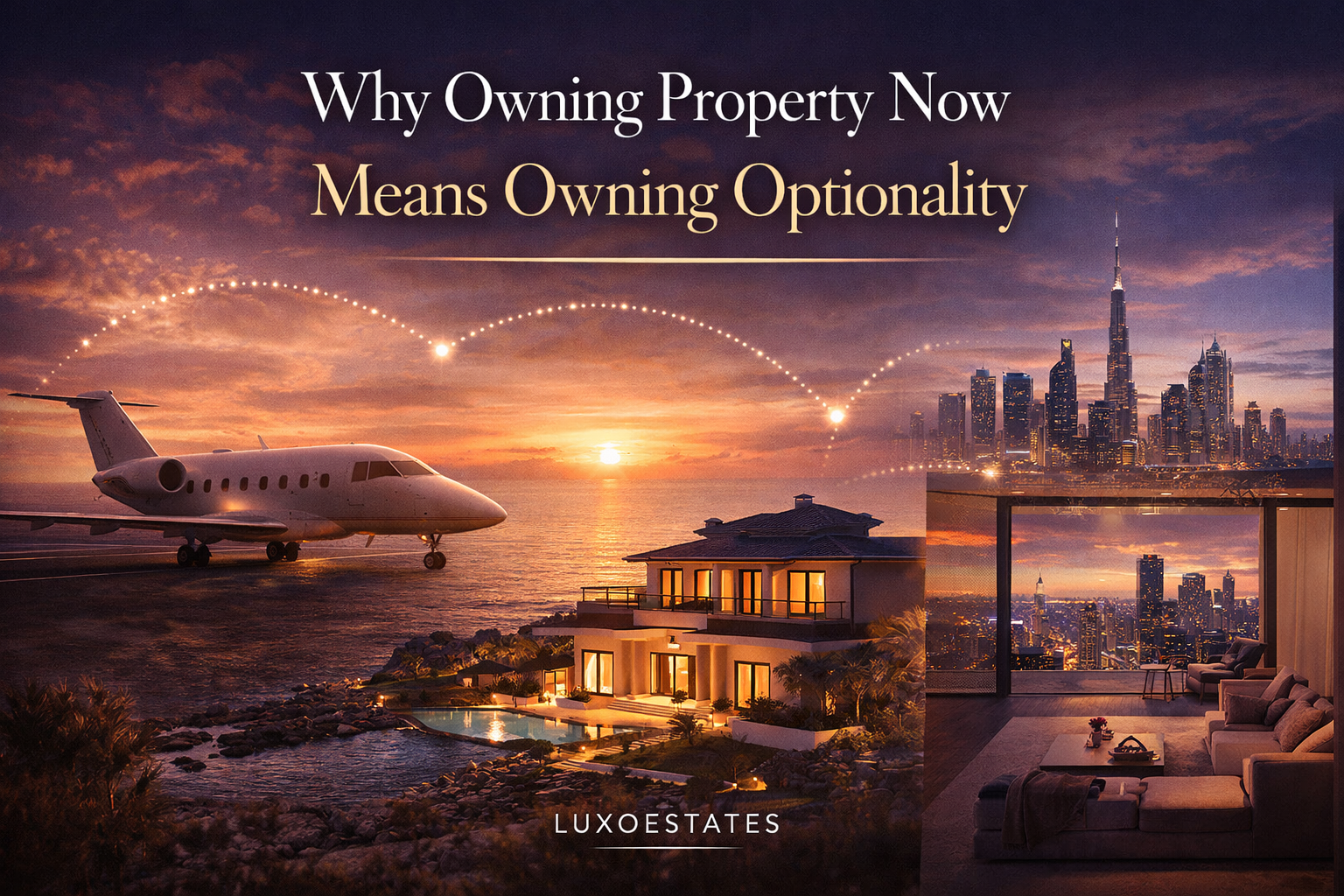
In today’s rapidly changing global environment, the meaning of property ownership is evolving. Traditionally, real estate represented stability, permanence, and long-term investment. Buyers acquired homes as fixed assets — places to live, symbols of status, or components of a diversified portfolio. However, a new perspective is emerging among ultra-high-net-worth individuals. Increasingly, owning property is less about permanence and more about flexibility. It is about optionality.
Optionality, in this context, refers to the ability to adapt, relocate, and respond to changing circumstances. In a world shaped by geopolitical uncertainty, economic volatility, and shifting regulatory frameworks, flexibility has become a critical form of security. For affluent individuals, property ownership now provides not just a place to reside, but a strategic set of options.
This shift reflects a broader transformation in how global wealth operates. High-net-worth individuals no longer structure their lives around a single country or city. Instead, they distribute their presence across multiple jurisdictions, aligning their lifestyle, business interests, and investments with different regions. Property plays a central role in this structure, offering physical access and legal connection to key locations.
Owning property in different parts of the world enables a level of mobility that was previously reserved for a select few. It allows individuals to adjust their base in response to economic changes, political developments, or personal priorities. In this sense, real estate becomes a tool for geographic diversification — not only of assets, but of lifestyle and risk exposure.
Importantly, optionality also intersects with residency and legal frameworks. In many jurisdictions, property ownership can facilitate long-term visas, residency rights, or pathways to citizenship. This transforms real estate into more than a financial asset; it becomes a gateway to access, opportunity, and long-term security.
The concept of optionality also influences how properties are selected. Buyers increasingly prioritize locations that offer stability, connectivity, and global relevance. Access to international transport, strong infrastructure, reliable institutions, and high-quality living environments all contribute to a property’s strategic value. These factors ensure that ownership provides not only comfort, but also flexibility.
At the same time, optionality reshapes perceptions of value. The worth of a property is no longer defined solely by its design, size, or immediate location. Instead, it includes the opportunities it creates — the ability to relocate, diversify, and respond to uncertainty. These intangible benefits are becoming central to high-level decision-making.
This evolution is particularly evident among family offices and global investors. Real estate acquisitions are increasingly aligned with broader strategies related to wealth preservation, risk management, and intergenerational planning. Property ownership becomes part of a wider system designed to maintain flexibility across an unpredictable global landscape.
Ultimately, the growing importance of optionality reflects a fundamental shift in priorities. In the past, luxury emphasized permanence and exclusivity. Today, it increasingly emphasizes freedom and adaptability. The most valuable assets are no longer those that anchor individuals to a single place, but those that allow them to move between opportunities with ease.
In this context, owning property is no longer simply about where one lives. It is about what that ownership enables. It is about having choices — and in an uncertain world, choice itself has become one of the most valuable forms of luxury.