
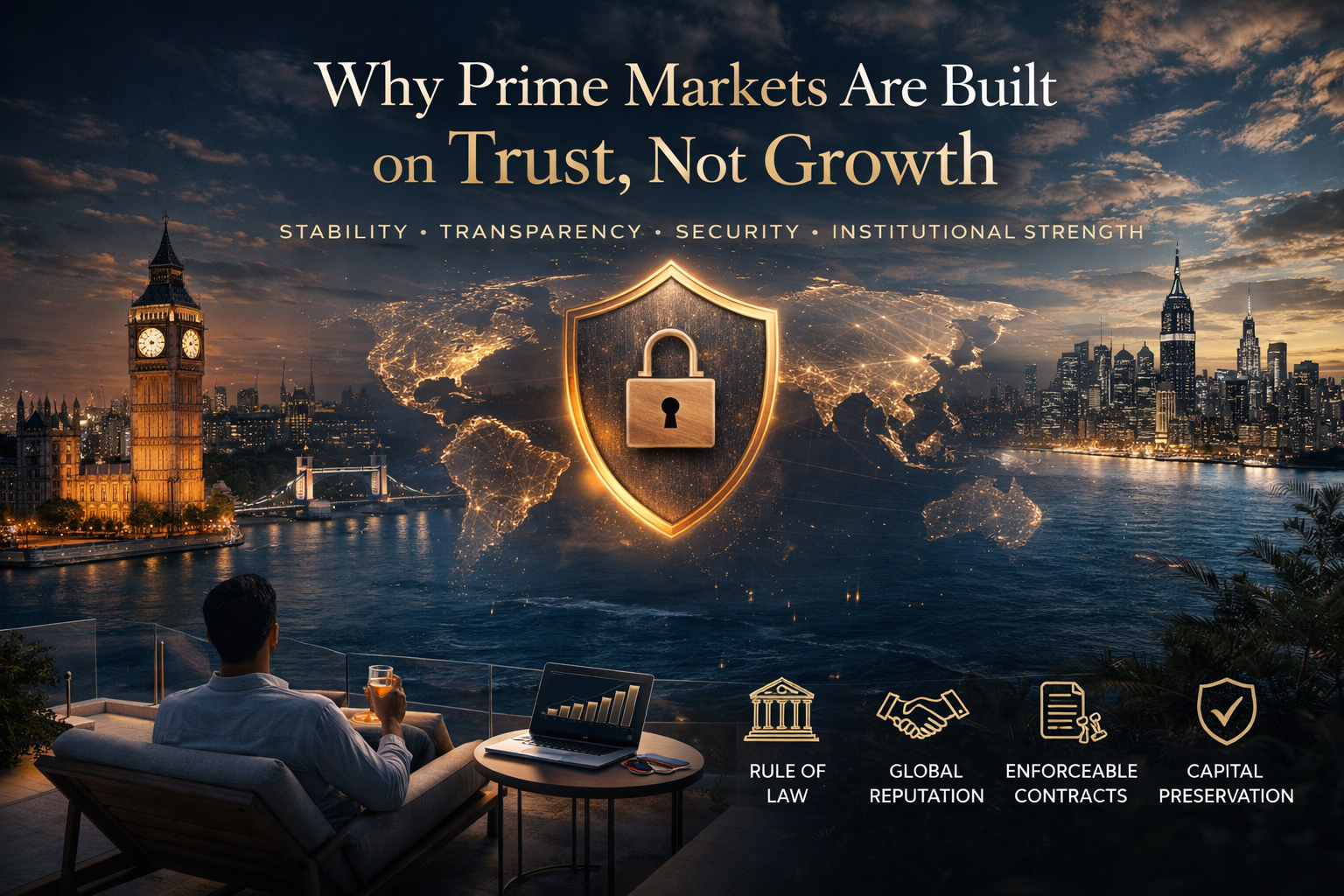
In real estate, growth is often seen as the primary driver of value. Emerging markets attract attention with the promise of rising prices, expanding infrastructure, and increasing demand. However, in the world of prime and ultra-prime property, a different dynamic prevails. The most resilient and valuable markets are not built on rapid growth, but on trust.
Trust operates as a foundational element in luxury real estate. It reflects the confidence that investors place in a location’s institutions, legal systems, and long-term stability. Unlike growth, which can fluctuate with economic cycles, trust develops gradually and sustains value across generations. For ultra-high-net-worth individuals, this distinction is critical.
Prime markets distinguish themselves through consistency rather than volatility. Buyers entering these markets are not typically seeking short-term gains. Instead, they prioritize capital preservation, security, and predictability. As a result, locations that demonstrate reliable governance, transparent regulation, and strong property rights attract sustained global demand.
Institutional strength plays a central role in building this trust. Legal certainty, enforceable contracts, and stable political environments reduce risk and encourage long-term investment. When investors commit significant capital, they look beyond price trends and focus on the reliability of the system in which their assets exist. Trust in institutions becomes as valuable as the asset itself.
Reputation reinforces this dynamic. Over time, certain cities and regions develop a global standing that signals stability and credibility. This reputation is not created quickly; it is earned through decades of consistent performance and international recognition. Once established, it attracts a continuous flow of capital, further strengthening the market.
Importantly, trust also supports liquidity. Markets perceived as stable and reliable tend to attract a broader and more diverse pool of buyers. This international demand ensures that properties can be transacted even during periods of economic uncertainty. While volumes may fluctuate, the underlying demand remains intact.
In contrast, growth-driven markets often depend on momentum. Rising prices and speculative activity can create rapid expansion, but they also introduce volatility. When economic conditions shift, these markets may experience sharper corrections. Without a strong foundation of trust, growth alone is insufficient to sustain long-term value.
This distinction is increasingly relevant in today’s global environment. As uncertainty becomes a structural feature of the economy, investors are reassessing their priorities. Stability, transparency, and institutional reliability are gaining importance, particularly among high-net-worth individuals managing significant portfolios across multiple jurisdictions.
Luxury real estate reflects this shift clearly. Prime markets are no longer defined solely by their potential for appreciation, but by their ability to maintain value under changing conditions. Trust becomes the mechanism through which these markets absorb shocks and preserve capital.
Ultimately, the strength of prime real estate lies in its foundation. Growth may attract attention, but trust sustains value. It shapes perception, supports demand, and anchors markets over time. For sophisticated investors, understanding this distinction is essential.
In a world where uncertainty is constant, the most valuable markets are not those that grow the fastest, but those that remain dependable.