

Best Wine Cellar Design & Installation Companies in Marbella 2026
A serious wine collection needs more than a spare cupboard — it needs stable temperature, controlled humidity, and darkness, none of which a Costa del Sol villa provides naturally given the region’s heat and light. This guide leads with a design studio genuinely headquartered in Marbella, and is upfront about where the other companies mentioned are actually based, since “serves Marbella” and “based in Marbella” are two different things worth knowing apart.
A quick note on how this guide was built: independently verifiable review-platform ratings weren’t reliably accessible for this category in this research pass, so this guide relies on documented company location, portfolios, and published service scope — disclosed transparently, including being explicit about which companies are actually headquartered in Marbella versus operating there as visiting specialists.
Quick Answer
CELLAR is genuinely headquartered in Marbella, with a confirmed address on Calle Ana de Austria, designing bespoke wine and spirits storage integrated into interior architecture for private clients, hotels, restaurants, and even superyachts. M&B Interior Design is based just along the coast in Sotogrande and runs a dedicated Marbella-focused custom wine cellar service line. L’Humidor is a Spain-wide bespoke brand (not Marbella-headquartered) with a dedicated Marbella/Costa del Sol offering and a separate architect-facing service.
Insuring a Serious Wine Collection
Once a collection reaches a meaningful value, standard home contents insurance frequently falls short of covering it properly — many general policies cap wine or collectibles coverage well below what a genuinely serious cellar can be worth, and may not cover the specific risks that actually threaten a wine collection, such as a cooling system failure that slowly cooks an entire room’s worth of bottles rather than a single dramatic loss event a standard policy is built to handle. Specialist collectibles or fine-wine insurance, increasingly offered as a rider on high-value home policies in Spain, typically covers replacement value at current market price rather than original purchase price — a meaningful distinction for older bottles that have appreciated significantly.
It’s worth raising this directly with a broker once a cellar project is underway rather than after it’s finished and stocked: some insurers specifically ask about the climate-control system’s specification and any temperature-monitoring or alarm features, which is one more reason to keep full documentation of the cellar’s engineering from whichever company builds it, alongside any bottle-level inventory and purchase receipts as the collection grows.
Why “Based in Marbella” Actually Matters
It’s a fair question why a company’s physical address should matter at all if the finished cellar looks the same either way. In practice, proximity affects the parts of a project that happen after the initial design phase: a servicing visit if the climate system develops a fault, a follow-up adjustment once a collection has settled into the space, or simply the ease of an in-person site visit before committing to a design rather than working entirely from photos and measurements sent remotely. A company genuinely based in Marbella, like CELLAR, can realistically offer faster response times on these practical, ongoing needs than a national brand dispatching a technician from another region.
One Local Studio, Two Regional Specialists
The genuinely Marbella-based studio: CELLAR operates with a confirmed local address and a client list spanning private residences to superyachts — the closest thing on this list to a true local specialist rather than a national brand with a local landing page.
The nearby Costa del Sol firm: M&B Interior Design is headquartered in Sotogrande, roughly 30 minutes down the coast, and treats the Marbella market as a core, explicitly named service area rather than an afterthought.
The national brand with local reach: L’Humidor operates across multiple Spanish cities with a dedicated Marbella page and an architect-facing service line, worth including for anyone comfortable working with a larger national specialist.

🍷 The Companies
CELLAR
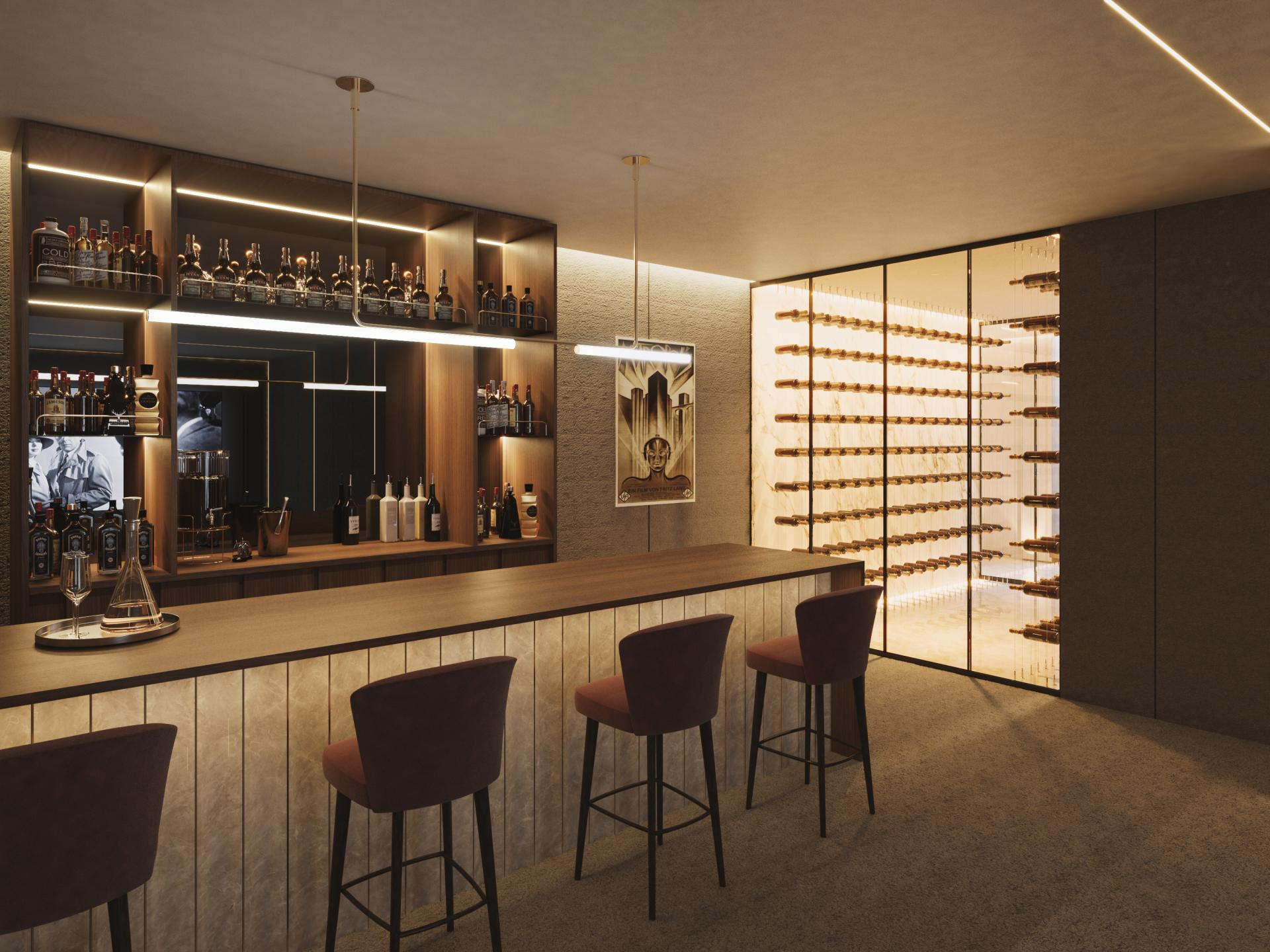
CELLAR is genuinely headquartered in Marbella, with a confirmed address at Calle Ana de Austria, 78 — a real local presence rather than a national brand’s satellite page. The studio’s own description frames its work as emerging “from the union between passion for wine and high-level spirits, design and architecture understood as art,” and its client roster reflects that positioning: private residential clients, hotels, restaurants, private members’ clubs, real estate developers, and — notably — superyachts, a category that requires genuinely specialised engineering given the space, weight, and motion constraints involved.
The studio’s service scope covers full-lifecycle project delivery: wine and spirits storage design, climate control systems engineered specifically for conservation, custom interior architecture, and material selection spanning natural wood, steel, aluminium, and stone, paired with integrated technology for temperature and humidity monitoring and design-forward LED lighting. Every project is described as completely custom and “unrepeatable” — a one-of-one approach rather than a catalogue system adapted per client.
Address: Calle Ana de Austria, 78, 29660 Marbella, Málaga
Phone: 657 476 119
Best for: Genuinely local Marbella studio, superyacht and hospitality-grade projects, fully bespoke interior-architecture-led design
M&B Interior Design
M&B Interior Design is headquartered in Sotogrande, within Cádiz province but firmly part of the same western Costa del Sol market as Marbella, and runs a dedicated wine cellar service line explicitly naming Sotogrande, Marbella, Mijas, and Estepona as its core coverage area — a genuinely regional operation rather than a distant national brand. The firm’s wine cellar offering includes personalised 3D-rendered design proposals before any construction begins, custom fabrication using premium woods, tempered glass, and integrated LED lighting, and professional installation of the climate and humidity control systems that make the finished space actually functional rather than just decorative.
The company states a typical project timeline of six to twelve weeks from initial consultation through completed installation, a useful benchmark for anyone planning a cellar around a broader villa renovation schedule. M&B works on both fully dedicated climate-controlled rooms and integrated wine furniture pieces built into existing living spaces, giving flexibility for villas where a standalone cellar room isn’t feasible.
Address: Av. del Conchudo, Local 1, SotoVila Market, 11310 Sotogrande, Cádiz
Phone: +34 662 90 60 92
Best for: 3D-rendered design proposals, integrated furniture-style wine storage, defined project timelines
L’Humidor
L’Humidor is transparently not a Marbella-headquartered company — it operates as a Spain-wide bespoke wine cellar and humidor brand, with dedicated pages for Marbella/Costa del Sol and Madrid, plus a separate service line built specifically for architects and design-build teams. It’s included here because its Marbella-specific offering and architect-facing structure make it a realistic option for anyone working with an architect on a new-build or major renovation who wants a single specification partner across multiple regions rather than a purely local vendor.
The brand’s name also signals a parallel specialism in cigar humidors — genuinely complementary given how similar the humidity and temperature-control engineering is between fine wine and cigar storage. The company publishes detailed technical content on its own site covering climate engineering for both categories, suggesting real in-house expertise rather than a purely design-led, subcontracted-engineering offering.
Best for: Architect-led specification across multiple Spanish regions, combined wine cellar and cigar humidor projects
Why a Marbella Villa Needs Real Engineering, Not Just a Nice Rack
It’s worth being direct about why this is a specialist category rather than something a general contractor or standard carpenter can handle well. The Costa del Sol’s climate — hot, bright summers with real humidity swings between coastal and inland areas — is genuinely hostile to wine storage without active climate control. A cellar room built without a proper vapour barrier, insulation rated for the temperature differential, and a dedicated cooling unit will drift with the ambient conditions outside it, defeating the entire purpose regardless of how good the racking and lighting look.
This is the real distinction between the companies profiled above and a general furniture maker who’ll happily build an attractive wine rack: CELLAR, M&B Interior Design, and L’Humidor all describe climate engineering as a core part of their process, not an afterthought bolted onto a finished room. Ask any prospective cellar builder directly what insulation R-value and vapour barrier approach they use, and how they size the cooling unit for the specific room volume — a company that can’t answer specifically is likely subcontracting the actual engineering.
Cooling System Types: What’s Actually Inside the Wall
| System Type | How It Works | Best For |
| Self-contained (through-wall) | Single unit, compressor and evaporator together | Smaller cellars, simpler installation, lower cost |
| Split system | Compressor located remotely, quiet evaporator inside | Larger cellars, noise-sensitive spaces near living areas |
| Ducted / centralised | Cooling delivered via ductwork from a central plant | Multi-room wine facilities, commercial-scale collections |
For most private Marbella villa cellars, a split system tends to be the practical middle ground — the compressor, which generates both heat and noise, sits away from the cellar itself (often in a plant room, garage, or outside), while the quiet evaporator unit inside the cellar maintains temperature without disturbing anyone using an adjacent dining or entertaining space. A self-contained unit is a reasonable choice for a smaller, standalone cellar where the compressor noise and heat output are less of a concern, or where budget is the primary constraint.
What Things Actually Cost
Pricing for a custom wine cellar varies enormously by size, materials, and whether structural work is required, but general ranges are worth knowing before requesting quotes from any of the companies above.
| Project Type | Typical Scope | Approx. Range |
| Integrated wine cabinet/furniture piece | Built into an existing room, no structural work | €6,000 – €18,000 |
| Small dedicated cellar room | Converted closet/under-stair space, 100-300 bottles | €15,000 – €35,000 |
| Full custom cellar room | Dedicated room, 500+ bottles, premium materials | €35,000 – €90,000+ |
| Superyacht or hospitality installation | Custom engineering for marine or commercial use | Quoted individually per project |
These are general market ranges for the category, not quotes from any specific company profiled above — every project should be quoted individually based on the actual space, materials, and climate-control requirements.
Materials and Design Choices That Matter
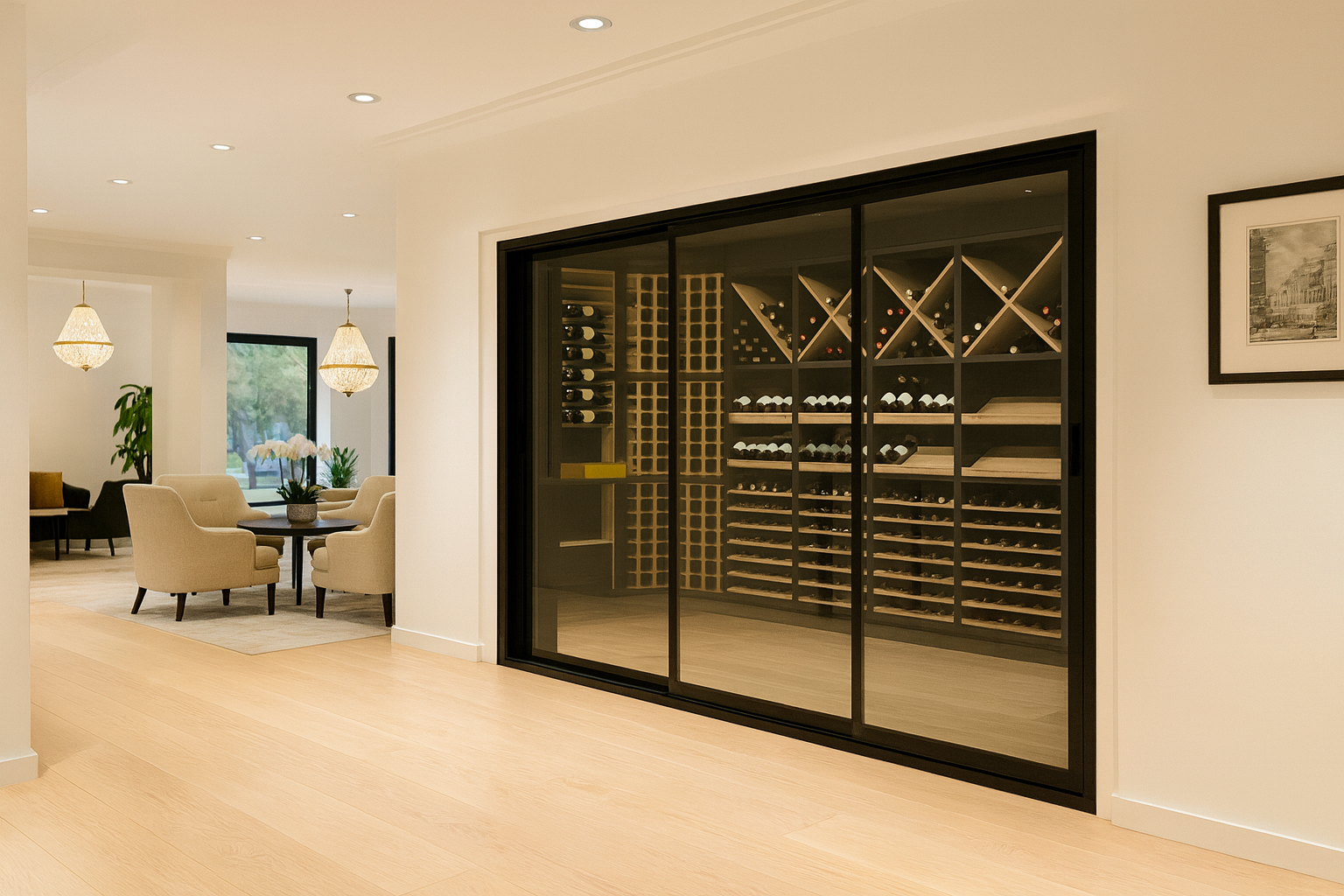
Beyond climate engineering, the visible design decisions genuinely affect both function and long-term durability. Wood species matters more than it might seem: mahogany and redwood are traditional choices prized for natural rot resistance in humid environments, while more contemporary Marbella-style cellars increasingly favour a mix of blackened steel, textured stone, and glass to fit a villa’s broader minimalist or Mediterranean-modern interior language rather than the traditional dark-wood “cave” look. Glass walls or doors — a popular choice for cellars visible from a dining or entertaining space — need to be properly sealed and often double- or triple-glazed to avoid undermining the insulation the rest of the room relies on.
Lighting deserves particular attention: UV exposure genuinely degrades wine over time, so LED lighting (which emits negligible UV compared to traditional incandescent or halogen fixtures) has become close to standard in serious cellar design, both for wine preservation and for the ambient, gallery-like display effect most Marbella clients are actually after when they choose a visible glass-walled cellar in the first place.
Racking and Capacity Planning
How a collection is racked affects both how many bottles fit and how usable the space actually is day to day. Traditional diamond bins store large volumes efficiently but make locating a specific bottle slower; individual bottle racking (each bottle in its own slot, label facing out) is less space-efficient but dramatically easier to browse and organise by region, vintage, or producer — the more common choice for a genuinely used collection rather than pure long-term storage. Many Marbella projects mix both: dense storage racking for everyday-drinking wine and a smaller, individually-racked display section for trophy bottles.
Capacity planning is worth doing honestly rather than optimistically: a genuinely active collector who buys regularly tends to fill a cellar faster than expected, so most designers, including the companies profiled here, will typically recommend sizing for meaningfully more capacity than the current collection to avoid a second renovation project within a few years.
A Buyer’s Checklist
| Ask before signing | Why it matters |
| Insulation and vapour barrier specification | Determines whether the room actually holds temperature long-term |
| Self-contained vs. split cooling system | Affects noise, heat output near living spaces, and long-term cost |
| Bottle capacity vs. current collection size | Undersizing means a second renovation within a few years |
| Who engineers the climate system in-house vs. subcontracted | Determines single-point accountability if something needs servicing |
| Timeline and how it fits a broader renovation schedule | A cellar often needs to be sequenced around other villa works |
Quick Guide
| Company | Actually Based In | Specialty | Best For |
| CELLAR | Marbella | Bespoke, hospitality & superyacht-grade | Genuinely local, high-end custom projects |
| M&B Interior Design | Sotogrande (Costa del Sol) | 3D design + integrated furniture | Defined timelines, flexible formats |
| L’Humidor | National (Spain-wide) | Cellars + cigar humidors, architect-led | Design-build projects via architects |
Frequently Asked Questions
Is there a wine cellar design company actually headquartered in Marbella?
Yes — CELLAR is genuinely based in Marbella, with a confirmed address on Calle Ana de Austria, and works across private residences, hospitality venues, and superyachts.
What temperature and humidity does a proper wine cellar need?
Most fine wine storage targets roughly 12-14°C with humidity around 60-70%, held as consistently as possible — fluctuation is generally more damaging to wine over time than a slightly imperfect but stable set point.
Can a wine cellar be installed in an existing Marbella villa, or only in new builds?
Both — all three companies profiled here work on retrofits (converting basements, under-stair space, or unused rooms) as well as new-build specification alongside architects, though retrofit projects typically require more careful assessment of existing insulation and ventilation.
How long does a custom wine cellar project typically take?
M&B Interior Design states a typical timeline of six to twelve weeks from consultation through completed installation — a reasonable general benchmark, though scope, custom materials, and any structural work will affect the final schedule.
Should I choose a self-contained or split cooling system for my cellar?
A split system, where the noisy, heat-generating compressor sits remotely from the quiet evaporator inside the cellar, is generally the better choice for a larger cellar or one near a dining or entertaining space. A self-contained through-wall unit is a reasonable, more affordable choice for a smaller, standalone cellar.
How much wine cellar capacity should I plan for?
Most designers recommend sizing meaningfully above your current collection, since active collectors tend to fill a cellar faster than expected — undersizing typically means a costly second renovation within a few years.
Does UV lighting damage wine in a display cellar?
Yes, prolonged UV exposure degrades wine over time, which is why LED lighting — which emits negligible UV compared to traditional incandescent or halogen fixtures — has become close to standard in serious cellar design, especially for glass-walled display cellars.
Should I get a wine fridge or a full custom cellar?
A wine fridge suits a modest, actively-drinking collection needing reliable short-to-medium-term storage without structural work. A custom cellar makes sense once the goals shift toward long-term aging of serious bottles, a larger collection, or using the cellar as a design and entertaining feature.
Does a wine cellar add value to a Marbella villa?
A well-engineered, properly climate-controlled cellar is increasingly seen as a genuine value-add feature in the Marbella luxury property market, though execution quality matters — a purely decorative display without real climate control can raise questions during a sophisticated buyer’s due diligence.
What is a vinoteca and how does it relate to building a home wine collection?
A vinoteca is the Spanish term for a specialist wine shop or tasting room. Marbella’s vinotecas offer tastings, expert guidance, and direct relationships with smaller producers — a practical way to start and grow a collection to fill a new cellar rather than buying blind or purely online.
Does standard home insurance cover a serious wine collection?
Often not fully — many standard policies cap wine or collectibles coverage below what a serious cellar can be worth and may not cover risks specific to wine, like a slow cooling-system failure. Specialist collectibles or fine-wine insurance, covering current market value, is worth discussing with a broker once a cellar project is underway.
How often does a wine cellar’s cooling system need servicing?
An annual service check is a reasonable standard, similar to servicing a home air-conditioning system — covering refrigerant levels, condenser cleaning, and confirming the unit is still holding its set temperature and humidity accurately.
How soon can I move bottles into a newly finished cellar?
A reputable installer will typically run the climate system for several days to a week after commissioning before recommending bottles be moved in, to confirm the room holds its target temperature and humidity under real conditions rather than just the design specification.
What’s Actually Going in the Cellar
It’s worth pausing on what fills these cellars in the first place, since the Costa del Sol’s own wine region shapes a fair amount of it. Many Marbella collectors build their cellars around a mix of serious international bottles and increasingly well-regarded wines from the vineyards inland toward Ronda, a growing high-altitude wine region within easy reach of the coast — our guide to the best vineyards near Marbella and Ronda covers the estates worth visiting and buying directly from, several of which supply bottles that end up racked in exactly the kind of cellar this guide covers. A cellar stocked partly with local Ronda wine also tends to make for a better story when entertaining guests than an entirely imported collection.
Stocking a Cellar: Marbella’s Vinotecas and Wine Shops
Before a cellar is even finished, most serious collectors are already thinking about how to fill it, and Marbella’s own retail wine scene — its “vinotecas,” the Spanish term for specialist wine shops and tasting rooms — is a genuinely useful resource for that. A good local vinoteca offers something a purely online wine merchant can’t: the ability to taste before committing to a case, staff who know which producers are drinking well right now versus which need another five years, and often direct relationships with smaller Spanish and Ronda-area producers that don’t have wide international distribution. Several of Marbella’s vinotecas also run private tastings, which pair naturally with a newly finished cellar — a practical, hands-on way to start building a collection with some guidance rather than buying blind.
For anyone planning both a cellar and a stocked collection to go with it, it’s worth treating the two as connected projects from the start: a designer like CELLAR or M&B Interior Design can advise on racking configured around how a collection is actually built up over time — starting with a smaller number of cases from a favourite local vinoteca and scaling from there — rather than only designing for a hypothetical finished collection that may look nothing like how the space actually gets used in year one.
Wine Cellar vs. Wine Fridge: Which Does a Marbella Villa Actually Need?
Not every collection justifies a full custom cellar, and it’s worth being honest about that before commissioning one. A standalone wine fridge — a freestanding or built-in unit holding anywhere from a dozen to a few hundred bottles — is a genuinely sensible choice for someone with a modest, actively-drinking collection who mainly wants reliable short-to-medium-term storage rather than long-term cellaring of investment-grade bottles. These units are widely available, require no structural work, and can usually be installed in a day.
A custom cellar earns its considerably higher cost and complexity when the goals shift toward long-term aging of serious bottles, a collection large enough that a fridge simply can’t hold it, or when the cellar itself is meant to function as a design feature and entertaining space rather than pure utility storage. Many Marbella villa owners land somewhere in between — a wine fridge in the kitchen for everyday bottles, paired with a smaller dedicated cellar room for the collection that actually benefits from serious long-term climate control. None of the three companies profiled above would discourage this hybrid approach; a good designer will generally ask about actual drinking and collecting habits before recommending scope, rather than defaulting to the largest possible project.
Humidity Control: The Part People Forget
Temperature gets most of the attention in wine storage conversations, but humidity is just as important and considerably easier to get wrong, particularly in a Marbella villa where the ambient climate swings between genuinely humid coastal air and drier inland conditions depending on the property’s exact location. Too little humidity dries out and shrinks natural cork over time, letting air seep into the bottle and oxidising the wine prematurely — a slow, often undetected form of spoilage that can ruin an otherwise perfectly stored collection over years. Too much humidity, on the other hand, encourages mould growth on labels and corks and can damage wooden racking or cardboard packaging over time.
The target range of roughly 60-70% relative humidity has to be actively maintained by the cellar’s climate system rather than left to chance, which is exactly why the companies profiled above treat humidity control as inseparable from temperature control in their engineering rather than as a secondary feature. It’s worth asking any prospective installer specifically how their system independently manages humidity, rather than assuming a cooling unit alone will keep humidity in range — in a Marbella climate, it generally won’t without dedicated engineering.
Seasonal Considerations for the Costa del Sol Climate
The Costa del Sol’s climate genuinely shapes how a wine cellar needs to be engineered compared to a cooler, more temperate region. Summer heat loads are substantial — a poorly insulated cellar room can see the surrounding structure reach temperatures well above what any cooling unit is efficiently sized to counteract if the building envelope itself wasn’t properly specified from the start. This is a strong argument for over-specifying insulation relative to what a similar project might use in a cooler climate, even though it adds some upfront cost.
The region’s occasional high-humidity coastal spells and drier Levante wind periods also mean a cellar’s humidity control system needs to handle a wider swing than a single stable climate would demand — another reason active, engineered humidity control matters more here than in many other parts of Spain or Europe. Conversely, the Costa del Sol’s mild winters mean heating loss is rarely a major design concern the way it might be in a colder climate, simplifying one side of the engineering equation even as the summer cooling and humidity sides demand more attention.
Wine Cellars and Marbella Property Value
For anyone thinking about resale as much as personal enjoyment, a well-executed custom wine cellar is increasingly recognised as a genuine value-add feature in the Marbella luxury property market, particularly for villas marketed toward international buyers who associate a proper cellar with serious, considered home design rather than a purely functional storage afterthought. Real estate listings for high-end Marbella villas increasingly feature a wine cellar or wine room prominently in marketing photography and descriptions, alongside more established value features like a home cinema, gym, or spa.
That said, the value-add depends heavily on execution quality — a genuinely well-engineered, properly climate-controlled cellar reads as a serious feature to a knowledgeable buyer or their advisor, while a purely decorative wine display without real climate control can actually raise questions during a sophisticated buyer’s due diligence. This is one more reason the engineering quality discussed throughout this guide matters beyond personal enjoyment alone.
Working with an Architect vs. a Direct Vendor
For a new-build villa or a major renovation already involving an architect, it’s worth considering whether the wine cellar should be specified through that architect relationship rather than commissioned separately. L’Humidor’s architect-facing service line exists specifically for this workflow, and CELLAR’s hospitality and superyacht client base suggests comfort working alongside other design professionals on a coordinated project rather than only direct-to-homeowner. Specifying the cellar early, alongside the broader architectural plan, allows the room’s structural insulation, plumbing, and electrical routing to be integrated into the main build rather than retrofitted afterward — generally both cheaper and more reliable than adding a cellar as an isolated project once the villa’s core structure is already finished.
For an existing property where no architect is already involved, working directly with a specialist like CELLAR or M&B Interior Design is the simpler path, since both companies describe handling design through installation without requiring a separate architectural intermediary for a typical residential project.
Ongoing Maintenance After Installation
A finished cellar isn’t a one-and-done purchase — like any active mechanical system, it needs periodic attention to keep performing years down the line. Cooling units, whether self-contained or split, typically benefit from an annual service check, similar in principle to servicing a home air-conditioning system, covering refrigerant levels, condenser cleaning, and verifying the unit is still holding its set point accurately rather than drifting slowly without anyone noticing. Humidity sensors and controllers can drift out of calibration over time too, which is why a genuinely well-specified system includes independent monitoring — a simple digital display or even a remote app alert — rather than relying on the cooling unit’s own internal readout alone.
It’s worth asking directly, at the point of commissioning a project, whether the company offers an ongoing maintenance contract or simply hands over the finished room with a manual. CELLAR’s hospitality and superyacht client base suggests genuine comfort with ongoing service relationships, given how critical uptime is for a commercial or marine installation; a homeowner project can reasonably expect a similar standard of aftercare, and it’s a fair, specific question to raise before signing rather than assuming it’s included.
A Realistic Project Timeline From First Call to First Bottle
| Stage | What Happens |
| Initial consultation | Site visit, discussion of collection size, style, and budget |
| Design proposal | 3D renders, material selection, climate system specification |
| Structural and MEP work | Insulation, vapour barrier, electrical and plumbing routing if needed |
| Cooling system installation | Unit fitted and commissioned, humidity and temperature calibrated |
| Racking, cabinetry, and finishing | Custom racking installed, lighting fitted, final materials applied |
| Commissioning and handover | System tested over several days before bottles are moved in |
That final commissioning stage is worth not rushing — a reputable installer will typically want to run the climate system for several days to a week before recommending bottles be moved in, confirming the room holds its target temperature and humidity under real conditions rather than assuming it will based on the design specification alone.
The Bigger Picture
A custom wine cellar sits at the intersection of engineering and design in a way few home features do — it has to actually work as a climate-control system, not just look impressive. For Marbella homeowners who specifically want a local team rather than a national brand’s regional page, CELLAR’s confirmed Marbella address makes it the standout genuinely local option, with M&B Interior Design’s nearby Sotogrande base a close second for anyone comfortable working slightly outside the city itself.
Whichever route a homeowner takes, the throughline worth remembering is that this is fundamentally an engineering project wearing a design project’s clothing — the racking, lighting, and materials are what a guest sees, but the insulation, vapour barrier, and climate system are what actually protect the collection for decades. A company willing to talk in detail about the unglamorous mechanical side of the project, not just the finish materials, is usually the one worth trusting with a genuinely serious cellar.
Looking for more on Marbella home design?
LUXO Estates covers the properties, the people, and the craftsmanship shaping life on the Costa del Sol.
Related reading:
Best Vineyards Near Marbella & Ronda
Best Smart Home Automation Companies in Marbella
LUXO Estates Homepage