The Best Bakeries in Marbella: Pastry Shops, Bread and What to Order
The best bakeries in Marbella are spread across the old town, the streets behind Puerto Banús, San Pedro Alcántara and the eastern urbanisations, and they range from a French-style patisserie to a long-established café with a glass counter of Spanish cakes. This guide groups them by area, says what each is listed as being known for, and explains what to order, using only details we found in published listings and marking clearly what you should confirm on arrival.
Quick Answer
For a traditional café with cakes in the town centre, look at La Canasta and Goyo. For French pastry, try Eric Café Pâtisserie or Rosas Café. For bread and sourdough, check Maleva Bakery in Marbella and Fermento in San Pedro. For gluten-free options, ask at Celicioso and The Bakery Banús. For churros, go to Churrería Ramón on the Plaza de los Naranjos. Go early, because small bakeries can sell out.
Read this first: we did not find opening hours for most of these venues, and directory pages sometimes disagree with each other. Where a listing gives hours we quote them, and otherwise we say so. Phone or check the venue’s own page before planning a trip around a particular bakery, and treat every address as “as listed”.

What Makes a Good Bakery in Marbella?
Spanish has several words for the places in this guide, and they mean slightly different things. A panadería sells bread, a pastelería sells cakes and pastries, and a confitería sits somewhere between the two, often with sweets and boxed gifts. In Marbella the lines blur, and many of the best-known venues are a cafetería with a counter of baked goods, which is why this guide includes cafés that bake as well as shops that only sell.
A few signs help you judge a bakery quickly. A short, changing counter usually means the goods were made that morning, while a very large display of identical items can mean the opposite. Venues that mention an obrador, a small production workshop, are generally making at least part of their range themselves. And a bakery that sells out is not a bad sign: one listing for The Bakery Banús advises visiting early for exactly that reason.
Bakeries in Marbella Town and the Old Town
The centre of Marbella has the longest-established cafés, along with several newer bakeries a short walk from the promenade. The table below lists the venues we found, with what each is listed as offering.
| Venue | Address (as listed) | Listed as known for |
|---|---|---|
| La Canasta | Av. Ramón y Cajal 1 | Cakes, pies, breakfast; guide says it opened in 1920 |
| Goyo Marbella | Calle Alonso de Bazán 3 | Apple pie, Austrian almond sponge, sandwiches, baguettes |
| El Piave | Calle Ntra. Sra. de Gracia 28 | Italian pastries, Argentine biscuits, homemade ice cream |
| Blú Café Marbella | Av. Puerta del Mar 2, local 2 | Italian, French, Spanish and Argentine pastries; empanadillas |
| Pastelería Panadería Eva | Av. Trapiche | Cakes and sweets; reviewers mention breakfasts and Christmas logs |
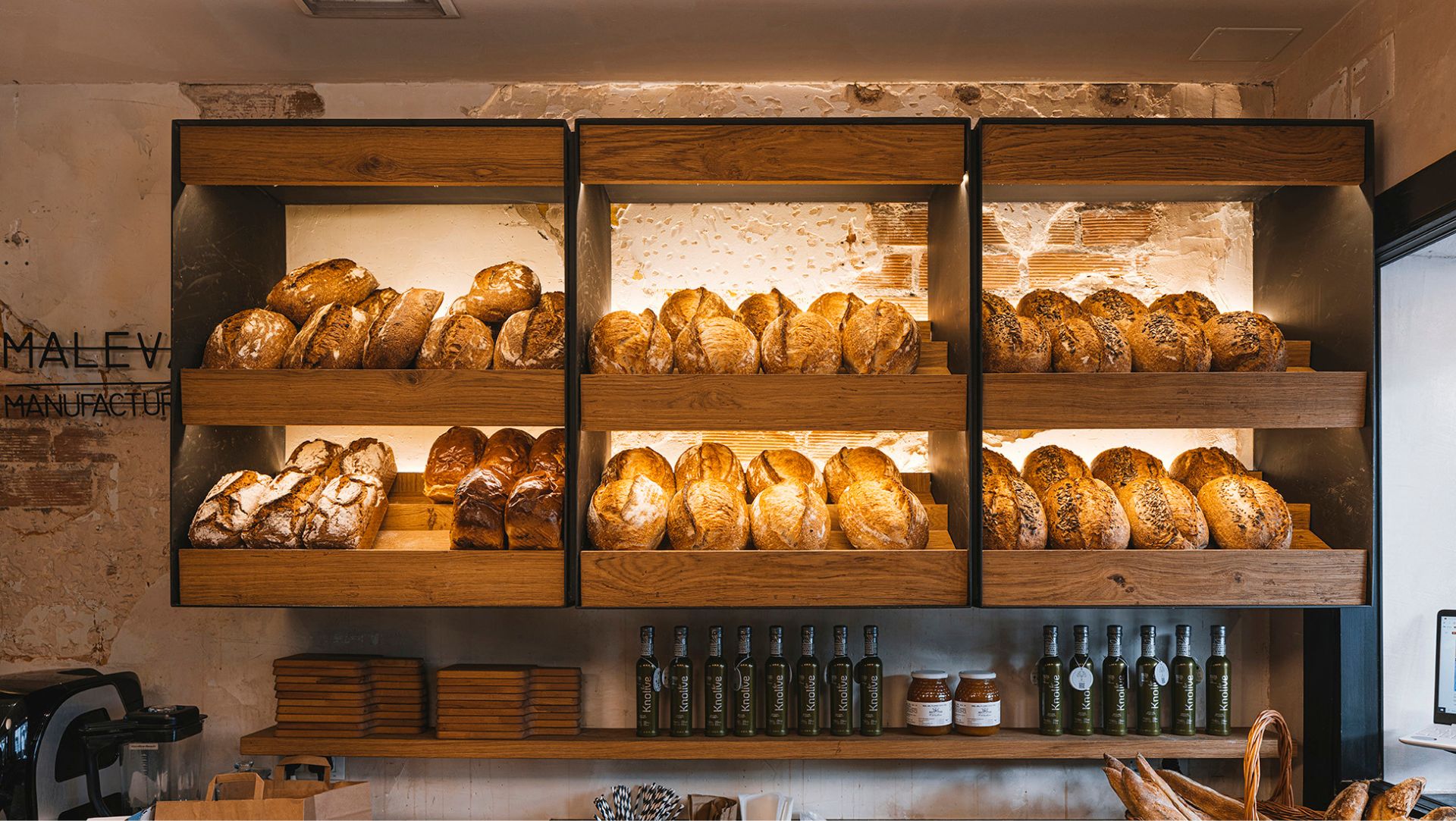
| Maleva Bakery | Calle Pablo Casals 11 | Vegetarian café; croissants, focaccia, sourdough mentioned by reviewers |
| Cocó Café | Av. Ricardo Soriano 35 | Cheesecake, breads, natural juices |
La Canasta and Goyo: the café-bakery tradition
La Canasta is described in a 2024 hotel-group guide as a café that “opened its doors in 1920”, serving breakfast and an extensive range of cakes and pies. A trade-press headline we found describes the La Canasta name as a Málaga-based brand that opened a first venue outside Málaga in Seville, so treat 1920 as the guide’s claim about the brand rather than about the Marbella address. A July 2026 listing of Málaga bakeries gives a different date, saying the Málaga La Canasta has operated since the 1980s, so we cannot confirm 1920 either way. Goyo is listed for its apple pie and an Austrian almond sponge, alongside sandwiches and baguettes, which makes it as much a lunch stop as a cake stop.
El Piave and Blú Café: the international counters
El Piave is listed as an Italian-style bakery near the promenade that makes cakes, Argentine biscuits and its own ice cream, using what the guide calls artisanal techniques. Blú Café Marbella is described as a family-run bakery offering Italian, French, Spanish and Argentine pastries and empanadillas, which gives you a useful range if your group cannot agree on one style.
Pastelería Panadería Eva and Maleva Bakery
Pastelería Panadería Eva, on Avenida Trapiche, has about 253 Google reviews on its directory page, and reviewers mention breakfasts, sandwiches and troncos de Navidad, the chocolate Christmas logs that appear in December. Maleva Bakery, on Calle Pablo Casals, has around 445 Google reviews. It is classed as a vegetarian venue, and its tags and reviewers mention croissants, brioche, focaccia, sandwiches, cakes and sourdough bread, with breakfast and brunch the common reasons to go.
Puerto Banús and Nueva Andalucía
The area around Puerto Banús has fewer traditional bakeries but several good places for French-style pastry and a quick early breakfast before the beach.
- The Bakery Banús (Calle Francisco Villalón 17, Nueva Andalucía): a listing describes it as open daily from 7:30 to 21:00, selling pastries, bread, small cakes and gluten-free options. Visitors praise the small cakes for not being too sweet, and its Google score on that listing is 3.8 out of 5 from 146 reviews, lower than some venues here, with some reviewers asking for better coffee and more outdoor seating.
- Eric Café Pâtisserie (Calle Ramón Areces, 29660): reviewers on a directory page mention éclairs, a brownie and a raspberry tart, and praise the coffee and breakfast. The page shows 203 Google reviews.
- Rosas Café (Avenida Playas del Duque, Gaviotas IV, local 3): a 2024 guide describes it as one of the few places to try French pastries, with barista coffee and a rose-themed interior.
San Pedro Alcántara and the East
Fermento, at Plaza de la Iglesia 1 in San Pedro Alcántara, is listed under its dish tags as a source of cakes and pastries, and reviewers mention cheesecake, bread and pastries. Its page shows 178 Google reviews. A different venue with a very similar name is listed in Fuengirola, so check that you have the San Pedro address if you search by name.
To the east of the town, Caffè San Martino Bistro in the Elviria commercial centre is listed for Danish pastries, along with breakfast dishes such as eggs benedict and pancakes. It suits a long breakfast after a morning at the beach clubs in Elviria more than a quick take-away.
Gluten-Free, Vegan and Healthy Options
If you need gluten-free or plant-based choices, three venues stand out in our sources. Celicioso, inside the Puente Romano resort, is described as offering a gluten-free menu with vegan, vegetarian and raw options, including a gluten-free baked macaron. The Bakery Banús lists gluten-free items, and Maleva Bakery is classed as vegetarian. Because kitchens differ, anyone with coeliac disease or a serious allergy should ask each venue about cross-contamination rather than rely on a listing.
Churros, Tejeringos and Old-Town Institutions
Sweet breakfast in Andalusia often means churros con chocolate, and Marbella has several places that make them. Churrería Ramón, on the Plaza de los Naranjos, is described as open since 1941 and serves tejeringos, a thicker, softer cousin of the churro, with chocolate or coffee. The Churrería-Chocolatería Marbella is listed on the Plaza de África and the Plaza de la Victoria, serving porras, which are thicker still, with chocolate and fresh juice. The three Churrería Generalife locations are listed as popular enough that you may have to queue.
For a more chocolate-focused stop, our guide to chocolatiers and artisan sweet shops in Marbella covers the fine-chocolate side of the town.
What to Order: Málaga and Andalusian Sweets
If you want to taste local sweets rather than international pastry, a 2017 article on Málaga’s typical desserts names five that are worth looking for:
| Sweet | What it is |
|---|---|
| Tortas locas | Puff pastry with custard and an egg-yolk glaze, topped with a cherry |
| Bienmesabe | Antequera dessert of almond, egg, sugar, sponge fingers and angel hair, said to date from 1635 |
| Pestiños | Fried dough of flour and wine, flavoured with aniseed, sesame and cinnamon, finished with honey or sugar syrup |
| Tortas de algarrobo | Carob-based sweet of Arab tradition from the Axarquía, made with aniseed, almonds and sweet wine |
| Baticate | Avocado, milk, sugar and cinnamon shake from the Axarquía, taken as a dessert or snack |
The same article says pestiños are eaten mainly at Christmas, in Lent and in Holy Week, so the season changes what a traditional counter will stock. If you are visiting in December, our guide to Marbella at Christmas covers what else is happening, and the Christmas log mentioned by reviewers of Pastelería Panadería Eva is a sign that festive baking appears on the shelves in the weeks before.
We did not find a source confirming which of the Marbella venues above stock these specific local sweets, so ask at the counter rather than assuming.
Ice Cream and Sweet Stops That Are Not Bakeries
Several places in the 2024 guide are better described as ice cream or crêpe stops than bakeries, but they fill a similar role on a walk. Rivareno Gelato (Calle el Califa) and Purolatte (Calle Notario Luis Oliver) are listed for Italian ice cream and crêpes, and Amorino at La Cañada offers ice cream, waffles and macarons, with the guide noting no colourings or artificial aromas. They are useful after a meal when you want something sweet without a seated order.
How to Plan a Bakery Morning in Marbella
- Go early. One listing says goods at The Bakery Banús can sell out, and the best items at small counters rarely last into the afternoon.
- Combine with a walk. The old-town venues sit within a short walk of the Plaza de los Naranjos, so you can pair a churro stop with a pastry from La Canasta or El Piave.
- Check hours the day before. The 2024 guide notes that many coffee shops and bakeries are open only for breakfast and snacks.
- Ask what is made that day. A good counter will tell you what came out of the oven that morning.
- Bring cash as a back-up. We did not find payment details for most venues, so do not assume cards are accepted at the smallest ones.
What is confirmed and what is not
Confirmed in listings: the venue names and addresses above, the specialities each listing mentions, review counts at the time of the directory pages, the 7:30 to 21:00 daily hours for The Bakery Banús on one listing, and the 1941 and 1920 dates quoted by the 2024 guide.
Not confirmed: opening hours for every other venue, which of them stock Málaga sweets, whether any are closed on Sundays or holidays, current prices and whether each venue is still trading. Review scores are not compared because the directories use different scales.
A Closer Look at Goyo and Granier
Two venues stand out in the directories for the sheer number of reviews they have collected, which is a better guide to popularity than a score. Goyo Marbella, at Calle Alonso de Bazán 3, has about 608 reviews across three sites on its GastroRanking page, made up of roughly 481 on Google, 127 on Tripadvisor and one on TheFork. Reviewers most often mention coffee, pastries, cake, chocolate, sweets and roscón, and the page notes that customers recommend the chocolate. The venue’s website lists the Marbella address under “boutique”, which suggests a shop-and-café format rather than a simple counter.
Granier, at Calle San Gabriel 6 in San Pedro Alcántara, is listed as both a bakery and a café, and its page shows about 911 reviews across two sites, of which around 866 are on Google. Reviewers mention pastries, sweets, pizza, sandwiches, crêpes, chocolate and cake, and the page places it under €20 per person. It is the largest review count of any bakery in this guide, and it sits in San Pedro rather than in Marbella town, which makes it a natural stop if you are staying on that side of the municipality.
Neither page gives opening hours, so confirm them before you go. The two pages also disagree with themselves on scores: the Goyo page shows an overall figure of 5.6 in one place and 7.69 in the text, which is exactly why we do not rank venues by score.
How to Read Directory Reviews for Bakeries
Directory pages are the main public record for small food businesses, but they need careful reading. Here is how we used them, and how you can too.
- Review count tells you about footfall. A venue with several hundred Google reviews is busy and probably consistent. A venue with a handful may be excellent or may be new.
- Scores are on different scales. Google uses five points, while some directories convert to ten, and a few pages quote two different totals for the same venue. Compare like with like or not at all.
- Look at what reviewers name. When several reviewers mention the same item, such as éclairs at Eric Café Pâtisserie or cheesecake at Fermento, that item is probably what the place does best.
- Read the recent reviews. A bakery can change hands or recipe. The oldest reviews may describe a different business.
- Note what is absent. If nobody mentions a particular product, the venue may not make it.
A Spanish Bakery Breakfast: How It Works
If you are used to a sit-down hotel buffet, a bakery breakfast in Marbella works differently. Most venues in this guide are counters with a few tables, and you order at the counter or from a server who clears a place for you. The simplest order is a coffee and one baked item, such as a croissant, a slice of cake or a toasted roll, and you can add a juice if the venue lists fresh juice, as several of the 2024 guide’s cafés do.
Bread plays a larger part in a Spanish breakfast than visitors expect. A small bread roll called a pitufo is the Málaga name for the smaller size of the viena, a classic sandwich loaf with rounded ends, and a Spanish-language bread guide credits a Málaga bakery founded in 1964 with coining the name for children. You will see pitufos filled with ham, cheese or tomato on café menus, and ordering one is a good way to taste local bread without buying a whole loaf.
The Breads of Málaga and Andalusia
Marbella’s bakeries sit in one of Spain’s most distinctive bread regions, and knowing a few names helps you read a menu or a counter. The table draws on a Spanish-language guide to eight typical Andalusian breads, published in March 2021 and updated in August 2025.
| Bread | Where | What the guide says |
|---|---|---|
| Mollete | Antequera (Málaga) | Made in Antequera since at least 1539, with a Protected Geographical Indication; soft and tender; often eaten with manteca colorá or oil and salt |
| Pan cateto | Málaga region | Compact crumb, medium-strength unrefined flour, darker than other breads; keeps about five days under a cloth |
| Albardilla | Málaga | Soft crumb and hard crust, low hydration; oval with a deep cut down the middle |
| Viena | Widely eaten | Sandwich bread with rounded ends, soft crumb and crisp crust |
| Pitufo | Málaga | The smaller size of the viena |
| Telera | Córdoba | Firm, crisp loaf made with candeal flour, the classic partner for salmorejo |
The guide also covers three breads from elsewhere in Andalusia: pan de Alfacar from Granada, regañá from Seville, which is closer to a cracker than a loaf, and saladilla from Granada, an olive-oil bread topped with coarse salt. We did not find a source saying which Marbella bakeries make these, so treat the table as a guide to what to look for, and ask at the counter. If a venue calls its loaf a mollete, check whether it is the protected Antequera product or simply a style of roll.
Beyond Bakeries: Sweet Stops Worth a Day Trip
The best-documented traditional confiterías in the province are in Málaga city rather than Marbella, and a morning there fits into a longer day. A July 2026 listing of Málaga bakeries names four, all in the historic centre:
| Venue | Address (as listed) | Listed as known for |
|---|---|---|
| Confitería Aparicio | Plaza de Capuchinos 15 | Pastelitos de gloria, marzipan and rich egg-yolk pastries |
| La Mallorquina | Calle Sagasta 1 | Classic cakes, tartas and Andalusian sweets |
| La Canasta | Plaza de la Constitución 13 | Freshly baked cakes, sandwiches and savoury pastries |
| Santa Canela | Calle Calderón de la Barca 8 | Cinnamon rolls and American-style bakes, with specialty coffee |
Two details in these sources conflict, and we show both rather than choosing. The July 2026 listing says La Canasta in Málaga has operated since the 1980s, while the 2024 Marbella guide says the café “opened its doors in 1920”. Likewise, the same listing says Confitería Aparicio has made sweets since 1908, while a March 2024 article in El Español says Ildefonso Aparicio founded the shop in 1941 on Plaza de Capuchinos. Both could be true if the dates refer to different things, such as the family’s trade and the shop, but we cannot tell from here.
The El Español article also reports that the owners said the business would not continue after their retirement because nobody would take it over. That was written in 2024, so confirm that Confitería Aparicio is still trading before you plan a trip around it.
Shops, Workshops and Wholesalers
When you search a directory for bakeries in Marbella, some of the results are not shops at all. A business directory for the Marbella area lists several companies that make bollería, the Spanish term for pastries and buns, and supply them to cafés and distributors, including Marenobella and Pronta Luna, and it describes Café Folies as a pastry supplier. These are producers, so you should not expect a counter or opening hours for walk-in customers. When you are choosing where to eat, stay with venues that describe themselves as a café, panadería or pastelería and publish an address and a phone number.
The Bakery Calendar: What to Look For Through the Year
Andalusian bakeries change their counters with the church and family calendar more than most visitors expect, and a counter you visit in July will look very different in December or April. The table below sets out the main seasonal sweets, with the sources we found for each.
| Season | Sweet | What sources say |
|---|---|---|
| Christmas | Troncos de Navidad, pestiños | Reviewers of Pastelería Panadería Eva mention Christmas logs; pestiños are eaten mainly at Christmas, in Lent and in Holy Week |
| Epiphany (5 to 6 January) | Roscón de Reyes | Ring-shaped cake topped with candied fruit, eaten on the night of 5 January and on 6 January, with a figurine and a dried bean inside |
| Lent and Holy Week | Torrijas, pestiños, hornazos | Torrijas are a Semana Santa tradition in Málaga; hornazos are pastries with a boiled egg inside |
| Year round | Tortas locas, bienmesabe, tortas de algarrobo, baticate | Typical Málaga sweets per a 2017 article |
Roscón de Reyes
The roscón is the clearest example of a seasonal bake. A reference page on the cake says it may descend from the Roman Saturnalia, when round cakes with figs, dates and honey were shared, and that by the third century a dried bean was baked inside, with the finder named a temporary king. In Spain it is served on the night of 5 January and on 6 January, the day of Reyes. A small figurine and a dried bean (haba) are hidden in it, and the person who finds the bean becomes the king of the table, while in some places the finder also pays for the cake. The ring is decorated with slices of candied fruit that stand in for the jewels of a crown.
The Goyo listing includes roscón among the items customers mention, and Confitería Aparicio in Málaga says it sells about 20,000 roscones at Christmas. In Marbella you will want to order ahead, especially for a larger size, since we did not find ordering details for any venue here. The festive calendar in our guide to Marbella at Christmas shows how the Three Kings parade on 5 January fits with this tradition.
Torrijas and Holy Week
Torrijas, slices of bread or pastry soaked and fried, are the sweet most associated with Lent and Semana Santa. The El Español article says Confitería Aparicio starts preparing them on Ash Wednesday and sells up to 80,000 during Lent, using pastry in place of bread and muscatel wine from the Málaga mountains, with up to 17 ingredients. That is a Málaga city example, but it shows the scale of the tradition in the province. If you are visiting Marbella around Easter, expect torrijas on the counter of traditional pastelerías, and ask what they are made from, since recipes vary a great deal.
Three Sample Bakery Routes
These routes group venues by the addresses in the listings. We have not walked them, so confirm opening hours and allow extra time between stops, particularly if you are using the car.
Route 1: The old town and the centre
Start at La Canasta on Avenida Ramón y Cajal for a traditional breakfast, then continue to Goyo on Calle Alonso de Bazán for a coffee and a slice of apple pie or almond sponge. Finish with a churro at Churrería Ramón on the Plaza de los Naranjos, which the guide says has been open since 1941, or an ice cream at El Piave near the promenade. This route is mostly in the centre and is best taken in the morning, when counters are fullest.
Route 2: Puerto Banús and Nueva Andalucía
Begin early at The Bakery Banús, which one listing gives as open from 7:30, for a pastry and a coffee. Then move to Eric Café Pâtisserie on Calle Ramón Areces for a second round of French-style pastry, or to Rosas Café at Playas del Duque if you prefer a sit-down breakfast with a gourmet menu. You are likely to need a car or taxi between stops, so choose two venues rather than three.
Route 3: San Pedro Alcántara
In San Pedro, combine Fermento at Plaza de la Iglesia 1 with Granier on Calle San Gabriel. Both are listed with several hundred Google reviews, and they are in the same part of the town, so you can try a bread-led stop and a pastry-led stop in one outing. Check hours for both, since neither listing gives them.
Questions to Ask at the Counter
A few simple questions get you the best of any bakery, and they work in English or Spanish:
- “¿Qué es lo que mejor sale hoy?” asks what is best today, and a good counter will point you to something fresh.
- “¿Esto lo hacéis vosotros?” asks whether they make it themselves, which matters if you want something artisanal.
- “¿Tenéis algo sin gluten?” asks about gluten-free choices, and you should follow up about cross-contamination if you have coeliac disease.
Frequently Asked Questions
What are the best bakeries in Marbella?
There is no single ranking we can verify. For cakes and a traditional café setting, La Canasta and Goyo are listed in the town centre. For French pastry, Eric Café Pâtisserie and Rosas Café are listed, and for bread and sourdough, Maleva Bakery and Fermento are the names reviewers mention.
Where can I find gluten-free bakery items in Marbella?
Celicioso in the Puente Romano resort is described as offering a gluten-free menu, and The Bakery Banús lists gluten-free options. If you have coeliac disease, ask about cross-contamination before ordering.
What time do bakeries in Marbella open?
It varies, and we found hours for only some venues. One listing gives The Bakery Banús as open daily from 7:30 to 21:00, and a 2024 guide says Café de Ronda opens at 8:00. A general note in that guide says many coffee shops and bakeries are open only for breakfast and snacks, so confirm in advance.
Where can I eat churros in Marbella?
Churrería Ramón on the Plaza de los Naranjos is described as open since 1941 and serves tejeringos with chocolate or coffee. The Churrería-Chocolatería Marbella and the Churrería Generalife venues are also listed.
What local sweets should I try in Marbella?
A 2017 article on Málaga’s sweets names tortas locas, bienmesabe, pestiños, tortas de algarrobo and baticate. Pestiños are eaten mainly at Christmas, in Lent and in Holy Week. Ask at the counter whether a venue stocks them.
Are there good bakeries in Puerto Banús?
The Bakery Banús is listed on Calle Francisco Villalón in Nueva Andalucía, close to Puerto Banús, and Eric Café Pâtisserie and Rosas Café are listed in the 29660 area. Review scores for The Bakery Banús are lower than for some venues in town, so read recent reviews before you go.
When is roscón de Reyes eaten in Spain?
It is served on the night of 5 January and on 6 January, the day of Reyes. A figurine and a dried bean are hidden inside, and the person who finds the bean becomes king of the gathering. Ask your bakery about ordering ahead, since we found no ordering details for Marbella venues.
What is a mollete de Antequera?
A soft, tender bread made in Antequera, in Málaga province, since at least 1539 according to a Spanish-language bread guide, and it has a Protected Geographical Indication. It is often eaten with manteca colorá or with oil and salt.
What is a pitufo in Málaga?
A pitufo is the smaller size of the viena, a classic sandwich loaf with rounded ends, a soft crumb and a crisp crust. It is commonly filled with ham, cheese or tomato for breakfast.
Is it worth taking a day trip from Marbella for bakeries?
Málaga city’s historic centre has four well-known confiterías and bakeries listed in a July 2026 guide, including Confitería Aparicio and La Mallorquina. Aparicio’s owners said in 2024 that the business would not continue after their retirement, so confirm it is still open before you go.
The Bigger Picture
Marbella is better known for its restaurants and beach clubs than for its bakeries, which is part of why a good counter feels like a discovery. The strongest options combine a breakfast table with a counter, so you can sit down for coffee and leave with something for later. For the wider context of where to eat and what to book, the hotel-group guide to Marbella coffee shops we used for several addresses is a useful second source, though dated May 2024, so check each venue before you set off.
Planning more than a pastry stop?
If you are considering living in or buying near the places that make Marbella’s mornings, LUXO Estates can help you find the right area, from the old town to San Pedro.