

How to Get to Marbella in 2026: Airports, Trains, Helicopters and Private Jets
Knowing how to get to Marbella is simpler than most guides make it, with one big catch: there is no train. Almost everyone arrives through Málaga airport, about 60 km away, and then continues by road in 45 to 60 minutes. What changes is how you make that last hour: a shared coach, a taxi, a chauffeur, a hire car or, for a very different budget, a helicopter or a private jet. This guide covers every route in 2026, with honest times and costs, and flags where the sources disagree.
Quick Answer
Fly into Málaga-Costa del Sol airport (AGP), 60 km from Marbella, then take a direct coach (about 45 minutes, roughly €8 to €14), a taxi (about €65 to €110), a private transfer, a hire car on the AP-7 or a helicopter (15 to 20 minutes, in the region of €800 to €1,500). There is no train to Marbella. Private jets also land at Málaga, which has a dedicated business-aviation terminal open around the clock. Gibraltar is a useful alternative for UK flights, especially if you are heading west towards Sotogrande.
Three things to know before you book: there is no train to Marbella or Estepona, and the long-discussed Fuengirola–Marbella rail line is only at feasibility-study stage; taxi fares, coach fares and coach timetables vary between sources, so the figures below are ranges to check on the day; and helicopter prices are indicative, not published tariffs. Always confirm the current price before you commit.
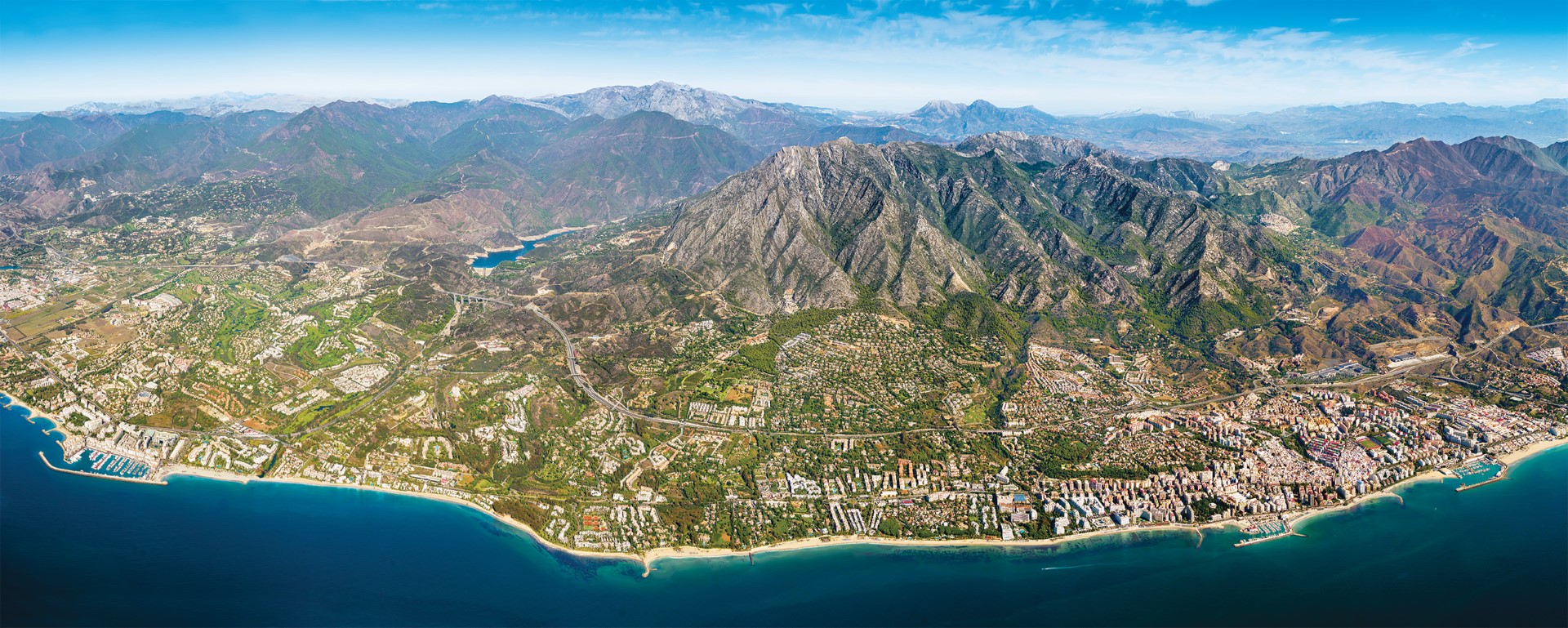
Málaga Airport: The Gateway to Marbella
Málaga-Costa del Sol airport is the main way in, and it is a busy one. According to Aena’s annual press release, the airport handled 26,760,549 passengers and 186,990 flights in 2025, up 7.4% and 6.9% on 2024, with about 83% of traffic international. The United Kingdom was the leading market with 6.15 million passengers, followed by Germany (2.01 million), the Netherlands (1.63 million), Italy (1.40 million) and France (1.39 million). The fastest-growing markets included the United Arab Emirates (up 75.7%), which matters for visitors flying in from the Gulf. Aena’s full figures are in its 2025 annual press release.
The airport is about 60 to 61 km from Marbella. By road the drive takes 45 to 60 minutes, depending on traffic and the route you take. Most international flights from the UK take roughly two hours and 40 minutes, and the airport has direct year-round services from London Heathrow and seasonal services from other UK cities.
The Seven Ways to Get From Málaga Airport to Marbella
| Option | Typical time | Typical cost | Best for |
| Direct coach (Avanza) | 40–60 min | About €8–€14 | Budget, light luggage |
| Licensed taxi | 50–60 min | About €65–€110 | Simplicity, no booking |
| Private transfer | 50–60 min | From about €65 | Families, fixed price |
| Private chauffeur | 50–60 min | About €120–€200 | Comfort, late arrivals |
| Rental car | About 50 min | About €30–€80 a day, plus tolls | Freedom to explore |
| Train plus bus | About 1 h 30 min | About €7–€8 | Rarely worth it |
| Helicopter | 15–20 min | About €800–€1,500 | Time-poor, special occasions |
The figures are drawn from several 2026 transfer and travel guides that quote different numbers for the same service, so treat them as a guide to the order of magnitude. Prices rise in July and August and for late-night arrivals.
By coach: the cheapest and the most direct
Avanza (also referred to as Portillo in some sources) runs a direct, non-stop coach from Málaga airport to the Marbella bus station, with a journey time of about 45 minutes. Fares quoted by different guides range from about €8 to about €14, and tickets can be bought online or at airport kiosks. The timetable matters: one source lists the last coach from the airport at 22:30 in winter and 23:10 in summer, while another lists eight daily services between 07:45 and 22:05, so check the current timetable before relying on a late arrival.
The Marbella bus station sits about a kilometre inland from the town centre, on the north side of the A-7 coast road. Local buses pass through the centre before terminating there, while long-distance coaches stop only at the station, so most hotel guests will still need a taxi for the last stretch.
By taxi or private transfer
A licensed taxi from the airport to Marbella is quoted anywhere from roughly €65 to €110, depending on the source, the time of day and the destination within Marbella. A pre-booked private transfer starts from about €65 and gives you a fixed price and a driver waiting at arrivals, which is worth having after a long flight. A full chauffeur service with a premium car is quoted around €120 to €200.
By car: the AP-7 or the A-7
Driving takes 50 minutes to an hour. You have two choices: the AP-7 toll motorway, with tolls quoted between about €5 and €9, which is faster and avoids the worst summer congestion, or the free coastal A-7, which is slower and busier. In July and August, traffic peaks, and one guide recommends arriving before noon or after 21:00 to avoid it. The same applies during Holy Week.
Train plus bus: possible, but rarely sensible
The Cercanías C1 line runs from Málaga airport to Fuengirola, where you change to a coach for Marbella. The total journey is about an hour and a half and costs about €7 to €8, but it involves a walk between the rail terminus and the Fuengirola bus station, and it is generally described as the slowest route. It is useful only if you are already using the train for another reason.
Is There a Train to Marbella?
No. Guides state it plainly: there is no train to Marbella and no train to Estepona. The nearest rail terminus on the coast is Fuengirola, and everything beyond it is a road journey.
A coastal rail line has been discussed for more than 160 years, with at least seven serious plans abandoned along the way. In early 2026 the Spanish government described the first stage as feasible, with the Fuengirola–Marbella stretch considered the most viable because it carries the most traffic. A feasibility study commissioned by the Ministry of Transport was expected to report after the summer of 2026. We found no published result at the time of writing, so any line is years away, and you should plan Marbella as a road-and-coach destination.
If you are coming from Madrid, the high-speed AVE train takes about two and a half hours to Málaga María Zambrano station, and you then need a further road transfer of roughly 50 minutes, for a total of about three and a half hours.

By Helicopter: Málaga to Marbella in 15 to 20 Minutes
For travellers who place a premium on time, a helicopter turns a one-hour drive into a 15 to 20 minute flight. One luxury-travel guide updated in June 2026 quotes a Málaga–Marbella transfer at about €800 to €1,500, which is an indicative range rather than a published tariff.
Marbella itself has heliports. One is in the Nagüeles district, just inland from the AP-7, near its junction with the A-7 bypass, and is described as hard to find. Another is near junction 177 of the A-7, on the road to Istán beside the Manolo Santana tennis club, and is operated by an air-ambulance company, so it is not a public arrival point. Helicopter flights are offered to the public by operators such as Heliair Marbella from Puerto Banús, including sightseeing flights quoted from €195 per person for 20 to 45 minutes and trips that land at Ronda, the Caminito del Rey, Granada or Seville. Those tour prices come from a directory page without a date, so confirm them with the operator.
The practical advice: book through a charter broker or your hotel, confirm exactly where you will land and how you will reach your final address, and do not assume that a helicopter can set you down at the door of a private villa without prior permission.
By Private Jet: Málaga’s Business Aviation Terminal
Málaga is the airport for private jets heading for Marbella. It has a single main runway of up to 3,200 metres, accepts aircraft from light jets to ultra-long-range types, and runs around the clock. Business aviation is handled by Universal Aviation Spain’s dedicated FBO, with its own lounges and customs and immigration processing inside the facility, which a 2026 handling guide says typically takes under 15 minutes. Both Jet A-1 and Avgas are available.
The airport has no curfew, and slots are required but described as easy to obtain, usually within one to two business days, with no prior-permission requirement. Planning matters most at peak times, such as Holy Week and the Málaga Fair in August, and during the summer months. A private jet brings you in at Málaga, then a car or helicopter takes you the final 60 km, which a good charter broker or concierge can arrange in advance. From the US East Coast, a long-range jet such as a Gulfstream G650 is quoted at about nine to ten hours non-stop.
Gibraltar Airport: The Alternative for UK Flights
Gibraltar airport sits a few hundred metres from La Línea in Spain. British Airways flies from London Heathrow, and easyJet serves Gatwick, Manchester, Birmingham and Bristol, though routes and operating days vary through the year. It is a smart choice if your destination is Sotogrande, about 25 to 30 minutes by road, or the western end of the coast. For Marbella itself, allow roughly an hour or more by road; one 2026 guide quotes about an hour and a half.
The most significant change is recent. According to a guide updated on 5 September 2026, routine immigration and customs checks were removed from the land border between Gibraltar and Spain on 15 July 2026. Passengers now complete both Gibraltar and Schengen immigration inside the airport terminal. British passport holders should note that time spent in Gibraltar now counts towards the usual 90 days in any 180-day Schengen allowance, and that passports must have been issued less than 10 years before arrival and remain valid for at least three months after departure.
Other Routes: Jerez, Sevilla and the Sea
- Jerez (XRY): about 130 km away and about an hour and a half by road, described as a secondary option for private aviation and useful only if you are combining the trip with Cádiz or Seville.
- Sevilla and Granada: both are linked to Marbella by long-distance coach, which is useful if you are touring Andalusia rather than flying in directly.
- By yacht: Puerto Banús marina accommodates vessels up to about 60 metres, and summer berths need advance booking.
Which Route Is Right for You?
| If you are… | Choose | Why |
| A budget traveller with a backpack | Direct coach | Cheapest option, about 45 minutes |
| A family with luggage | Private transfer | Fixed price, driver at arrivals |
| Arriving late at night | Pre-booked chauffeur or taxi | Coaches stop running late |
| Staying a week or more | Rental car | Villages, beaches and restaurants are spread out |
| Short on time | Helicopter | 15–20 minutes |
| Flying privately | Málaga business-aviation terminal | 24-hour operation, customs on site |
| Heading to Sotogrande | Gibraltar airport | About 25–30 minutes away |
How to Get to Marbella From Where You Live
The best route depends heavily on where you are travelling from, because the airport’s traffic is dominated by a handful of markets and each has its own pattern.
From the United Kingdom
The UK is by far the airport’s largest market, with 6.15 million passengers in 2025, and flying time is about two hours and 40 minutes. Heathrow has direct year-round services, while other UK airports are served seasonally, so winter schedules are thinner than summer ones. If your flight lands at Gibraltar instead, you can reach Sotogrande in 25 to 30 minutes, and Marbella in roughly an hour or more.
From Germany, the Netherlands, Italy and France
These four markets together account for around 6.4 million passengers a year (2.01 million, 1.63 million, 1.40 million and 1.39 million respectively), so direct flights are plentiful in the main season. As with the UK, availability falls in winter and rises from spring, so check the schedule for your own month rather than assuming a daily service.
From the Gulf
The United Arab Emirates was the fastest-growing market in 2025, up 75.7%, with Qatar rising 39%. Many visitors from the Gulf arrive on private aircraft, which is why the business-aviation terminal at Málaga matters for Marbella in particular, and why the helicopter and chauffeur options are in regular demand.
From the United States
There is no standard scheduled nonstop route covered by our sources, so most travellers connect through Madrid, London, Frankfurt or Amsterdam. A long-range private jet such as a Gulfstream G650 can fly nonstop from the US East Coast in roughly nine to ten hours.
From Madrid and the rest of Spain
The AVE high-speed train from Madrid to Málaga takes about two and a half hours, and you then need roughly 50 minutes by road to Marbella, which makes about three and a half hours in total. Flying is technically possible but rarely faster than four hours door to door once airport time is counted, so for many travellers the train plus a transfer is the more relaxed choice. Long-distance coaches also link Marbella directly with Madrid, Seville, Granada, Córdoba, Cádiz and other cities.
Peak Season: When Getting to Marbella Gets Hard
The same road that takes 50 minutes in February can take far longer in August. The sources point to a consistent pattern, summarised below.
| Period | What to expect | What to do |
| July and August | Traffic peaks on the coast roads, especially in the afternoon | Arrive before noon or after 21:00; use the AP-7 toll road |
| Holy Week (March or April) | Similar planning pressure as summer; private-aviation demand rises | Book transfers and aviation slots early |
| Málaga Fair (August) | Peak demand at the airport and for ground transport | Coordinate handling and parking in advance |
| December | The airport’s strongest month in 2025, with 1.68 million passengers | Book pick-ups and rental cars ahead for the holidays |
| Off-season weekdays | Quieter roads and shorter queues | Taxis and coaches are easiest here |
The December figure is a useful reminder that Marbella is no longer only a summer destination: December 2025 set a seasonal record for both passengers and flights at Málaga, with 1.68 million passengers and 12,657 operations.
What a Family Actually Pays: Three Worked Examples
Quoted ranges are hard to compare, so here is the arithmetic for three typical groups, using the lower and upper ends of the ranges above. They are illustrations, not quotes.
- A solo traveller: the coach costs about €8 to €14, a taxi about €65 to €110, and a private transfer from about €65. The coach is clearly cheapest.
- A couple: two coach tickets cost about €16 to €28, while a taxi is about €65 to €110 and a private transfer from about €65. The coach is still much cheaper, but the gap narrows once luggage is involved.
- A family of four: four coach tickets cost about €32 to €56 in total, a taxi about €65 to €110 for the whole car, and a private transfer from about €65. At this size the taxi or a private transfer costs only a little more than the coach and is far easier with children and luggage.
The lesson is that the coach wins for one or two people and loses its advantage quickly as the group grows. A hire car costs about €30 to €80 a day, plus fuel and tolls, so it makes most sense when you plan to stay a week or more and want to explore.
Once You Arrive: Getting Around Marbella
Getting to Marbella is only half the question. The town is spread along the coast, and the options for moving around are worth knowing before you land.
- Local buses: seven urban routes and a night service run within Marbella. A single journey costs €1.18, paid to the driver on board.
- Ride-hailing: Uber, Cabify, Bolt and BlaBlaCar are all reported to operate in Marbella, though availability varies by time and location.
- Taxis: a typical city ride is quoted at €10 to €20. Book ahead at peak times rather than hailing on the street.
- The Fly Blue catamaran: a transport guide reports an hourly service between Puerto Banús and Marbella from March to November, about 30 minutes each way and €10 for an adult one way. As with any seasonal service, confirm the timetable before relying on it.
- Cycling: the town has about 298 cycling routes of varying difficulty, with dedicated bike lanes in places.
- Car hire: available from standard agencies as well as luxury and supercar rental firms.
- Helicopter: operators such as Heliair Marbella fly from Puerto Banús for sightseeing and transfers.
If you plan to see the villages and the interior, a car is the practical choice. Our guide to the white villages near Marbella explains which ones repay the drive.
Arriving by Sea or by Road
Not everyone comes through an airport. Two other routes deserve a short mention, because they suit a particular kind of visitor.
By yacht
Puerto Banús marina can take vessels up to about 60 metres, and summer berths need to be booked well in advance. For owners and charter guests, arriving by sea is part of the appeal: you step off at the heart of the Marbella nightlife and dining scene, with the helicopter pad and chauffeur pick-up close by. If you plan to arrive this way, contact the marina early in the year, since the best berths go first.
By road from elsewhere in Spain or Europe
Driving in is straightforward, since the AP-7 toll motorway and the coastal A-7 both pass Marbella. Long-distance coaches connect Marbella with Madrid, Seville, Granada, Córdoba, Cádiz, Almería and other cities, which is the cheapest way to arrive from elsewhere in Spain without a car. If you drive, remember that Marbella has limited parking in the old town and that gated communities usually require advance notice for visitors.
Renting a car: a few practical points
Standard rental agencies operate at Málaga airport and in Marbella, and luxury and supercar rental firms serve visitors who want something more distinctive. A few habits make the experience smoother: collect the car at the airport rather than in town if you have luggage; ask how tolls are handled on the AP-7; photograph the vehicle before leaving; and check whether your accommodation includes parking, because spaces in the busiest parts of Marbella are scarce in summer.
A Door-to-Door Timeline for a Private Arrival
Private arrivals are often misunderstood as instant. In reality, every leg still takes time, and the real advantage is predictability rather than raw speed. This is an illustrative example, with timings based on the figures in this article.
- Touchdown at Málaga. Taxi to the business-aviation terminal, where customs and immigration are processed inside the facility, typically in under 15 minutes.
- Transfer to your onward option. A chauffeured car for the 60 km road journey takes about 50 to 60 minutes. A helicopter transfer takes about 15 to 20 minutes, plus boarding and the transfer from the heliport to your final address.
- Arrival at your address. Allow extra time for gated-community access and luggage.
The point is that a jet removes the queues and the baggage hall, while the final 60 km remains a separate decision. A good concierge or charter broker will arrange both legs together so that the car or helicopter is waiting when you land.
Arrival Checklist: Ten Things to Do Before You Land
- Decide your transfer before you fly. Book a private transfer or chauffeur ahead, or decide at which kiosk you will buy a coach ticket.
- Check the coach timetable if you land late. Sources disagree on the last departure, so verify it.
- Know your destination address in Marbella. The town stretches along the coast, and the transfer price can vary by destination.
- Choose the AP-7 or the A-7. The toll road (about €5 to €9) is faster; the free coast road is slower and busier.
- Time your arrival if you can. Before noon or after 21:00 avoids the worst of the summer traffic.
- Keep ID and documents handy. If you arrive via Gibraltar, remember that Gibraltar and Schengen checks now happen inside the airport.
- Carry some cash and a card. Coach and taxi payment methods vary.
- Download a ride-hailing app. Uber, Cabify and Bolt are reported in Marbella.
- Confirm villa or hotel access. Gated communities often need advance notice for visitors and drivers.
- Plan your first meal. See our guide to the best restaurants in Marbella for arrival-night options.
Common Mistakes When Travelling to Marbella
- Looking for a train. There is none, and the Fuengirola link is the nearest rail point.
- Trusting a single price. Taxi, coach and helicopter prices vary between sources, so check the current fare before you commit.
- Arriving in the afternoon rush in summer. The road is at its worst between midday and early evening in July and August.
- Booking a late coach without checking the timetable. The last service differs by source, so confirm the final departure.
- Assuming a helicopter lands at your door. Landing sites are limited, so plan the final leg.
- Forgetting peak events. Holy Week and the Málaga Fair strain transfers, slots and parking.
- Ignoring the Gibraltar option. For Sotogrande and the western coast, it can be the better airport.
Frequently Asked Questions
How far is Marbella from Málaga airport?
Marbella is about 60 to 61 km from Málaga airport. By road the journey takes 45 to 60 minutes, depending on traffic and whether you take the AP-7 toll motorway or the coastal A-7.
Is there a train to Marbella?
No. There is no train to Marbella or Estepona. The nearest rail terminus is Fuengirola, from where you change to a coach. A Fuengirola–Marbella rail link is only at feasibility-study stage.
How much is a taxi from Málaga airport to Marbella?
Sources quote roughly €65 to €110, depending on the time of day and your destination in Marbella. A pre-booked private transfer starts from about €65 and gives you a fixed price.
How long is a helicopter flight from Málaga to Marbella?
A helicopter transfer takes about 15 to 20 minutes, compared with 45 to 60 minutes by road. One 2026 guide puts the cost at about €800 to €1,500, an indicative range rather than a published tariff.
Can private jets land near Marbella?
Private jets land at Málaga airport, about 60 km away, which has a dedicated business-aviation terminal open 24 hours with customs and immigration processed on site. A car or helicopter completes the journey to Marbella.
What is the best time to travel to Marbella to avoid traffic?
Arrive before noon or after 21:00 in July and August, and plan similarly for Holy Week. The AP-7 toll road, at about €5 to €9, is faster than the free coastal A-7 at peak times.
Is it cheaper to take the bus or a taxi from Málaga airport to Marbella?
For one or two people the direct coach is cheaper, at roughly €8 to €14 each. For a family of four, a taxi at about €65 to €110 for the whole car costs only a little more than four coach tickets and is easier with luggage.

The Bigger Picture
Marbella is one of the most international small cities in Europe, and its arrival experience reflects that: a major airport an hour away, no rail, a motorway that can be a pleasure or a car park depending on the month, and a ladder of options that runs from an €8 coach to a chartered helicopter. The right choice is rarely the most expensive. It is the one that matches your luggage, your arrival time and how you plan to move around once you are here.
Once you have arrived, see our guides to the perfect day in Marbella, the white villages near Marbella and the best restaurants in Marbella.
Arriving to stay?
LUXO Estates covers the properties, the people and the lifestyle shaping the Costa del Sol.
Related reading:
A Perfect Day in Marbella
White Villages Near Marbella
Best Restaurants Marbella 2026
LUXO Estates Homepage