Marbella Old Town: A Walking Guide to Squares, Chapels and Hidden Corners
The Marbella old town, known in Spanish as the Casco Antiguo, is a compact district of whitewashed lanes, small squares, chapels and the remains of a Moorish castle, centred on the Plaza de los Naranjos. Sources suggest that a basic walk takes about one to two hours, and longer with a meal or a museum stop. This guide explains what to see, where the sources disagree, how to park and how to order a route, and it marks which details are confirmed and which are not.
Quick Answer
Start at the Plaza de los Naranjos, the heart of the Marbella old town, then visit the Church of the Incarnation, the castle walls and the Ermita de Santiago. Add the Museo del Grabado Español Contemporáneo if you like art, and walk Calle Ancha to the Santo Cristo chapel. Allow 1 to 2 hours. Go in the early morning or the evening, avoid the squares from June to September at midday, and park outside the lanes, since sources advise against driving in.
Read this first: the sources we used disagree on the year of the town hall (1485 or 1568), the museum entry price (€3 or free), the number of works in the museum and parking prices. We give each version with its source. Check opening hours and prices locally before you go.
What Is the Marbella Old Town?
The Marbella old town sits in the centre of the town, north of the seafront avenues, and one guide places it north of Avenida Ramón y Cajal. Avenida Ricardo Soriano is described as the main street just outside it. A hotel-group blog says the historic centre is mainly the result of a Muslim settlement, though Marbella’s beginnings go back to the Roman period, and that from the 12th century the town grew north along what is now Calle Ancha. It later spread east around Calle Málaga, where a cross marks the Reconquest. The nearest beach, Playa Venus, is about an 8-minute walk away, according to a travel blog.
For a wider view of the town, see our guide to a perfect day in Marbella, which places the old town within a full day.
A Short History, and Where Sources Disagree
| Subject | What the sources say |
|---|---|
| Castle walls | Remnants of a Moorish castle dated to the 9th to 10th centuries (Málaga travel guide); a Muslim construction attributed to Abd al-Rahman III and a Site of Cultural Interest since 1949 (hotel-group blog) |
| The Reconquest | 1485 under the Catholic Monarchs; the hotel-group blog gives 11 June 1485 and says tradition has the Muslim governor handing over the keys, with a cross on Calle Málaga marking the spot and the day celebrated as the feast of San Bernabé |
| Plaza de los Naranjos | A hub since the 15th century (Málaga travel guide); built from 1485 after the conquest (encyclopedia and travel blog); the orange trees that give the square its name were planted in 1941 (encyclopedia) |
| Town hall (Casa Consistorial) | 1568 in Renaissance style (Málaga travel guide, travel blog and encyclopedia); one local-guide page gives 1485 |
| Casa del Corregidor | 17th century (Málaga travel guide); 1552 (travel blog); described as late Mudéjar Gothic (hotel-group blog) |
| Church of the Incarnation | Begun in the 16th century on the site of a mosque (Málaga travel guide); 16th to 17th centuries (travel blog) |
The pattern is clear even where the details are not: Roman and Muslim roots, a Christian reconquest in 1485 and most of the visible monuments dating from the 16th and 17th centuries. If a date matters to you, treat the 1568 town hall as the better-supported figure, since three sources give it and the plaque on the building is reported to commemorate the 1485 conquest and not its own construction.
The Plaza de los Naranjos and Its Three Buildings
The Plaza de los Naranjos, or Orange Square, is the old town’s social and administrative heart. An encyclopedia entry describes white Andalusian houses and three historic buildings around it, the Casa Consistorial, the Casa del Corregidor and the Ermita de Santiago, with a Renaissance fountain at the centre surrounded by orange trees.
- The town hall: an encyclopedia entry says it has a sundial and a coat of arms, and that plaques in Old Spanish commemorate the 1485 conquest, the establishment of the water supply in 1632 and additions in 1779.
- The Casa del Corregidor: the magistrate’s house, with a stone balcony noted by the Málaga travel guide. The hotel-group blog says its ground floor is a restaurant.
- The Ermita de Santiago: a small chapel that the Málaga travel guide calls the oldest religious building in Marbella.
Every source warns that the square is very busy from June to September, and a travel blog adds that the restaurants on the square are overpriced and that cheaper options are on the side streets. The hotel-group blog suggests walking two or three streets away for more authentic bars and fewer tourist prices.
The Church, the Chapels and the Plaza de la Iglesia
The Church of Our Lady of the Incarnation stands on the Plaza de la Iglesia, which a travel blog describes with a central fountain and palm trees and the hotel-group blog says hosts markets and concerts. The Málaga travel guide describes a Baroque façade and a gold altarpiece, says entry is usually free and advises covering shoulders and knees. It adds that evening classical concerts cost about €15 to €25.
The Chapel of San Juan de Dios, known as “El Hospitalillo”, is described as a small Baroque church of the 16th century, and a hotel-group tourist guide says it holds an image of the Virgen del Carmen. The Ermita del Santo Cristo, on the Plaza de Santo Cristo, is called the oldest sanctuary in the city by the hotel-group blog, and the Málaga travel guide mentions a couple of small bars with outdoor seating on the square. A travel blog says Calle Ancha, draped in bougainvillea, leads to it.
The Castle and the Walls
Parts of the old Moorish castle and its walls survive, and entry to the visible sections is free according to the Málaga travel guide. It places well-preserved stretches on Calle Portada and Calle Salinas, while a hotel-group guide says Calle Fortaleza runs past the walls, so the street names differ by source and the lanes beside the wall are the place to look. The hotel-group blog says the castle has been a Site of Cultural Interest since 1949 and mentions Roman traces in the alcazaba and walls. The walls are partly preserved, and the hotel-group guide gives no detail on towers, so do not expect a full circuit.
Museo del Grabado Español Contemporáneo
The engraving museum is in the old Hospital Bazán on Calle Hospital Bazán, in the old town. A web page on the museum describes a 16th-century Renaissance building that was once the residence of the mayor Alonso de Bazán, who gave it to the town as a hospital for the poor. The museum opened on 28 November 1992, and the page lists works by Picasso, Miró, Tàpies and Chillida, and Jean Cocteau material since 2021. The sources disagree on several points:
| Detail | Version and source |
|---|---|
| Entry price | €3 (Málaga travel guide and the museum web page, which also lists €1.50 for students and free for retired people); free (travel blog) |
| Number of works | About 4,000 (museum web page); over 1,300 (hotel-group blog); over 1,000 across three floors (travel blog) |
| Opening hours | Monday 9:00 to 14:00, Tuesday to Friday 9:00 to 19:00, Saturday 9:00 to 14:00, closed Sundays and public holidays (museum web page, undated) |
The museum web page also says it closed in July 2015 for planned annex works that never started, after which the building was embargoed for emergency shoring, and that it reopened in June 2016. The hours come from an undated page, so confirm them before you go.
Streets and Corners Worth Finding
- Calle Ancha: a bougainvillea-draped street, pink in spring and summer, with craft shops and tapas bars, and it leads toward the Santo Cristo chapel.
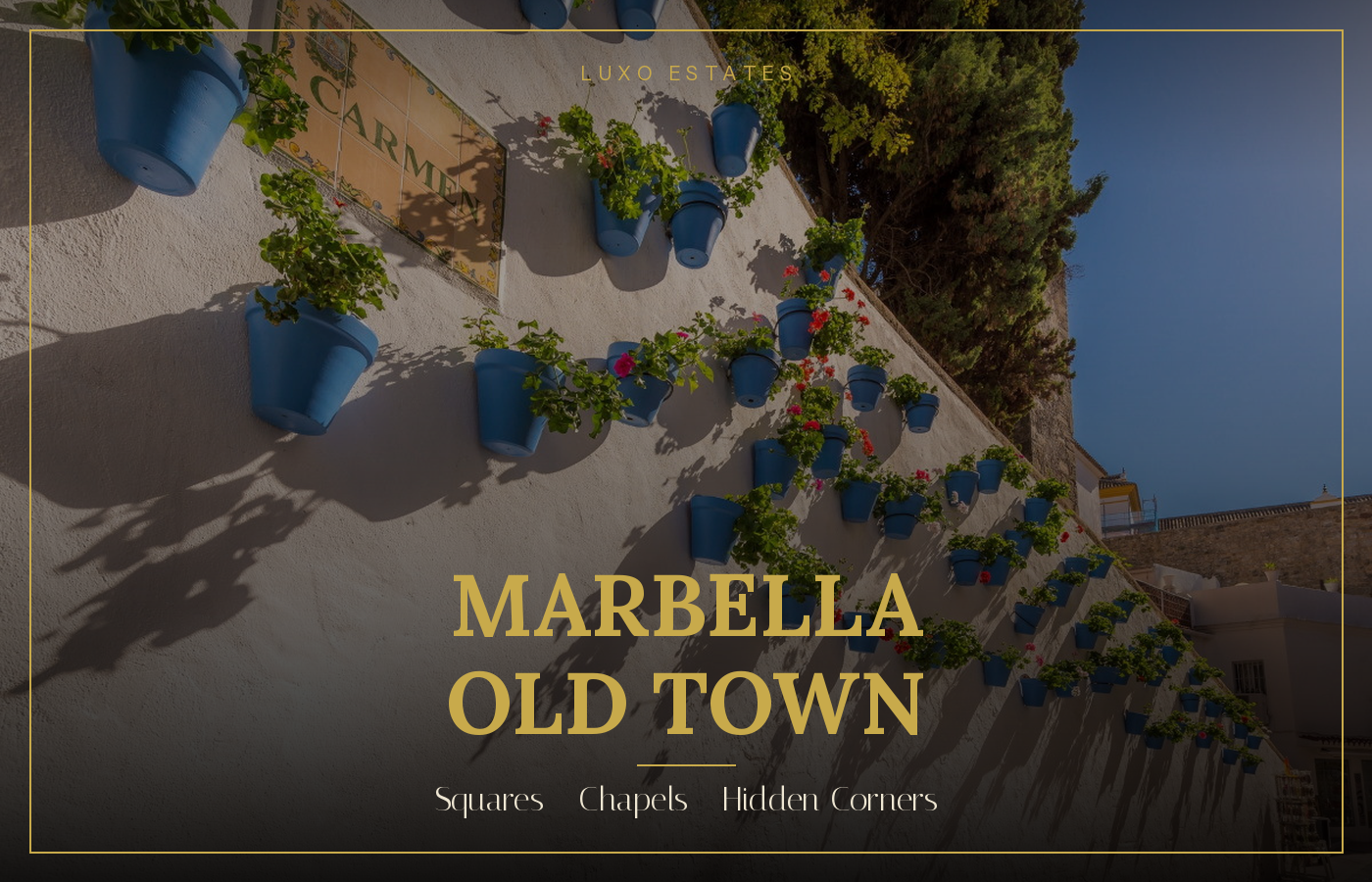
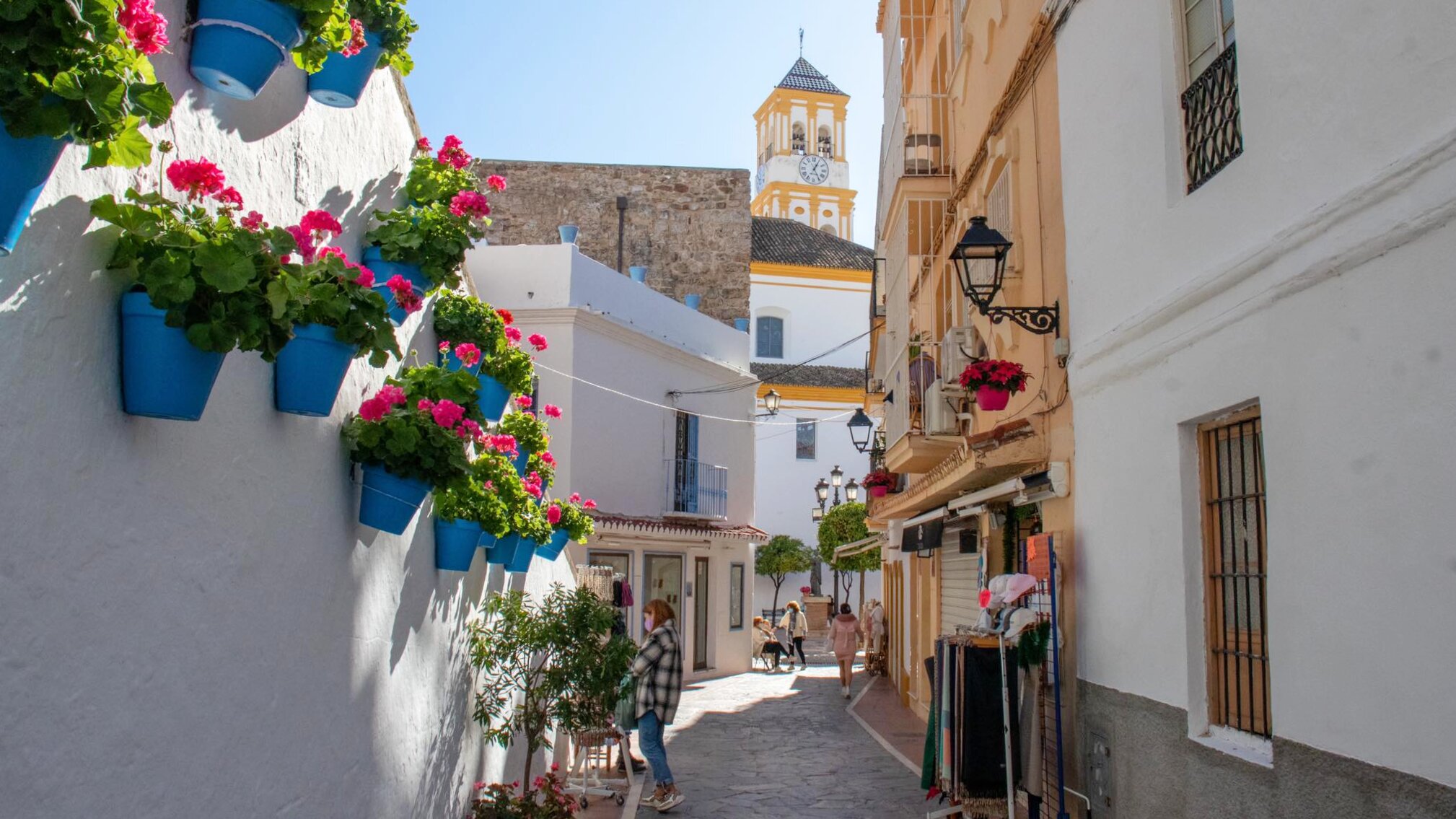
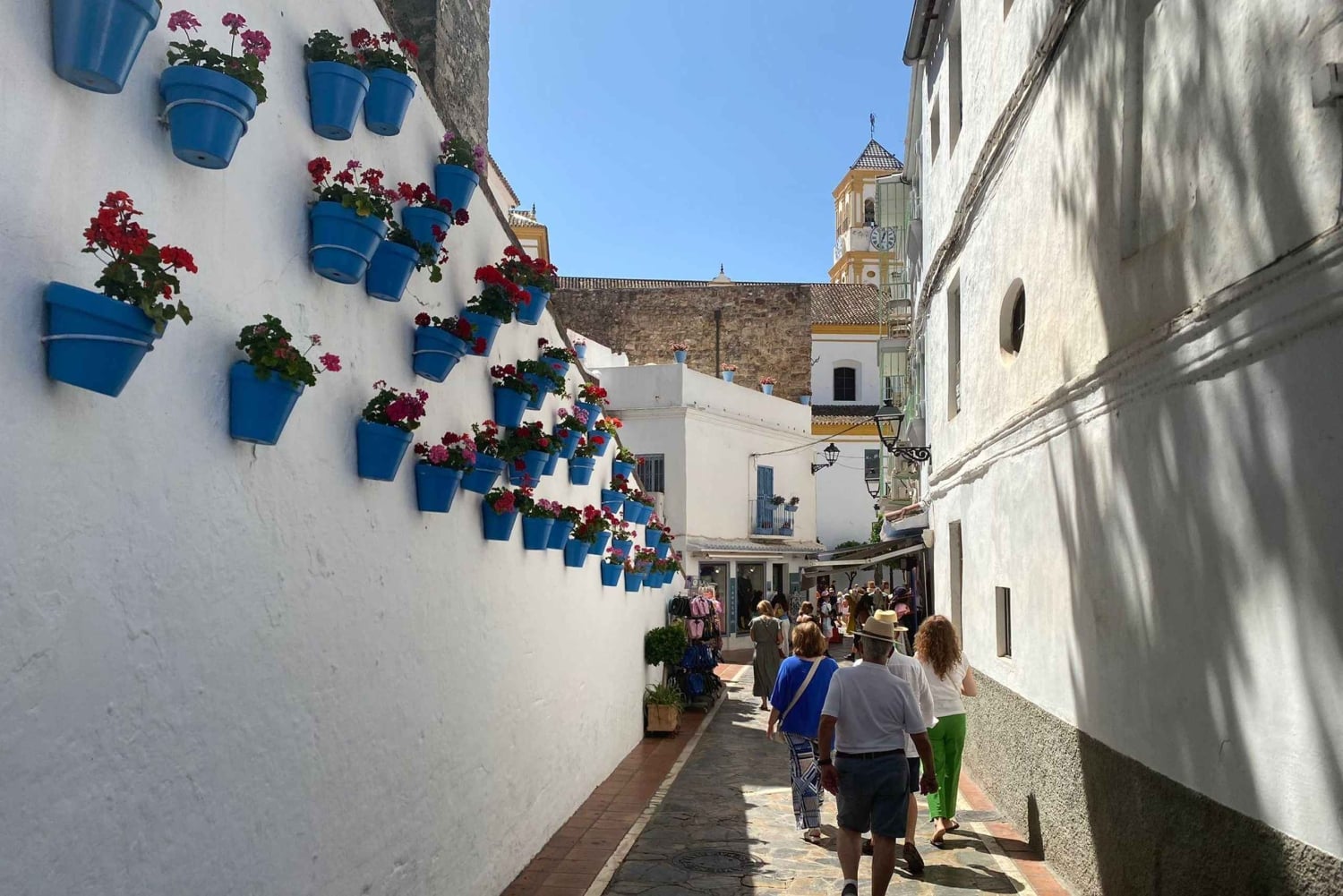
- Calle Carmen: called the most photographed street by a travel blog, with blue pots of red and pink carnations and a view of the church. The blog says it is quietest in the late afternoon in summer.
- Calle Nueva: the blog mentions a Marbella sign for photos, and calls Calle Nueva and Calle Gloria the main shopping streets.
- Calle Gloria and Calle Caballeros: other photogenic streets in the same blog.
- Near the town hall: blue plant pots with bright flowers.
The advice shared by most sources is to wander the side streets and not follow a checklist, to look up at the flowered balconies and façades, and to walk in loops and not in straight lines.
A Suggested Walking Route
The order below is our own, built from how the sources group the stops. We did not walk or time it, so treat it as a sequence and not a schedule.
| Stop | What to look for |
|---|---|
| 1. Plaza de la Victoria or the Alameda park | Where the car parks are; walk into the old town from here |
| 2. Calle Ancha | Bougainvillea, craft shops and tapas bars |
| 3. Ermita del Santo Cristo | The chapel and the small square with bars |
| 4. Plaza de la Iglesia | The Church of the Incarnation, its fountain and palms |
| 5. Calle Carmen | Flower pots and the view of the church |
| 6. Plaza de los Naranjos | The town hall, Casa del Corregidor, Ermita de Santiago and fountain |
| 7. The castle walls | Surviving sections beside the lanes near the square |
| 8. Museo del Grabado Español Contemporáneo | Renaissance building and prints; check hours |
A hotel-group blog also names the Parque de la Alameda, the Parque de la Constitución and the Parque Arroyo de la Represa as green stops outside the lanes, if you want a break from the stone and whitewash. We describe two of them below.
Eating and Drinking
We have not reviewed any restaurant, and we name places only as the sources do. The hotel-group blog identifies three dining zones: the Plaza de los Naranjos; Calle Ancha and Calle Tetuán; and Calle Virgen de los Dolores with Ortiz de Molinillo. It says Bar El Estrecho states that it has served homemade food since 1954 and that Casa Eladio is listed in the Michelin Guide. A travel blog mentions Taberna La Niña del Pisto, The Farm Marbella, Mia Cafe Tapas and Bar and Casanis Bistrot on Calle Ancha. The Málaga travel guide gives typical prices of €15 to €20 for a set lunch menu, €3 to €5 for coffee with toast and €1 to €2 for bottled water.
The hotel-group blog advises booking ahead at popular restaurants, going early to traditional bars and expecting no-booking spots to be busy. For a seaside meal after your walk, our guide to chiringuitos in Marbella will help.
Parking and Getting There
The Málaga travel guide advises against driving into the old town’s narrow streets. The sources list several car parks and disagree on prices, so use the table as a guide to where, not how much.
| Car park | What the sources say |
|---|---|
| Plaza de la Victoria | Closest to the centre (hotel-group blog); €4 per hour (travel blog) |
| Avenida del Mar | About €1.50 per hour, about five minutes’ walk (travel blog); free but hard to find space (hotel-group guide); free, in the white zone (parking guide) |
| Municipal Market | Often has more spaces (Málaga travel guide); a few minutes’ walk from the Plaza de los Naranjos (hotel-group guide) |
| Parking Alameda | Blue zone at €1.20 per hour (parking guide) |
| Las Albarizas, street parking | Free, about 1.5 km away, 15 to 20 minutes on foot, often full on summer weekends (parking guide) |
The Málaga travel guide quotes about €2 to €3 per hour and €18 to €25 for a full day, which does not match the other sources, so expect variation. It adds that local buses L-1, L-2 and L-3 serve the Ricardo Soriano stop, about a 5 to 10 minute walk from the old town. For longer journeys, see our guide to how to get to Marbella.
When to Go
- Early morning: the local-guide page recommends it for empty cobbles and soft light.
- Late afternoon and evening: several sources recommend these hours for atmosphere, and the Málaga travel guide suggests evenings after 7 pm in summer, when temperatures can exceed 35°C.
- Spring and autumn: the Málaga travel guide calls April to May often the best, with orange blossom, and September to October similar. Our guide to Marbella in autumn covers the season.
- Siesta: small shops often close from about 2 pm to 5 pm and on Sundays, while restaurants stay open.
The Old Town at Fiesta Time: San Bernabé
The old town is also the setting for part of Marbella’s main summer fair. A festival listing, updated on 8 September 2026, gives the 2026 dates of the Feria y Fiestas de San Bernabé as 8 to 14 June, with the pilgrimage on 31 May and the main day on 11 June, and marks the edition as finished. According to the listing:
- the daytime fair, with marquees, horse rides and flamenco street parades, takes place in the old town, while the night fair is held at the Cortijo de Miraflores fairground;
- the solemn Mass is held in the Church of Our Lady of the Incarnation, followed by a procession of the patron saint on 11 June;
- entry to the fairground and the old town is free, and concerts are priced by artist;
- the programme has more than 50 activities, including a flamenco gala, bullfighting events and the election of the fair’s queen and ladies.
The hotel-group blog adds that the Reconquest is celebrated on the feast of San Bernabé, which links the fair to the 11 June 1485 date discussed above. Expect crowds and closed streets in fair week, and check the dates for the next edition, since this listing covers 2026 only. Our Marbella events calendar for 2026 and 2027 tracks the dates through the year. We found no verified source on the Easter processions in the old town, so we do not describe them.
Two Chapels in More Detail
Ermita del Santo Cristo de la Vera Cruz
An encyclopedia entry says this hermitage sits in the Barrio Alto, a historic suburb of the ancient city that is considered part of the old town. It describes a chapel built in the 15th century and expanded in the 18th, with a main façade covered in stone, the rest finished in lime stucco, as in many Andalusian hermitages, and a square bell tower with a roof of glazed ceramic. The entry names no heritage status, and its tourism-board link is dead, so we cannot confirm a designation. The hotel-group blog calls it the oldest sanctuary in the city.
Chapel of San Juan de Dios
A Spanish encyclopedia entry describes this 16th-century chapel as part of the former Hospital Real, which the Catholic Monarchs had built after the conquest of the city. It has a simple plan and a stone portal in a round arch, with a carved door showing the city’s coat of arms and a pomegranate, a symbol of the former Nasrid Kingdom of Granada. The notable interior elements are a Mozarabic coffered ceiling and fragments of frescoes, which the entry calls unusual for Castile and a sign of mixed artistic styles. It adds that a 2010 restoration uncovered two 16th-century arches, citing a regional newspaper. The hotel-group blog calls the same building “El Hospitalillo” and says it was built by order of the Catholic Monarchs.
Opening hours for both chapels are not given in the sources, so treat them as exteriors unless you find the doors open.
Green Pauses: Alameda Park and Arroyo de la Represa
Parque de la Alameda
A hotel-group guide, modified in May 2025, says the Alameda dates to the 18th century, when it was laid out as a place of recreation for the residents, and that it originally covered about 20,000 m², about a fifth of the urban centre at the time, before urban growth reduced it. It sits between the old town and the seafront promenade. The guide lists:
- a ceramic fountain from 1792, known as the Fuente de la Virgen del Rocío, at the heart of the park;
- benches with Andalusian tiles around the fountain;
- trees including ficus, jacarandas, date palms, araucarias and London plane trees;
- a central walkway with two side paths and six ornamental roundabouts with built-in benches.
The guide says the park was Marbella’s social hub in the 19th and early 20th centuries, hosting fairs and celebrations, and that a major renovation in 1930 added paved and marble paths, with the Casino building on its western side. It gives its boundaries in the text as streets including Avenida del Mar and Avenida Miguel Cano, while its FAQ gives a different boundary, so we do not rely on either for navigation. A car park of the same name lies nearby.
Arroyo de la Represa and the bonsai museum
The hotel-group blog lists the Arroyo de la Represa park, with two artificial lakes and a bonsai museum, among the green stops. The two sources disagree about the museum. A separate guide to the Marbella Bonsai Museum says it has been closed since December 2018, that its 25-year lease with the town hall expired in October 2017, that the building was slated to become a municipal library and that the collection’s owner was seeking a new location. We could not find an up-to-date source, so check before you plan a visit around it.
How to Read the Old Town: What to Look For
A quick way to enjoy the old town is to read its layers. The sources let you spot four of them.
- Roman and Muslim roots: the castle walls and the plan of narrow lanes, since the hotel-group blog says the historic centre is mainly the result of a Muslim settlement.
- The Reconquest: the plaque on the town hall and the cross on Calle Málaga, both linked to 1485.
- The 16th and 17th centuries: the town hall, the Casa del Corregidor, the church and the Hospital Bazán, which now houses the engraving museum.
- The 18th and 19th centuries: the Alameda, the chapel of Santo Cristo’s expansion and the social life that gathered around the park.
It also helps to look for details at street level. The sources point to the sundial and coat of arms on the town hall, the stone balcony of the Casa del Corregidor, the gold altarpiece and Baroque façade of the church, the glazed ceramic roof of the Santo Cristo bell tower and the pomegranate on the San Juan de Dios door.
Three Ways to Spend Your Time
These plans use only the stops and times in the sources, and they are not tested.
One hour: the essential loop
Start at the Plaza de los Naranjos, step into the Plaza de la Iglesia for the church, walk Calle Carmen for the view and the flower pots and return by the castle walls. This fits the sources’ estimate of about an hour for the basics.
Half a day: add the museum and a meal
Do the loop in the morning, visit the engraving museum while it is open, which the web page says is from 9:00 on weekdays and until 14:00 on Mondays and Saturdays, and have lunch on a side street, where a travel blog says prices are lower than on the square. Shops close around 2 to 5 pm, so use that time for the meal.
Evening: atmosphere and a concert
Arrive in the late afternoon, when Calle Carmen is quietest in summer, walk the squares as the light softens and check for evening classical concerts at the church, priced at about €15 to €25 according to the Málaga travel guide. Dinner on Calle Ancha or Calle Tetuán fits the dining zones the hotel-group blog describes. For a night out beyond dinner, see our guide to craft beer bars in Marbella.
A Rough Budget for a Day in the Old Town
Using only the figures the sources give, a simple day looks like this. Prices change, so treat them as examples and not as quotes.
| Item | Figure listed | Source |
|---|---|---|
| Coffee with toast | €3 to €5 | Málaga travel guide |
| Set lunch menu | €15 to €20 | Málaga travel guide |
| Bottled water | €1 to €2 | Málaga travel guide |
| Engraving museum | Free to €3 | Sources differ |
| Evening concert in the church | About €15 to €25 | Málaga travel guide |
| Parking, three hours at €1.50 per hour | €4.50 | Travel blog price, our arithmetic |
| Parking, three hours at €4 per hour | €12 | Travel blog price, our arithmetic |
On those figures, a visitor who has coffee, a set lunch, a museum entry and three hours of cheaper parking spends roughly €23 to €33 before any shopping, and about €15 to €25 more if they add a concert. The parking line shows why the choice of car park matters: the same three hours cost €4.50 in one source and €12 in another, a difference of €7.50, about the price of a coffee and a museum entry.
Who Will Enjoy the Old Town Most
- Photographers: the flower pots, bougainvillea and whitewashed walls reward early morning light, according to the local-guide page.
- History readers: the walls, the Reconquest plaques and the Hospital Bazán reward a slow walk, with the hotel-group blog’s dates as a guide.
- Art lovers: the engraving museum has work by Picasso, Miró, Tàpies and Chillida, and Jean Cocteau material, according to the museum web page.
- Families: the squares and fountains are easy to enjoy, and the Alameda has benches and shade, though we found no source on prams or accessibility. Our guide to Marbella with kids adds more ideas.
- Visitors short of time: the one-hour loop covers the essentials, and the beach is close for the rest of the afternoon.
Practical Tips for Walking the Old Town
- Footwear: the Málaga travel guide recommends comfortable shoes for the cobbled streets.
- Pickpockets: the same guide advises watching for them in crowded areas, which means the squares in summer and fair week.
- Dress code in the church: cover your shoulders and knees.
- Shop hours: many shops close for the afternoon and on Sundays, and restaurants stay open.
- Beach nearby: a travel blog says Playa Venus is about an 8-minute walk, which makes a swim a natural end to the visit.
- Accessibility: we found no source on step-free routes, and the lanes are cobbled, so ask locally if you need level access.
- Cash and prices: the Málaga travel guide gives sample prices for a set lunch, coffee and water, which are useful for budgeting but may be out of date.
What is confirmed and what is not
Confirmed in published sources: the main sights and their general periods, the 1485 Reconquest, the town hall’s Renaissance style, the Site of Cultural Interest status of the castle since 1949 (one source), the museum’s address and published hours, and the car parks named.
Not confirmed: exact construction dates for the town hall and the Casa del Corregidor, the museum’s entry price and number of works, current parking prices, walking times, current opening hours of churches and chapels, whether the bonsai museum is open, the dates of the next San Bernabé fair and the quality of any restaurant.
Frequently Asked Questions
How long does it take to see the Marbella old town?
Sources suggest about one to two hours for a basic walk, and longer if you stop for a meal, a drink or the museum.
What is the most important square in the Marbella old town?
The Plaza de los Naranjos, or Orange Square, is the old town’s heart, with the town hall, the Casa del Corregidor, the Ermita de Santiago and a Renaissance fountain.
Is it free to visit the Marbella old town?
Walking the lanes and squares is free, and sources say the castle walls and the Church of the Incarnation are usually free to see. The engraving museum is listed at €3 by two sources and as free by one.
Where should I park for the Marbella old town?
Sources name the Plaza de la Victoria, Avenida del Mar, the Municipal Market and Parking Alameda, and advise against driving into the narrow streets. Prices differ between sources, so check the signs.
When is the best time to visit the Marbella old town?
Early morning and the evening are the most recommended times. Spring and autumn are often considered best, and the squares are very busy from June to September.
Is the Marbella old town worth visiting for photographs?
Sources point to Calle Ancha, Calle Carmen, Calle Nueva and the Plaza de los Naranjos for photographs, with flower pots, bougainvillea and whitewashed walls. Early morning gives the softest light, according to one guide.
When is the San Bernabé fair in Marbella?
A festival listing gives 8 to 14 June in 2026, with the main day on 11 June. The daytime fair is held in the old town and the night fair at the Cortijo de Miraflores, so check the dates for the next edition.
Is the Marbella bonsai museum open?
One guide says the museum has been closed since December 2018, while a hotel-group blog still lists it among the sights of the Arroyo de la Represa park. We could not confirm its current status, so check before you go.
Can I visit the churches and chapels in the Marbella old town?
The Málaga travel guide says entry to the Church of the Incarnation is usually free and asks visitors to cover their shoulders and knees. The sources give no opening hours for the chapels, so treat them as exteriors unless the doors are open.
How old is the Marbella old town?
Sources describe Roman roots and a mainly Muslim settlement, with the castle walls dated to the 9th to 10th centuries and the Reconquest in 1485. Most visible monuments date from the 16th and 17th centuries.
The Bigger Picture
The Marbella old town is small, and that is its appeal: in an hour or two you pass from a Renaissance square to a Baroque church, a chapel with Moorish foundations and a lane of flowered balconies, a few minutes from the seafront. It rewards slow walking and side streets more than a checklist. A hotel-group blog on the Marbella old town offers another view of the same streets, with its own list of places to see, eat and visit.
Looking for a home near the old town?
If you would like to live within walking distance of the squares and the sea, LUXO Estates can help you find the right property in central Marbella.
Related Reading
- A Perfect Day in Marbella: Luxury Itinerary
- The Golden Mile in Marbella: Secrets Tourists Miss
- White Villages Near Marbella Worth the Detour
- Chiringuitos in Marbella: How to Choose and What to Order