

Guide prepared by the LUXO Estates team with verified data from the Spanish Notaries’ Council, the Junta de Andalucía Tax Authority (ATAG), the Spanish Land Registry, and specialist property lawyers active on the Costa del Sol.
Spain is one of the most legally secure and transparent real estate markets in Europe for foreign buyers. The process is clearly defined, costs are regulated by law, and foreign nationals have exactly the same property ownership rights as Spanish citizens. But it is also a process that differs fundamentally from the UK, US, Dutch, Scandinavian and German systems that most LUXO buyers are familiar with — and those differences catch people out, often at expensive moments.
This guide walks you through every single step of buying a property in Marbella as a non-resident: from your first property search to the moment the title deed is in your name, registered at the Land Registry and the keys are in your hand. We include every cost, every tax, every document and every deadline — with worked examples at three price points so you can see exactly what the numbers look like for your specific budget.

Can Foreigners Buy Property in Marbella?
Yes — and without restriction. Spanish law grants foreign nationals exactly the same property ownership rights as Spanish citizens. There is no minimum investment requirement, no nationality restriction, and no requirement to be a Spanish resident before buying. Spain received over 93,000 foreign homebuyers in 2024 according to the Spanish Notaries’ Council, with the Costa del Sol remaining the number one region for non-resident buyers. You do not need a visa, a residency permit or any special government approval to buy a property in Marbella as a foreigner.
What you do need is an NIE (foreign identification number), a Spanish bank account and an independent Spanish property lawyer. Everything else flows from those three foundations.
Step 1: Obtain Your NIE Number
The NIE (Número de Identificación de Extranjero) is your Spanish tax identification number. It is required for every legal and financial transaction in Spain — buying property, opening a bank account, paying taxes, signing contracts. Without it, you cannot proceed with any legally binding step in the purchase process.
The NIE is a number only — it is not a residency permit, does not give you any right to live in Spain and does not obligate you to pay Spanish income tax. It simply identifies you in the Spanish tax and legal systems.
| How to Obtain Your NIE | Detail |
|---|---|
| Option A: Apply in person in Spain | Book an appointment at a National Police Foreigners’ Office (Oficina de Extranjería). In Marbella, wait times can stretch to several months. Apply in Estepona or Fuengirola for shorter waits. |
| Option B: Apply via Spanish consulate before arriving | Available in the UK, US, Netherlands and most countries with a Spanish consulate. Faster if your consulate has capacity. |
| Option C: Via a gestoría or lawyer (recommended) | Your Spanish property lawyer or a gestoría can apply on your behalf using a power of attorney. This is the most efficient route for buyers who are not yet in Spain. |
| Documents required | Form EX-15, valid passport + photocopy, proof of reason for application (purchase contract or intent letter), tax fee payment (Modelo 790, Código 012, ~€10-12) |
| Timeline | 2-8 weeks depending on method and location. Start this process as early as possible — ideally before you even begin seriously viewing properties. |
Critical timing point: you need your NIE before you can sign any legally binding purchase contract or pay any taxes. Many buyers underestimate how long this takes and find themselves unable to proceed at a critical moment in the purchase. The safest approach is to instruct a Spanish lawyer to obtain your NIE via power of attorney at the very start of your property search — not when you have found a property you want to buy.
Step 2: Open a Spanish Bank Account
A Spanish bank account is required to transfer the funds for your purchase, pay purchase taxes, cover ongoing costs such as IBI (property tax) and community fees, and manage all Spanish financial obligations after completion.
Non-residents can open a non-resident account (cuenta de no residente) with just a passport and proof of foreign address. However, Spanish banks’ KYC (Know Your Customer) requirements for foreign account holders are significantly more demanding than in most Northern European markets. Arrive at your first bank appointment with a comprehensive documentation package:
- Passport (original and copies)
- NIE (once obtained)
- Proof of address in your home country (utility bill, bank statement, no older than 3 months)
- Three to six months of bank statements from your home bank
- Source of funds documentation (evidence of savings, salary, investment accounts, property sale proceeds)
- For high-net-worth buyers: a letter from your home bank confirming the relationship and account standing
Popular banks among non-resident buyers on the Costa del Sol include Santander, Sabadell, CaixaBank and Bankinter. For purchases above €2M, private banking relationships with Banco Santander Private Banking, Banca March or international institutions with Spanish operations are also available.
Practical tip on currency exchange: do not use your Spanish bank account’s default currency conversion for transferring the purchase funds from abroad. Currency exchange rates can change the real cost of your property by tens of thousands of euros — GBP/EUR moving from 1.16 to 1.12 on a £500,000 budget changes your purchasing power by €20,000. Use a specialist foreign exchange service (OFX, Wise, Moneycorp, Currencies Direct) to lock in your rate. We cover this in detail in the currency exchange section below.
Step 3: Define Your Budget and Start Your Property Search
This sounds obvious, but it is where many non-resident buyers make their first costly mistake: they define their budget as the property price rather than the total acquisition cost. Total purchase costs typically add 10-15% to the property price in Spain, including taxes, notary fees, registry fees and legal costs. A property listed at €1,000,000 will cost you approximately €1,100,000-€1,150,000 all-in. See our full cost breakdown table and worked examples for precise figures.
Once your net budget is clear, use it to identify which areas and property types are realistic. Our Marbella property prices by neighbourhood guide gives you current price-per-m² data for every area, so you can immediately understand what your budget realistically delivers in each zone.
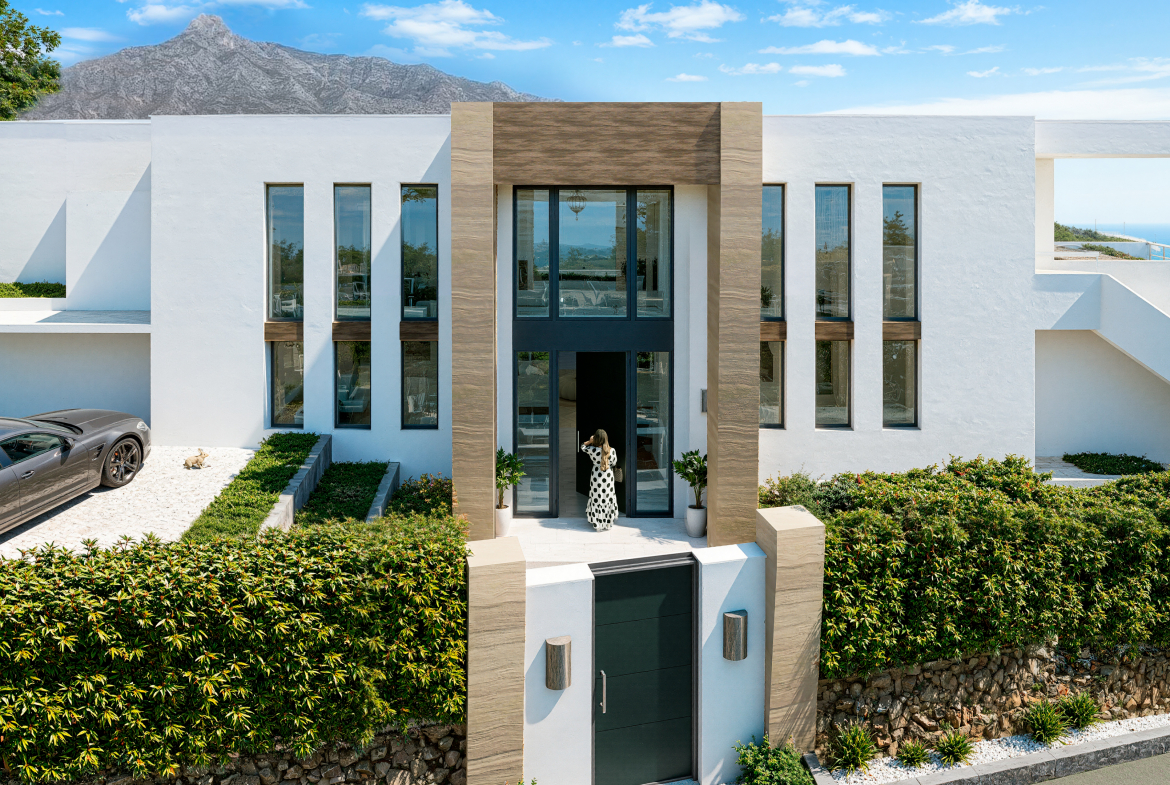
When searching for properties in Marbella, browse by area to understand the micro-market before you fall in love with a specific property:
- Golden Mile properties — €6,329-€24,000+/m²
- Puerto Banús properties — €5,500-€12,000/m²
- Nueva Andalucía properties — €3,200-€5,578/m²
- Sierra Blanca properties — €9,000-€12,000+/m²
- East Marbella properties — €2,500-€4,500/m²
- La Zagaleta properties — from €5M
- Estepona properties — €2,800-€4,200/m²

Step 4: Make an Offer and Agree the Price
Once you have identified a property you wish to buy, your agent submits a written offer on your behalf. In Spain, verbal offers carry no legal weight — everything must be documented in writing. The offer will typically state the offered price, proposed payment structure (cash or with mortgage), any conditions (subject to survey, subject to finance) and the proposed timeline to signing the arras contract.
The vendor may accept, reject or counter-propose. Once a price is agreed in writing and both parties have confirmed their intention to proceed, the process moves to legal due diligence and the arras contract.
Important for non-resident buyers: unlike in the UK, the agreed price is not legally binding until the arras contract (private purchase contract) is signed and the deposit is paid. Between offer and arras, either party can walk away. Speed to arras therefore matters — a seller who has received your offer may also be in negotiation with another buyer, and the first to sign and pay a deposit typically secures the property.
Step 5: Appoint an Independent Spanish Property Lawyer
Hiring an independent Spanish property lawyer (abogado) is not legally required in Spain — but for non-resident buyers, it is as close to essential as anything in this guide. The notary’s role in a Spanish purchase is to verify the deed and formalize the transaction, not to check for legal issues with the property or protect the buyer’s interests. Only your own independent lawyer does that.
Your lawyer will handle:
- Full legal due diligence on the property (see Step 6)
- Reviewing and negotiating the arras contract
- Obtaining your NIE if not already done
- Coordinating with the notary for the escritura
- Paying all purchase taxes on your behalf within the legal deadlines
- Registering the property in your name at the Land Registry
- Transferring utilities and community fee contracts to your name
- Ongoing annual tax compliance if required
While not legally required, hiring a lawyer is strongly recommended — especially for foreign buyers — to ensure legal compliance and protect your interests throughout the transaction. Legal fees typically run at 1% of the purchase price plus 21% VAT — approximately €3,630 on a €300,000 purchase, scaling accordingly for higher-value properties.
Always instruct a lawyer who is completely independent of the selling agent, the developer and the vendor. In the Marbella market, there are excellent English-speaking property law firms with decades of experience specifically in Costa del Sol transactions. Your LUXO agent can provide introductions to vetted independent legal professionals.
Step 6: Due Diligence — What Your Lawyer Checks
This is the most important stage of the entire process and the one that most non-resident buyers underestimate. Spanish property law has some specific characteristics that can create significant problems if due diligence is not thorough. Your lawyer should verify:
| Check | What It Covers | Where It Is Checked |
|---|---|---|
| Legal ownership | Confirms the vendor is the legitimate registered owner with the right to sell | Land Registry (Registro de la Propiedad) |
| Charges and encumbrances | Outstanding mortgages, loans, liens or easements registered against the property | Land Registry |
| IBI and community fee status | All local property taxes and community fees are paid up to date — unpaid IBI follows the property, not the previous owner | Ayuntamiento and community administrator |
| Urban planning compliance | The property is legally built with all required licences; there are no outstanding infraction orders or demolition orders | Ayuntamiento (town hall planning department) |
| First occupation licence/habitability certificate | The property is legally classified as residential and has been granted official permission to be inhabited | Ayuntamiento |
| Cadastral reference value | The official reference value used by Hacienda as the tax base for ITP calculations | Catastro portal |
| Community of owners rules | No restrictions on foreign ownership, holiday rental or other uses the buyer intends; no special levies (derramas) pending | Community administrator |
| Building structure and condition | Independent survey to assess structural condition, necessary repairs, and whether the physical property matches the registered description | Independent surveyor (recommended for older properties) |
For the Marbella luxury market specifically, two additional checks are particularly important: first, that the built surface area matches between the Land Registry and the Catastro (discrepancies are common in older properties and can affect the tax calculation); and second, that any extensions or improvements to the property since original construction have been properly declared and legalised. An unlegalised extension does not automatically prevent a purchase, but it creates ongoing legal risk and should be factored into the price negotiation.
Step 7: Sign the Reservation and Arras Contract
Once due diligence is complete and your lawyer is satisfied, the process moves to the private purchase contracts. There are two stages:
Reservation Contract (Contrato de Reserva)
A reservation contract removes the property from the market while due diligence is completed. It involves a reservation deposit of typically €6,000-€10,000 (for standard Marbella properties) up to €20,000-€50,000+ for luxury properties. This deposit is refundable if the deal does not proceed through no fault of the buyer, but the property is taken off the market for an agreed period — typically two to four weeks.
Arras Contract (Contrato de Arras Penitenciales)
The arras contract is the legally binding private purchase agreement between buyer and seller. It specifies the agreed price, payment terms, deposit amount, conditions, and completion date. The standard deposit at arras is 10% of the purchase price, though this is negotiable and can be higher for luxury properties or where the seller requires greater certainty.
The arras contract has a specific legal consequence under Spanish law that non-resident buyers must understand clearly: if you as the buyer withdraw from the purchase after signing the arras, you forfeit your entire deposit. If the seller withdraws, they must pay you double the deposit you paid. This mutual penalty structure makes the arras contract the point at which the transaction becomes genuinely committed for both parties — which is why thorough due diligence before signing is so important.
Step 8: Arrange Financing (If Needed)
If you are financing part of the purchase with a Spanish mortgage, this must be arranged and, in principle, agreed before you sign the arras contract. Do not sign a purchase contract with a mortgage condition if you have not already received a mortgage in principle from a Spanish bank.
Spanish banks typically lend non-residents between 60% and 70% of the purchase price or valuation (whichever is lower). The remaining 30-40% must be funded from your own resources, plus the full acquisition costs on top. For a €1,000,000 purchase, this means having at least €400,000-€430,000 in cash available before a Spanish mortgage even comes into play.
| Mortgage Feature | Non-Resident Terms (2026) |
|---|---|
| Maximum LTV | 60-70% of purchase price or valuation (lower of the two) |
| Maximum term | Typically 20-25 years for non-residents (vs 30 years for residents) |
| Eligible applicants | All nationalities — income must be provable and declared in home country |
| Documentation required | Passport, NIE, last 2 years’ tax returns, last 6-12 months’ payslips or business accounts, last 6 months’ bank statements, credit report from home country |
| US buyer additional requirement | IRS Form W-9 and FATCA declaration forms |
| Valuation (tasación) | Required — conducted by a bank-approved valuer, typically €400-€700. Bank will lend against the lower of purchase price or valuation. |
| Under 2019 Mortgage Law | Banks now bear most mortgage deed costs, including notary fees for the mortgage deed and Land Registry inscription of the mortgage — you do not pay these. |
Step 9: Sign the Escritura at the Notary
The completion of a Spanish property purchase takes place at a notary (notario) — a state-appointed public official who verifies the identity of both parties, confirms the transaction complies with Spanish law, and officially records the transfer of ownership in a public deed (escritura pública de compraventa).
On the day of completion:
- Both buyer and seller (or their legal representatives with power of attorney) attend the notary in person.
- The notary reads the full deed aloud and confirms both parties understand and agree the terms.
- The balance of the purchase price (total price minus the arras deposit already paid) is transferred — typically via a bank cheque (cheque bancario) issued by your Spanish bank, or by wire transfer confirmed on the day.
- Both parties sign the escritura.
- The notary retains the original deed and provides the buyer with a notarised copy.
- The buyer pays the notary fees on the day.
Your lawyer will attend alongside you and will have reviewed the deed in advance to confirm it matches the agreed terms. Notary fees in Spain are regulated by the Spanish government and range from approximately €600 to €1,200 depending on the property value — all notaries charge identical regulated rates for the same services.
Note on power of attorney: if you cannot attend completion in person — which is common for non-resident buyers who may be overseas on the completion date — you can grant your lawyer a power of attorney (poder notarial) to sign the escritura on your behalf. This is entirely standard and legally valid in Spain.
Step 10: Pay Taxes and Register the Property
After signing the escritura, your lawyer handles three final obligations:
- Payment of purchase taxes — must be paid to the relevant regional tax authority within 30 calendar days of signing the title deed at the notary. Late payment incurs surcharges of 1%-20% depending on the delay, plus interest. Your lawyer will manage this deadline.
- Registration at the Land Registry (Registro de la Propiedad) — the notary sends the deed electronically; your lawyer follows up to ensure registration is completed and you receive the final registered deed. This process typically takes two to six weeks after completion.
- Transfer of utilities — electricity (Endesa, Iberdrola), water, internet and community fee contracts are transferred to your name. Your lawyer or gestoría handles this.
Full Cost Breakdown: Taxes and Fees in Andalusia (2026)
Andalusia — the autonomous community in which Marbella is located — has one of the most buyer-friendly tax regimes in Spain. The Costa del Sol stands out when comparing purchase costs across Spanish regions. In regions like Valencia or Catalonia, the Property Transfer Tax on resale homes can reach 10%. A €500,000 purchase in Valencia incurs approximately €50,000 in ITP — compared to €35,000 on the Costa del Sol. That is a €15,000 saving simply by choosing Andalusia, which can be reinvested into furniture or renovations.
Resale Property (ITP Route)
| Cost | Rate in Andalusia | Detail |
|---|---|---|
| ITP (Impuesto de Transmisiones Patrimoniales) | 7% flat | Applied to the higher of the purchase price or the cadastral reference value. Andalusia applies a flat 7% ITP confirmed for 2025-2026, down from the previous rate that reached 10% in earlier years. Paid via Modelo 600 to ATAG within 30 days of signing. |
| Notary fees | ~0.2-0.5% (regulated) | Government-regulated rates — all notaries charge identical fees. Range approximately €600-€1,200 depending on property value. |
| Land Registry fees | ~0.1-0.25% | Cost of registering the deed at the Registro de la Propiedad. Typically €400-€800. |
| Legal fees (abogado) | ~1% + 21% VAT | Industry standard. On a €500,000 property: approximately €6,050 incl. VAT. |
| Gestoría (if separate from lawyer) | €200-€500 | Administrative processing of taxes and registry if your lawyer does not handle these directly. |
| Total additional costs (resale) | ~10-11% | Budget 10-11% on top of the purchase price for a resale property in Andalusia. |
New Build Property (VAT Route)
| Cost | Rate | Detail |
|---|---|---|
| IVA (VAT) | 10% | Applied to the purchase price. Non-reclaimable by individual buyers. |
| AJD (Stamp Duty / Actos Jurídicos Documentados) | 1.2% in Andalusia | Applied to the purchase price on the notarised deed. Andalusia AJD rate is 1.2%. |
| Notary fees | ~0.2-0.5% | Same regulated rates as for resale. |
| Land Registry fees | ~0.1-0.25% | Same as resale. |
| Legal fees | ~1% + 21% VAT | Same as resale. |
| Total additional costs (new build) | ~13-14% | New builds cost slightly more in taxes due to VAT + AJD replacing ITP. |
Worked Examples at Three Price Points
Example A: €500,000 Resale Apartment — Nueva Andalucía
| Item | Amount |
|---|---|
| Purchase price | €500,000 |
| ITP (7%) | €35,000 |
| Notary fees | €1,000 |
| Land Registry | €600 |
| Legal fees (1% + VAT) | €6,050 |
| Total acquisition cost | €542,650 |
| Additional costs as % of price | 8.5% |
Example B: €1,500,000 Resale Villa — Golden Mile
| Item | Amount |
|---|---|
| Purchase price | €1,500,000 |
| ITP (7%) | €105,000 |
| Notary fees | €1,200 |
| Land Registry | €800 |
| Legal fees (1% + VAT) | €18,150 |
| Total acquisition cost | €1,625,150 |
| Additional costs as % of price | 8.3% |
Example C: €5,000,000 New Build Villa — Sierra Blanca
| Item | Amount |
|---|---|
| Purchase price | €5,000,000 |
| IVA / VAT (10%) | €500,000 |
| AJD stamp duty (1.2%) | €60,000 |
| Notary fees | €1,500 |
| Land Registry | €1,000 |
| Legal fees (1% + VAT) | €60,500 |
| Total acquisition cost | €5,623,000 |
| Additional costs as % of price | 12.5% |
Resale vs. New Build: How the Costs and Process Differ
| Resale Property | New Build Property | |
|---|---|---|
| Main tax | ITP — 7% in Andalusia | IVA (10%) + AJD (1.2%) = 11.2% |
| Total acquisition costs | ~10-11% on top of price | ~13-14% on top of price |
| Payment structure | Typically 10% at arras, balance at notary | Staged payments: reservation → 20-30% during build → balance at completion |
| Due diligence risk | Unlegalised extensions, outstanding debts, IBI arrears | Developer insolvency risk, delivery delays, off-plan changes |
| Legal protection for buyer | Standard arras penalties (forfeit/double return) | Bank guarantee required by law to protect stage payments |
| Structural guarantee | None (property already built and sold) | 10-year structural guarantee from developer required by law |
| Customisation | None — you buy as-is | Often possible to select finishes and layouts during build phase |
| Completion timeline | Typically 4-10 weeks from offer to keys | 6 months to 2+ years depending on build stage |
Ongoing Tax Obligations After Purchase
Buying a property in Marbella as a non-resident creates ongoing annual tax obligations, whether or not you rent the property out. Understanding these before you buy prevents surprises later.
| Tax | Who Pays | Rate / Amount | Filing Deadline |
|---|---|---|---|
| IBI (Impuesto sobre Bienes Inmuebles) | All property owners | 0.4-1.1% of cadastral value annually. For a €1.5M Marbella villa, typically €2,000-€4,500/year. | Annual, set by each Ayuntamiento. Direct debit strongly recommended. |
| Imputed income tax (IRNR) — vacant periods | Non-resident owners who do not rent the property | 1.1% of cadastral value × tax rate. EU/EEA residents: 19%. Non-EU (incl. UK post-Brexit): 24%. | 31 December of the year following the tax year (i.e., 2025 tax year due 31 Dec 2026) |
| IRNR on rental income | Non-residents who rent the property | EU/EEA: 19% on net income (expenses deductible). Non-EU: 24% on gross income (no expense deduction). | Quarterly (Modelo 210) within 20 days of end of each quarter |
| Community fees (cuota de comunidad) | All owners in developments/urbanisations | Varies widely — €100-€500+/month depending on community | Monthly or quarterly direct debit. Set up immediately after purchase. |
| Wealth tax (Impuesto sobre el Patrimonio) | Largely abolished for residents in Andalusia; non-residents: potential exposure on Spanish assets | Consult specialist tax adviser — rules and exemptions vary by status | Typically aligned with annual income tax declaration |
| 3% withholding on sale | Buyer withholds from seller at time of purchase (if seller is non-resident) | 3% of total sale price withheld and paid to AEAT via Modelo 211 within one month of the sale | Not applicable at purchase — relevant when you eventually sell |
For a deeper dive into the rental income tax treatment, our holiday rental ROI and tax guide covers the numbers by residency status in detail.
Currency Exchange: Protecting Your Budget
For non-resident buyers purchasing in euros from a non-euro currency — British pounds, US dollars, Norwegian or Swedish kroner, UAE dirhams — currency exchange is one of the most financially significant decisions of the entire purchase process, and one of the least discussed.
Currency rates can change the real cost of your home by tens of thousands of euros. GBP/EUR moving from 1.16 to 1.12 on a £500,000 budget changes your purchasing power by €20,000. USD/EUR shifts throughout 2024 led to 8-12% swings, altering affordability dramatically.
| Currency Strategy | How It Works | Best For |
|---|---|---|
| Spot transfer (standard bank transfer) | Convert at today’s rate when you need the funds | Small amounts or when rates are currently favourable |
| Forward contract | Lock in today’s rate for a future transfer date (typically up to 12 months). Requires a small deposit. | When you have signed arras and know your completion date — protects against rate movement |
| Limit order | Instruction to convert automatically when rate hits your target | When you have time and a specific rate target in mind |
| Specialist FX provider | OFX, Moneycorp, Currencies Direct, Wise — typically 0.5-2% cheaper than high street banks on large transfers | All non-euro buyers — the saving on a €500,000 transfer vs. a bank can be €5,000-€10,000 |
The optimal strategy for most non-resident buyers: once you have signed an arras contract and confirmed your completion date, use a specialist FX provider to set a forward contract locking in today’s exchange rate for the balance payment due at the notary. This eliminates the risk of the rate moving against you between arras and completion — a period that typically runs four to eight weeks for resale properties.
The 8 Most Expensive Mistakes Non-Resident Buyers Make
- Not getting the NIE early enough. Delays in obtaining the NIE are the single most common reason purchase timelines extend beyond the arras deadline. Start the process at the beginning of your property search, not when you have found a property.
- Using the selling agent’s recommended lawyer. In Spain, dual agency (where the same professional acts for both parties) is unfortunately not uncommon. Always instruct an independent lawyer — one who is not commercially connected to the agent or developer.
- Underestimating total acquisition costs. Total costs add 10-15% to the purchase price. A property listed at €800,000 will cost approximately €880,000-€915,000 all-in. Budget for this before you start viewing.
- Skipping the independent survey. The notary does not inspect the physical condition of the property. Your lawyer checks the legal position. Neither tells you if the roof needs replacing, the pool has structural issues, or the electrical system is non-compliant. An independent survey (peritaje) typically costs €500-€1,500 and is money very well spent, particularly for older properties.
- Signing the arras before due diligence is complete. Once you have signed and paid a 10% arras deposit, you have lost it if you withdraw. Completing thorough legal due diligence before signing the arras is non-negotiable.
- Use your standard bank for currency exchange. For large transfers, the difference in exchange rate between a high-street bank and a specialist FX provider can easily run to €10,000-€20,000 on a mid-to-large Marbella purchase.
- Overlooking the ongoing tax obligations. Buying a non-resident property in Spain creates annual tax obligations regardless of whether you rent it out. Failing to file the imputed income tax (IRNR) creates back-tax exposure with interest and surcharges.
- Buying without checking community fee status. Unpaid community fees do not follow the seller — they follow the property. Always instruct your lawyer to obtain a community administrator’s certificate confirming zero arrears before signing the arras.
Full Timeline: From Search to Keys
| Stage | Typical Duration | Key Actions |
|---|---|---|
| Pre-search preparation | 4-12 weeks | NIE application, Spanish bank account, appoint lawyer, define total budget |
| Property search and viewings | Variable (days to months) | Define area priorities, view properties with LUXO agent, compare options |
| Offer and negotiation | 1-2 weeks | Submit written offer, negotiate price and terms |
| Reservation contract | 1 day | Pay reservation deposit (€6,000-€50,000 depending on price), property taken off market |
| Due diligence | 2-4 weeks | Lawyer checks Land Registry, Ayuntamiento, Catastro, IBI status, community, structure |
| Arras contract | 1 day | Sign arras, pay 10% deposit (less reservation already paid) |
| Mortgage arrangement (if applicable) | 3-6 weeks | Bank valuation, mortgage approval, documentation |
| Notary preparation | 1-2 weeks | Lawyer reviews draft escritura, confirms funds transfer, notary appointment |
| Completion (escritura) | 1 day | Sign at notary, pay balance, receive keys |
| Post-completion | 4-6 weeks | Pay taxes (ITP or VAT+AJD within 30 days), Land Registry registration, utility transfers |
| Total (cash purchase) | 8-16 weeks typically | Faster possible if NIE is ready and due diligence is clean |
| Total (with mortgage) | 12-20 weeks typically | Mortgage process adds 4-8 weeks to timeline |
Frequently Asked Questions
Can a non-resident buy property in Marbella without a Spanish bank account?
Technically, it is possible to transfer funds via an international wire directly, but in practice a Spanish bank account is required to pay taxes, set up ongoing direct debits for IBI and community fees, and manage all post-purchase financial obligations in Spain. Opening a Spanish account should be one of the first steps you take.
What is the ITP rate for Marbella in 2026?
Andalusia applies a flat 7% ITP on resale property transactions, confirmed for 2025-2026. This is calculated on the higher of the declared purchase price or the official cadastral reference value of the property.
Do I need to be present at the notary in person?
No. If you cannot attend completion in person — which is common for non-resident buyers — you can grant your Spanish lawyer a notarised power of attorney (poder notarial) to sign the escritura on your behalf. This is entirely standard and legally valid.
How long does the full purchase process take?
For a cash purchase with a clean due diligence result, the process from offer to keys typically takes 8-16 weeks. Mortgage purchases typically add 4-8 weeks for the bank valuation and mortgage approval process.
What happens to my deposit if the seller withdraws?
Under the standard arras penitenciales structure, if the seller withdraws after signing the arras contract, they must pay you double the deposit you paid. If you withdraw, you forfeit the deposit. This mutual penalty structure is the standard for Spanish property transactions.
Are there any taxes on buying a new build versus a resale property?
Yes — significantly. Resale properties attract ITP at 7% in Andalusia. New builds attract IVA (VAT) at 10% plus AJD stamp duty at 1.2% — total 11.2%. New builds therefore cost approximately 4-5% more in acquisition taxes than resale properties.
Do I pay tax as a non-resident if I don’t rent my Marbella property out?
Yes. Even if you leave the property vacant and earn no rental income, you are required to file an annual imputed income tax return (IRNR) via Modelo 210, declaring notional income equal to 1.1% or 2% of the property’s cadastral value. The tax rate is 19% for EU/EEA residents and 24% for non-EU residents, including UK nationals post-Brexit.
Can UK nationals buy property in Spain post-Brexit?
Yes. Brexit has no impact on the right of UK nationals to purchase property in Spain. The buying process and rights of ownership are identical to those of other non-EU buyers. The post-Brexit differences relate to visa requirements if you wish to live in Spain long-term — see our complete expat guide to moving to Marbella for residency options.
Ready to buy your property in Marbella?
At LUXO Estates, we guide non-resident buyers through every step of the Marbella purchase process — from finding the right property in the right neighbourhood to introducing you to vetted independent lawyers, tax advisors and currency specialists. Our service is transparent, our knowledge is local and our listings cover the full market.
Browse all Marbella properties → |
Golden Mile → |
Nueva Andalucía → |
La Zagaleta → |
Speak with our team →