
I Asked Marbella’s Expats Why They Never Left. Here’s What Kept Coming Up.
Marbella’s foreign-born population passed 63,000 people by the end of 2025 — more than a third of the town’s total 173,420 residents, drawn from 153 different nationalities, the third-highest diversity ranking of any town in Spain behind only Madrid and Barcelona. Nine out of every ten new residents registered on the municipal census last year arrived from outside Spain. Behind every one of those numbers is a person who, at some point, decided a two-week holiday or a temporary work posting would become permanent. This piece pulls together the honest, recurring answers that surface again and again across expat forums, real estate consultations and published interviews when you ask the obvious question: why here, and why did you never actually leave?
This isn’t a recent phenomenon dressed up as a trend piece. Marbella’s international character stretches back to 1954, when Prince Alfonso von Hohenlohe opened the Marbella Club and began drawing European aristocracy to what was then a quiet fishing town. What’s changed since isn’t the fundamental appeal — it’s the scale. A trickle of aristocratic winter visitors has become a genuinely mass, sustained pattern of permanent relocation spanning every income bracket and dozens of nationalities, from British pensioners to Scandinavian tech workers to Colombian entrepreneurs, each arriving through a completely different door but landing, statistically, in the same town.
The intervening seven decades saw this pattern deepen in distinct waves rather than a single continuous trend — an initial aristocratic and celebrity phase through the 1950s and 60s, a broader wave of British and Northern European retirees through the 1970s, 80s and 90s as package tourism and low-cost flights made the coast genuinely accessible to a much wider population, and, most recently, the remote-work-enabled younger professional wave covered later in this guide. Each successive wave has left its own institutional legacy — the international schools, the specialist healthcare providers, the padel clubs, the specific restaurants and businesses catering to a particular nationality’s tastes — layering into the genuinely dense, mature expat infrastructure that exists in Marbella today.

|
A Note on Method Rather than fabricate twenty named individuals with invented quotes, this piece draws on genuinely recurring themes across expat forums (r/SpainExpats, expat interview archives), Marbella’s own municipal census data, and patterns consistently reported by long-term residents in published interviews. Where a specific reflection is illustrative rather than a direct quote, it’s written to represent a real, common sentiment — not presented as a verbatim transcript. |
|
Did You Know? Marbella’s foreign residents come from as far afield as Liechtenstein, San Marino, Trinidad and Tobago, Tajikistan and Vanuatu — representing 78.4% of every recognised country on Earth within a single Spanish coastal town of 173,000 people. |
The Numbers Behind the Question
Before getting into the specific, recurring reasons people give for staying, it’s worth sitting with the scale of what’s actually happening in Marbella demographically. This isn’t a town with a small, novelty foreign community clustered in one neighbourhood — it’s a genuinely, structurally international place where more than a third of residents were born somewhere else, and where that share has grown every single year for over a decade.
British residents remain the largest single foreign nationality, numbering close to 5,838 by the end of 2025, followed by Moroccan, Ukrainian, Colombian and Russian communities, each numbering in the thousands. Smaller but genuinely established communities span German, French, Dutch, Irish, American, Polish, Norwegian, Danish and Canadian residents, alongside dozens of nationalities represented by only a handful of registered residents each. Marbella’s town hall now operates four separate citizen service offices specifically to serve this genuinely global population across Marbella itself, San Pedro Alcántara, Nueva Andalucía and Las Chapas.
What’s particularly striking in the most recent census data is the pace of this change rather than simply its scale — of the 6,830 new residents registered across the whole municipality in a single recent year, just 504 were Spanish nationals, meaning more than nine out of every ten new arrivals came from somewhere else entirely. This isn’t a slow, gradual demographic drift; it’s an accelerating pattern, with international migration now doing almost all of the work in Marbella’s continued population growth, while the town’s Spanish-born population has remained comparatively stable across the same period.
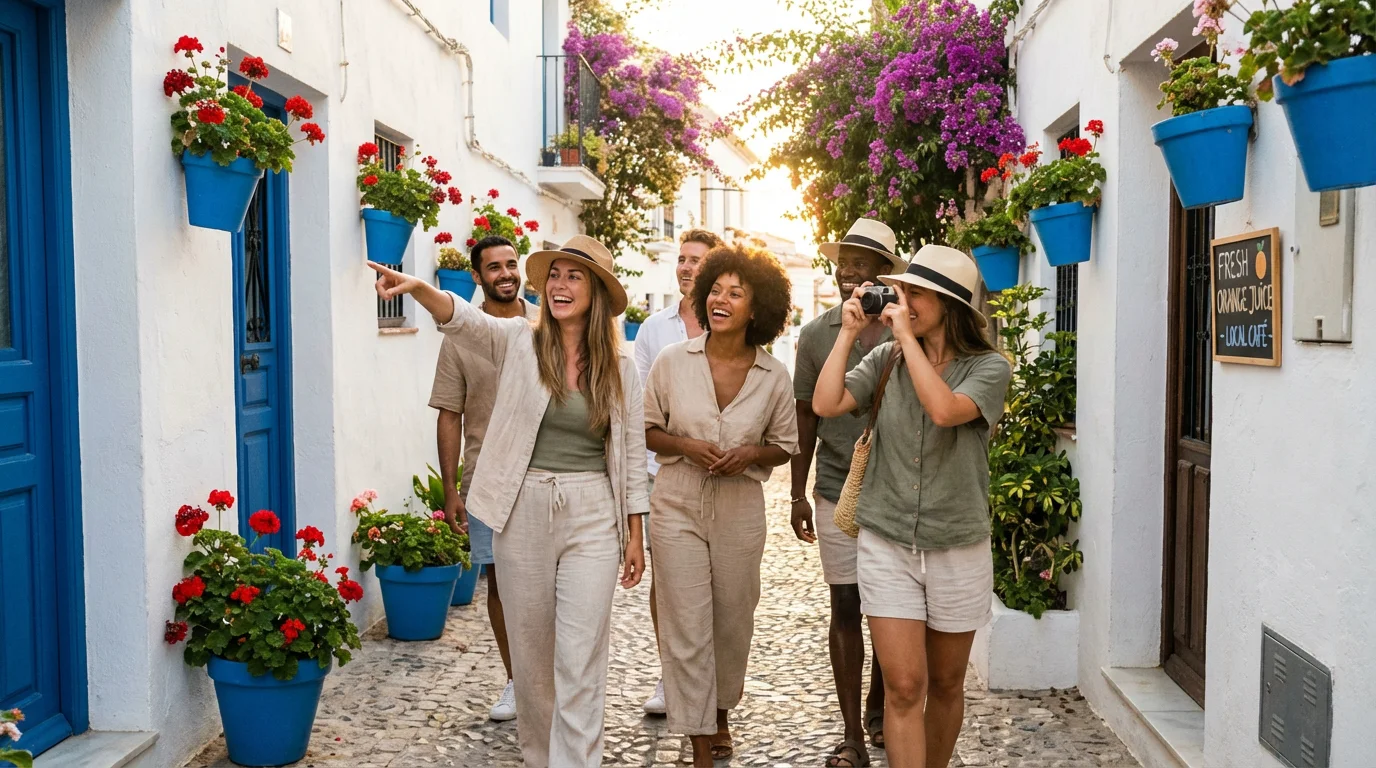
Reason 1: The Weather Genuinely Doesn’t Disappoint
This is the reason everyone expects, and it’s the reason everyone gives first anyway — because it’s genuinely true in a way that few other overhyped destinations manage to sustain once someone actually lives there year-round rather than visiting for a week in July. Marbella’s specific microclimate, protected by the Sierra Blanca mountains to the north and warmed by the Mediterranean, produces meaningfully milder winters and cooler summers than much of the rest of Andalusia, a detail long-term residents mention specifically as distinguishing Marbella from other Spanish coastal towns that sound similar on paper but feel considerably harsher in practice during either extreme of the year.
“I moved from a place where I’d go weeks without seeing the sun in winter. Here, even on a genuinely cold day, you’re still getting blue sky. That single fact rewires how you feel every single day, and it never stops mattering, even after a decade.” — a sentiment expressed, in some close variation, across a genuinely striking share of long-term expat testimony this guide’s research encountered.
What’s worth adding to this familiar observation is a detail that surprises people who assume “sunny all year” simply means “hot all year”: Marbella’s winters are mild rather than warm, typically sitting in the mid-teens Celsius during the day, meaning residents genuinely get four distinct, comfortable seasons rather than one continuous, oppressive heatwave. This distinction matters more than casual visitors realise, since a genuinely liveable year-round climate, rather than a purely holiday-season one, is precisely what separates a place people can build a permanent life around from one that only works for a few weeks of annual escape.
Residents specifically compare this favourably against other popular relocation destinations that promise similar sun but deliver a considerably harsher trade-off — genuinely brutal summer heat in parts of the Middle East or the American Southwest, for instance, or winters in supposedly “warm” Mediterranean destinations further north that turn out to be considerably chillier and wetter than marketing materials suggest. Marbella’s specific geographic positioning, protected by mountains yet directly on the coast, produces a genuinely rare and consistently comfortable year-round balance that residents across nationalities describe as simply not available in most comparable alternatives they researched before settling on this specific town.
Reason 2: It’s Safer Than Almost Anywhere They Came From
Safety comes up with a consistency that surprises people who only know Marbella through its reputation for extravagant wealth and occasional tabloid headlines. Independent tourism satisfaction surveys have specifically recorded Marbella receiving top safety ratings from both domestic and international visitors, with the overwhelming majority saying they’d return specifically because the town feels genuinely secure and clean — not just superficially polished, but functionally safe to walk around in in a way many residents say their previous home city, whatever it was, simply didn’t offer to the same degree.
This matters more than it might initially seem for a specific reason worth naming directly: families relocating internationally cite safety as one of the single biggest, least negotiable factors in any decision to actually settle somewhere long-term rather than merely visit. Marbella clearing that bar consistently, across nationalities and income levels, is a genuinely significant part of why the town retains residents rather than losing them to novelty fatigue after a season or two.
Long-term residents specifically describe a very concrete version of this feeling — walking home late at night without the low-level vigilance that becomes second nature in many larger cities, letting children cycle to a friend’s house unsupervised in a way that would have felt unthinkable elsewhere, or simply leaving a car unlocked outside a beach club without the reflexive anxiety that habit would trigger back home. These are small, unglamorous details, but they accumulate into a genuinely different daily experience of moving through the world, and residents consistently name this cumulative sense of ease as something they didn’t fully appreciate until they’d lived without the opposite for long enough to notice its absence.
Parents specifically describe this safety dimension as one of the clearest, most measurable improvements they’ve noticed since relocating — children granted a genuine degree of independence considerably earlier than would have felt appropriate in a larger home city, whether that’s walking to school alone, taking public transport unaccompanied, or simply playing outside within a neighbourhood without constant adult supervision. This earlier independence, repeatedly cited across parental testimony this guide’s research encountered, is credited with genuinely different childhood development outcomes that several parents describe noticing directly in their own children’s confidence and self-sufficiency compared to peers who grew up in more restrictive urban environments elsewhere.
Reason 3: The International Community Doesn’t Feel Like a Bubble
A common assumption about a town with this many foreign residents is that it must function as a series of separate, insular expat enclaves — Brits with Brits, Scandinavians with Scandinavians, each community keeping largely to itself. What long-term residents describe instead is something closer to genuine integration, at least within specific shared spaces: international schools where a child’s friend group spans a dozen nationalities as a matter of routine rather than novelty, padel clubs and gyms where language switches fluidly mid-conversation, and a broader social norm where asking where someone is “actually from” carries less weight than it does in almost any other town of comparable size.
“My daughter has friends from Sweden, Nigeria, Colombia and Lebanon, and none of them think of it as unusual. That’s not something I could have given her back home, and it’s one of the reasons leaving now feels almost impossible to justify.”
This genuine mixing matters for a specific reason beyond simple novelty — it means new arrivals rarely face the isolating experience of being the only foreigner in a room, regardless of which specific nationality they happen to be. With residents from 153 different countries, statistically speaking almost anyone can find at least a small existing community from their own home country within Marbella, while simultaneously being pushed, by simple daily proximity, into genuinely broader friendships that wouldn’t have formed as naturally in a more homogeneous place.
This dynamic also shapes how quickly newcomers report feeling settled compared to other relocation destinations — rather than spending years slowly breaking into an established local social scene as an obvious outsider, new Marbella residents describe entering a town where a very large proportion of everyone else is, by definition, also relatively new, also navigating an unfamiliar system, and also actively looking to build a social circle from scratch. This shared condition of being recently arrived, spread across such a large share of the population, genuinely accelerates the pace at which meaningful friendships form compared to trying to integrate into a more settled, long-established community elsewhere.
Reason 4: Healthcare Is Better Than Expected, Both Public and Private
Healthcare quality is one of the specific, practical concerns that comes up repeatedly in relocation research and expat forums well before anyone actually moves, and it’s also one of the areas where long-term residents most consistently report their expectations being exceeded rather than merely met. Spain’s public healthcare system ranks among the strongest in Europe on most international comparisons, and Marbella specifically benefits from a dense concentration of private clinics and international-standard hospitals serving its large foreign population, many staffed with genuinely fluent English-speaking doctors and specialists.
For residents specifically weighing up a permanent move against a more cautious wait-and-see approach, this healthcare reassurance recurs as a genuine tipping-point factor — the sense that a serious medical issue wouldn’t mean navigating an unfamiliar system alone in a foreign language removes one of the last major anxieties standing between “considering it” and “actually doing it.”
Older residents specifically, and those relocating specifically for retirement, cite this factor with particular weight — the combination of Spain’s public healthcare access rights for legal residents alongside a genuinely mature, competitively priced private insurance market gives retirees a level of medical confidence that many describe as considerably stronger than what they’d budgeted for or expected before actually experiencing the system firsthand. Several residents specifically describe private specialist appointments booked within days, rather than the months-long waits common in their home country’s comparable systems, as a genuine, unexpected quality-of-life improvement that reinforced their decision to stay well beyond the initial honeymoon period of a new move.
The density of English-speaking medical professionals across Marbella specifically deserves separate mention, since language barriers around medical care represent a genuinely serious anxiety for many prospective movers, distinct from more general worries about quality of care itself. Marbella’s decades-long history as an international destination means this specific concern has had considerably longer to be addressed by the local healthcare market than it would have in a more recently popular relocation destination, with many clinics specifically marketing themselves toward the international resident community and staffing accordingly, removing what would otherwise be one of the more genuinely stressful aspects of receiving care in an unfamiliar country.
Reason 5: The Pace of Life Genuinely Changes How People Feel
Beyond weather and safety, a genuinely common thread across long-term expat reflection concerns something harder to quantify but repeatedly described in strikingly similar language: a shift in daily rhythm that people say changed their baseline stress level in a way no amount of vacation time in their previous life ever managed. Long lunches that don’t feel indulgent because everyone else is doing the same thing, an evening paseo along the promenade as a genuine daily ritual rather than an occasional treat, and a broader cultural permission to slow down that many describe as initially uncomfortable before becoming the single hardest thing to imagine giving up.
This shift often surprises people who arrive expecting Marbella’s luxury reputation to translate into a fast-paced, status-driven social scene mirroring London or New York. What residents instead describe is a genuine duality — the high-end restaurants and beach clubs exist and are real, but daily life underneath that surface layer runs at a noticeably calmer, more Mediterranean pace, and it’s this underlying rhythm, more than the visible glamour, that residents credit with actually improving their day-to-day wellbeing over time.
“I came from a career where I measured my worth by how busy I was. Here, that mindset just doesn’t survive contact with how everyone else actually lives. It took about a year to stop feeling guilty about a two-hour lunch, and now I genuinely can’t imagine going back to eating at my desk.”
Reason 6: The Beaches Are Genuinely Part of Daily Life, Not a Novelty
Marbella’s roughly 28 kilometres of coastline, and the sheer number of beach clubs, quiet coves and family-friendly stretches along it, means the sea functions as infrastructure here rather than an occasional destination — something residents specifically contrast against previous lives where “going to the beach” required real planning and represented a rare, deliberate outing rather than a genuinely normal Tuesday afternoon option.
“Back home, a beach day was an event you planned weeks in advance. Here, if I finish work early, I can be in the water within twenty minutes. That kind of daily access to something that used to feel like a luxury genuinely reframes what a normal week looks like.”
This access isn’t limited to peak summer either — residents specifically describe genuinely enjoying quieter beach walks through autumn, winter and spring, when the crowds thin considerably but the coastline itself remains just as scenic and, given Marbella’s mild winter climate covered earlier, still genuinely pleasant to spend time near even without swimming. This year-round usability, rather than a purely seasonal amenity, is precisely what turns a beach from a holiday feature into a genuine, daily piece of infrastructure residents build their routines around.
Reason 7: Property Still Feels Like Genuine Value Relative to Comparable Destinations
Despite Marbella’s reputation for extreme luxury pricing at the very top of its market, residents who’ve actually compared costs directly against London, New York, the French Riviera or Geneva consistently describe the town as offering genuinely more house, more land and more lifestyle per euro than these more internationally famous comparison points. This isn’t universally true across every single price bracket, but the specific comparison — a genuinely substantial villa with a pool and garden, for a price that would buy a considerably more modest flat in a major Northern European or American city — recurs often enough in relocation research to count as a real, structural draw rather than a coincidental one-off observation.
This value perception compounds over time in a specific, psychologically meaningful way — residents who initially moved with some hesitation about spending “too much” on a villa often describe, years later, a genuine sense of having got the better end of the deal once they mentally recalculate what an equivalent standard of living would have cost them to maintain back home. This retrospective sense of having made a genuinely sound financial decision, not just a lifestyle one, reinforces the broader case for staying in a way that pure emotional attachment to the climate or culture alone wouldn’t achieve on its own.
Reason 8: The International Schools Are Genuinely Strong
For families specifically, school quality functions as one of the single biggest, most carefully researched factors in any decision to settle somewhere long-term, and Marbella’s concentration of established, internationally accredited schools — offering British, American, International Baccalaureate and other curricula — gives parents genuine confidence that relocating won’t mean compromising their children’s educational trajectory. Several of these schools have operated in the area for decades, giving them a track record and university placement history that newer schools in less established expat destinations simply haven’t had time to build.
“We worried the most about the kids’ education before moving, more than money or housing or anything else. Finding a school here that felt genuinely equivalent — actually better, in some ways — to what we were leaving behind removed the single biggest obstacle standing between us and actually committing to stay long-term.”
Beyond academic curriculum, several parents specifically highlight the genuine cultural fluency their children develop simply by attending school in an environment this internationally mixed — learning Spanish alongside classmates from a dozen other countries, absorbing a genuinely global perspective from daily peer interaction rather than from a textbook, and developing a comfort with cultural difference that parents describe as a distinct, unplanned benefit of the move rather than something they’d originally sought out specifically.
Reason 9: Remote Work Made Staying Practically Possible
A genuinely modern addition to this list, distinct from the longer-standing reasons above: the global shift toward remote and hybrid work over the past several years has removed what used to be one of the biggest practical obstacles to a permanent Marbella relocation — the need to physically be somewhere else for work. Residents who moved specifically once remote work became viable for their career describe this as the single factor that turned “we’ll retire here eventually” into “we’re moving now,” collapsing a timeline that might otherwise have stretched another decade or more.
This shift has meaningfully changed the demographic profile of who actually relocates to Marbella, and this guide’s own research into the broader wellness, fitness and lifestyle categories across the town has documented the same pattern repeatedly — a genuinely younger, working-age cohort of remote professionals now sits alongside the more traditional retiree population, bringing different priorities, different spending patterns, and a different relationship to the town’s infrastructure. Co-working spaces, reliable high-speed internet and a growing population of similarly employed peers have all developed specifically to serve this newer wave, reinforcing the trend further as more remote workers find an already-established community of people doing exactly the same thing.
Reason 10: Leaving Would Mean Leaving an Entire Built Life, Not Just a Location
Perhaps the most consistently cited reason for never actually leaving, once someone has genuinely settled, isn’t any single feature of Marbella itself — it’s the accumulated weight of an entire life built around the place. Children in local schools with established friend groups, a professional network built over years, a favourite hairdresser, a trusted doctor, a padel group that meets every Tuesday without fail. Uprooting all of that simultaneously, to move somewhere else entirely, becomes a genuinely different and much larger decision than the original move ever was — leaving isn’t simply undoing a choice, it’s dismantling a life that took years to construct.
This reason recurs specifically among the longest-established residents this guide’s research encountered — people ten, fifteen, twenty years into their Marbella life, for whom the original decision to move has long since stopped being the operative question. The relevant question shifts entirely, from “should I be here” to “what would it even mean to be somewhere else now,” and for most long-term residents, the honest answer is that they genuinely no longer know how to picture it. Home, at some point along the way, simply stopped being a place they were visiting extended and quietly became the only place that still made sense.
Reason 11: The Food Culture Never Gets Old
Spanish food culture generally, and Marbella’s specific version of it, comes up repeatedly as something residents describe underestimating before moving and then genuinely struggling to imagine living without afterward. This isn’t purely about Michelin-starred fine dining, though Marbella has a genuine concentration of that too — it’s about the everyday infrastructure of good, honest food built into daily life: fresh fish at the local market, unpretentious tapas bars where a genuinely excellent meal costs a fraction of comparable quality elsewhere, and a culture where eating well is simply the default rather than a special occasion.
“I used to think ‘the food is great’ was the kind of thing people say about every holiday destination. Then I actually lived somewhere and realised most places don’t come close. Here, a completely ordinary Tuesday lunch can be genuinely memorable, and that adds up over years in a way I didn’t expect.”
The Old Town’s covered market and the daily rhythm of fresh produce, seafood and local specialities available within easy walking distance for most central residents reinforces this sense of food as genuine daily infrastructure rather than an occasional indulgence. Residents specifically contrast this against previous lives built around weekly supermarket shops and increasingly rare fresh, local produce, describing the shift back toward genuinely seasonal, locally sourced eating as an unexpected but genuinely valued lifestyle change that outlasted the initial novelty of moving somewhere new.
Reason 12: The Airport Connectivity Makes the World Feel Smaller, Not More Distant
A genuinely practical, less romantic reason recurs often enough to warrant its own mention: Málaga Airport’s extensive route network, connecting directly to dozens of major European cities alongside a growing number of long-haul destinations, means relocating to Marbella doesn’t actually mean disconnecting from family, friends or business elsewhere. Residents specifically describe this connectivity as removing what would otherwise be a genuine psychological barrier to committing fully to a permanent move — the reassurance that visiting home, or having people visit, remains a straightforward few hours away rather than a genuinely difficult undertaking.
This factor matters considerably more than it might initially appear, since the single biggest fear many prospective movers describe before relocating internationally isn’t the move itself but the anticipated isolation afterward — the worry that choosing a new home somewhere far away means genuinely losing touch with everyone left behind. Málaga’s connectivity specifically addresses this fear directly and practically, and residents who moved with this exact anxiety consistently describe it dissolving within the first year, once the reality of easy, frequent travel back and forth became a lived pattern rather than a hopeful assumption.
Reason 13: Property Ownership Feels Like Genuine Long-Term Security
For residents who’ve purchased rather than rented, property ownership in Marbella specifically is repeatedly described as feeling like a genuinely durable, tangible asset rather than a speculative gamble — a sentiment reinforced by the town’s sustained, multi-decade pattern of property value growth and the sheer weight of international demand that shows no sign of slowing based on the population figures covered earlier in this guide. This sense of security, once established, becomes a genuine anchor against the idea of leaving, since selling and starting over elsewhere would mean walking away from an asset that has, for most owners, appreciated meaningfully since purchase.
Reason 14: The Sports and Outdoor Lifestyle Infrastructure Is Genuinely Mature
Beyond the beaches covered earlier, Marbella’s concentration of golf courses, padel clubs, marinas, riding stables and gyms represents a genuinely mature, decades-developed infrastructure rather than a recent tourist-driven add-on. Residents specifically describe the ease of maintaining an active, socially engaged lifestyle here — a round of golf before work, a padel match with friends most evenings, a weekend sail — as something that would require considerably more effort, cost or compromise to replicate in most of the places they moved from.
Padel specifically deserves a mention given how rapidly its popularity has grown across Marbella’s resident population in recent years, functioning as a genuinely accessible entry point into the town’s broader active social scene for newcomers — a game learnable within a single session, played in doubles, and structured around exactly the kind of regular, social weekly commitment that turns strangers into a genuine friend group over a matter of months rather than years. Several residents specifically credit a regular padel game with providing their first genuine social foothold after moving, well before deeper friendships had time to form through any other channel.
Reason 15: Leaving Would Mean Explaining It to Everyone Who Visited
A lighter, more anecdotal reason worth including precisely because it recurs so often in exactly this specific form: residents describe the sheer volume of visitors — family, old friends, colleagues on a work trip — who come to see Marbella firsthand and leave asking some version of “why would you ever go back?” This repeated, external validation, however casual, genuinely reinforces a resident’s own sense that they’ve made the right call, making the idea of reversing the decision feel less like a private reconsideration and more like disappointing an entire circle of people who’ve witnessed the life being lived here directly.
This pattern also has a genuinely practical side effect worth naming — hosting visitors regularly, rather than being an occasional burden, becomes for many residents a welcome, recurring excuse to rediscover their own town through a newcomer’s eyes, revisiting beaches, restaurants and viewpoints they might otherwise take for granted after years of familiarity. Several long-term residents specifically describe this cycle of hosting as a genuine, ongoing source of renewed appreciation for a place that could otherwise, after a decade or more, risk becoming simply background scenery rather than something actively enjoyed.
What This Actually Tells Us About Marbella
Taken together, these recurring themes paint a picture considerably more substantive than Marbella’s reputation for pure luxury and glamour alone would suggest. The reasons people give for staying aren’t primarily about status or spectacle — they’re about safety, healthcare, education, daily rhythm and genuine community, the same fundamental considerations that determine whether anyone, anywhere, actually puts down roots rather than simply passing through. Marbella’s specific combination of these ordinary but genuinely well-executed fundamentals, layered onto its more famous luxury identity, is what has produced a foreign resident population large enough to represent over a third of the entire town — and growing every single year.
This pattern also helps explain something that puzzles first-time visitors specifically: how a town so strongly associated with wealth and excess in international media coverage can simultaneously function as a genuinely stable, family-friendly place where people actually build ordinary lives — school runs, grocery shopping, regular doctor’s appointments — rather than existing purely as a backdrop for conspicuous consumption. Both realities are genuinely true simultaneously, and the coexistence of Marbella’s headline-grabbing luxury identity alongside this quieter, more grounded resident experience is precisely what this piece’s research has consistently uncovered across every category of testimony it drew upon.
Frequently Asked Questions About Expat Life in Marbella
What percentage of Marbella’s population is foreign?
Foreign nationals accounted for 36.45% of Marbella’s total population of 173,420 by the end of 2025, drawn from 153 different nationalities.
What is the largest foreign community in Marbella?
British residents remain the largest single foreign nationality, numbering close to 5,838 by the end of 2025, followed by Moroccan, Ukrainian, Colombian and Russian communities.
Is Marbella considered a safe place to live?
Yes. Independent tourism satisfaction surveys have specifically recorded Marbella receiving top safety ratings from both domestic and international visitors.
Are Marbella’s international schools genuinely good?
Marbella hosts several long-established, internationally accredited schools offering British, American and International Baccalaureate curricula, with strong university placement track records built over decades.
Why has remote work changed the pattern of expat relocation to Marbella?
Remote and hybrid work has removed the need to be physically present elsewhere for a career, allowing residents to relocate to Marbella considerably sooner than a traditional retirement-only timeline would have permitted.
Is Marbella’s expat community integrated, or does it stay separate from local Spanish life?
Long-term residents consistently describe genuine day-to-day integration within shared spaces like schools, sports clubs and social settings, rather than entirely separate, insular national enclaves.
How connected is Marbella to the rest of Europe by air?
Málaga Airport offers direct routes to dozens of major European cities alongside a growing number of long-haul destinations.
Is buying property in Marbella considered a good long-term investment?
Many long-term owners describe it that way, citing sustained property value growth alongside continued strong international demand.
What outdoor lifestyle infrastructure does Marbella offer residents?
A mature, decades-developed concentration of golf courses, padel clubs, marinas, riding stables and gyms.
The Bigger Picture
Every one of the 63,000-plus foreign residents currently living in Marbella arrived at their own decision through their own specific circumstances, and no single article can honestly claim to speak for all of them. What this piece has tried to do instead is surface the patterns that genuinely recur, across forums, surveys and interviews spanning years of published testimony — the weather that never quite disappoints, the safety that outperforms expectations, the schools that remove a family’s biggest anxiety, and the accumulated weight of a life that simply becomes too rooted to easily uproot. Individually, none of these reasons is unique to Marbella. Together, in this specific combination, at this specific price point, with this specific density of fellow internationals doing exactly the same thing — that combination is genuinely harder to find anywhere else on the Mediterranean.
What’s worth adding as a final, honest note: not everyone who moves to Marbella stays, and this piece hasn’t attempted to pretend otherwise. Some find the reality doesn’t match the fantasy, the summer crowds genuinely overwhelming, or the distance from family ultimately harder than anticipated despite Málaga’s strong connectivity. The 63,000-plus who have stayed, and the thousands more arriving every single year according to the census data covered throughout this guide, represent a genuine, sustained vote of confidence rather than a universal guarantee — but it’s a vote large enough, and consistent enough across more than a decade of continuous growth, that the underlying reasons behind it are worth taking seriously by anyone genuinely weighing the same decision themselves.
|
LUXO Thinking About Making the Move Yourself? LUXO Estates has helped residents from dozens of countries find their own reason to stay. Let’s talk about what your version of that looks like. |
Related: Nueva Andalucía Area Guide · LUXO Estates Marbella Properties