
Building a Villa in Marbella from Scratch: The Complete 2026 Guide to Costs, Timeline, Permits and Everything Between
Building a villa Marbella allows you to design from scratch is the ultimate expression of the Marbella dream — a home designed entirely around your life, your aesthetic, your needs, on a plot you have chosen for its views, its position and its privacy. But it is also one of the most complex, expensive and time-consuming projects you can undertake in the Spanish property market. The total investment for a luxury villa — including plot purchase, architectural design, permits, construction, landscaping and furnishing — typically ranges from €2 million for a high-quality 400 m² villa in Benahavís to €7 million+ for a 1,000 m² ultra-luxury estate in La Zagaleta or Sierra Blanca. The timeline from plot purchase to moving in is realistically 24-36 months. And the number of things that can go wrong — planning complications, budget overruns, construction delays, utility connection failures, licence refusals — is significant enough that approximately 30% of self-build projects on the Costa del Sol experience material delays or cost increases beyond the original budget.
This guide is the honest version — covering everything from plot classification (the single most important check you will make) through architect selection, permit timelines, construction costs per square metre, the hidden expenses nobody warns you about, the timeline dependencies that determine whether your project takes 18 months or 36, and the critical question that most self-builders never ask until it is too late: should you build at all, or is buying an existing villa the smarter move? Every section includes real 2026 data from the Marbella and Benahavís markets, not generic Spanish averages.
Build vs Buy: Should You Build at All?
Before committing to an 18-36 month construction project with a budget of €2-7 million and the logistical complexity of managing architects, builders, inspectors and permit applications in a foreign country with a different legal system and a different language — ask yourself honestly: is building the right choice? In many cases, buying an existing modern villa (built within the last 5 years) delivers 90% of the same result at 60-70% of the cost, in a fraction of the time, with dramatically less risk. Modern resale villas in Marbella already have the specifications most buyers want: aerothermal heating/cooling, underfloor heating, floor-to-ceiling windows, open-plan living, infinity pools, smart home systems and contemporary architecture. The only things you cannot get from a resale are absolute personalisation (your exact floor plan, your exact finishes, your exact kitchen layout) and the satisfaction of creating something from nothing.
| Factor | Build from scratch | Buy existing (modern) |
|---|---|---|
| Timeline | 24-36 months | 6-12 weeks (see our buying timeline guide) |
| Cost certainty | Low — 20-40% overruns common | High — fixed purchase price |
| Personalisation | Total — every detail is yours | Limited to renovation scope |
| Risk level | High — permits, delays, builder quality, budget | Low — property exists, can be inspected |
| Stress level | Very high — managing a construction project in Spain from abroad is demanding | Low to moderate |
| Resale value | Variable — bespoke designs may not suit every buyer | Known — comparable sales data available |
If after considering this table you still want to build — because you have a specific vision, a specific plot, or the creative ambition to design something truly unique — then this guide will equip you to do it right. If you decide to buy instead, see our what your budget buys guide and our off-plan guide for modern alternatives that deliver much of the new-build experience without the construction risk.
Step 1: Finding and Buying the Right Plot
| Area | Plot price range | Character |
|---|---|---|
| La Zagaleta | €2M-€5M+ (3,000-10,000 m²) | Europe’s most exclusive gated estate. Maximum privacy, two golf courses. See our La Zagaleta guide |
| Sierra Blanca / Cascada de Camoján | €1.5M-€4M (2,000-5,000 m²) | Hillside privacy, sea views, gated, near Starlite quarry |
| El Madroñal | €800K-€3M (1,500-4,000 m²) | Gated hillside, sea + mountain views, 15 min Puerto Banús |
| Nueva Andalucía (premium) | €500K-€2M (1,000-3,000 m²) | Golf Valley, families, established community |
| Golden Mile | €2M-€5M+ (rare, small plots) | Almost no plots available. Land scarcity = premium. Beachfront impossible |
| Estepona / Benahavís (wider) | €300K-€1.5M (1,000-3,000 m²) | Best value, growing infrastructure, sea/mountain views |

The Critical Check: Plot Classification (Suelo Urbano vs Urbanizable vs No Urbanizable)
This is the single most important due diligence step in any self-build project — and the one that causes the most catastrophic failures when skipped. Spanish land is classified into three categories, and the classification determines whether you can build, when you can build, and what you can build. Getting this wrong can freeze your investment for years or result in a permanent inability to construct.
| Classification | Can you build? | Detail |
|---|---|---|
| Suelo urbano | Yes — immediately | Fully serviced urban land. Road access, utilities available, building permitted subject to licence. This is what you want |
| Suelo urbanizable | Eventually — but not yet | Earmarked for future development. May require years of bureaucratic process, infrastructure installation and reclassification before building is permitted. High risk |
| Suelo no urbanizable (rústico) | No — residential construction prohibited | Rural, agricultural or protected land. Building a residential villa is not permitted. Period. Some agents market rustic plots as “building opportunities” — they are not |
The rule: only buy suelo urbano for a self-build project. Verify the classification at the Catastro (cadastral office) and confirm it with the Town Hall’s planning department (Gerencia de Urbanismo). Do not rely on the seller’s description or the agent’s assurance. Your independent lawyer must verify this before you pay a single euro. For the full legal due diligence process, see our non-resident buyer guide.
Step 2: Choosing Your Architect
Your architect is the single most important person in your self-build project — more important than the builder, more important than the project manager, more important than the interior designer. They design the home, specify the materials, manage the permit application, supervise construction quality and — crucially — navigate the relationship between your vision and the planning regulations that govern what can actually be built on your specific plot. Architect fees in Marbella typically range from 6% to 12% of total construction cost, depending on the complexity of the design and the level of service.
Marbella has a deep pool of architectural talent — from established practices with 50 years of Costa del Sol experience to younger studios bringing contemporary European design sensibilities. The key factors in choosing are not just design quality but local experience (understanding of Marbella Town Hall planning requirements), builder relationships (an architect who knows which construction companies deliver reliably) and communication style (you will be working with this person for 2-3 years).
Notable Marbella-based architectural studios include ARK Architects (contemporary luxury, Villa Cullinan), González & Jacobson (large-scale estates), Tobal Arquitectos (Marbella classics), A-cero (international profile) and numerous boutique studios specialising in the contemporary Mediterranean aesthetic that dominates the current market. Interview at least three before committing. Ask to see completed projects. Visit those projects in person. Talk to the clients. The architect’s portfolio on Instagram is not the same as the reality of living in one of their buildings.
The architectural style you choose has long-term implications beyond aesthetics. Contemporary minimalist villas (the dominant style in Marbella since 2015 — clean lines, flat roofs, floor-to-ceiling glass, white render, infinity pools) have the broadest resale appeal and the highest market demand. They attract international buyers across all nationalities and tend to appreciate faster than other styles. Traditional Andalusian-style villas (terracotta roofs, arched windows, courtyards, decorative tile work) have a loyal but smaller market and tend to appeal more to Spanish buyers and British traditionalists. Highly personalised or avant-garde designs — while potentially stunning — can limit your resale audience significantly. If there is any chance you will sell within 15 years, design for broad appeal first and express personal taste through interiors, art and furnishings rather than structural choices that are expensive to reverse.
One increasingly important design consideration: energy efficiency. Andalusia’s updated building code (CTE 2024) requires higher insulation standards, solar panel integration for hot water and increasingly strict energy certification targets. Designing for energy efficiency from the outset — aerothermal systems, excellent insulation, passive solar orientation, photovoltaic panels — adds approximately 5-10% to construction costs but reduces ongoing utility bills by 40-60% and significantly enhances the property’s resale value and rental appeal. Scandinavian buyers, in particular, expect these features as standard, and the growing ESG awareness among international buyers makes energy-efficient design a competitive advantage rather than a luxury add-on. See our Scandinavian buyers guide for more on this buyer segment’s priorities.
Step 3: The Design Phase (3-6 Months)
The design phase runs from initial concept to completed project documentation ready for permit submission. This is the phase where your villa moves from an idea in your head to a set of architectural drawings, structural calculations, mechanical specifications and technical documents that together form the “proyecto básico” (basic project) and “proyecto de ejecución” (execution project) required by Spanish building regulations. Expect this phase to take 3-6 months depending on design complexity and the number of revision rounds between you and your architect.
The design must comply with the PGOU (Plan General de Ordenación Urbanística) — Marbella’s municipal planning framework — which sets maximum built area, maximum height, setback distances from boundaries, plot coverage ratios and aesthetic guidelines. Your architect will know these parameters intimately and design within them. Attempting to push boundaries — building higher than permitted, covering more plot area than allowed, encroaching on setbacks — will result in permit refusal and redesign costs.
Step 4: Building Permits — Licencia de Obra Mayor (2-6 Months)
The Licencia de Obra Mayor (Major Construction Licence) is the legal permission to begin construction. It is issued by the Town Hall (Ayuntamiento) of the relevant municipality — Marbella, Benahavís or Estepona — and requires submission of the complete architectural project with all technical documentation. The permit timeline varies significantly between municipalities and depends on project complexity, current application volumes and any queries raised by the planning department.
| Municipality | Typical permit timeline | Notes |
|---|---|---|
| Marbella | 3-6 months | High volume of applications, thorough review process |
| Benahavís | 2-4 months | Smaller municipality, often faster processing. Covers La Zagaleta, El Madroñal |
| Estepona | 3-5 months | Growing volume, modernising planning department. See our Estepona guide |
Additional permits you may need: environmental impact study (if near protected areas), geotechnical and structural studies (mandatory for all new builds), activity licence (if you plan to use the property for tourist rental — see our VFT guide), and a demolition licence if an existing structure needs to be removed before construction begins.
Step 5: Construction Costs in Marbella 2026
| Quality level | Cost per m² (built) | Includes |
|---|---|---|
| Standard quality | €1,800-€2,200/m² | Good-quality finishes, standard installations, adequate for comfortable living |
| High-end luxury | €2,500-€3,500/m² | Premium materials, underfloor heating, aerothermal, smart home, high-end kitchens/bathrooms |
| Ultra luxury | €4,000+/m² | Bespoke everything — imported stone, custom metalwork, B&B Italia kitchens, Dornbracht bathrooms, Crestron automation, cinema, spa, wine cellar |
Critical distinction: these are construction costs only — they do not include the plot, architect fees, permits, landscaping, pool, furniture or utilities connection. The total project cost is typically 40-60% higher than the construction cost alone. This is the number that most self-builders underestimate, and it is the primary source of budget overruns. For the hidden costs breakdown, see the section below.
Step 6: The Construction Process (12-18 Months)
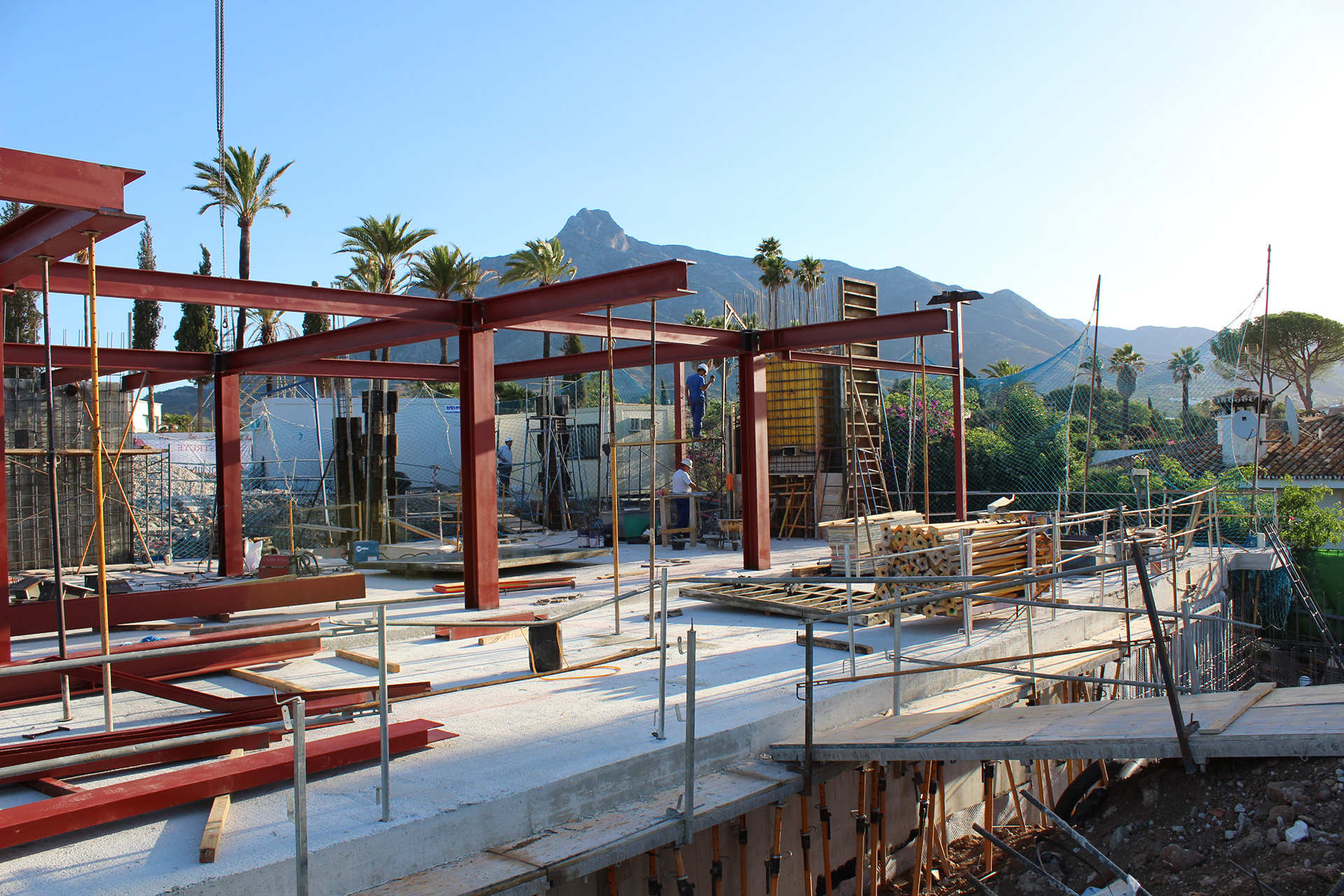
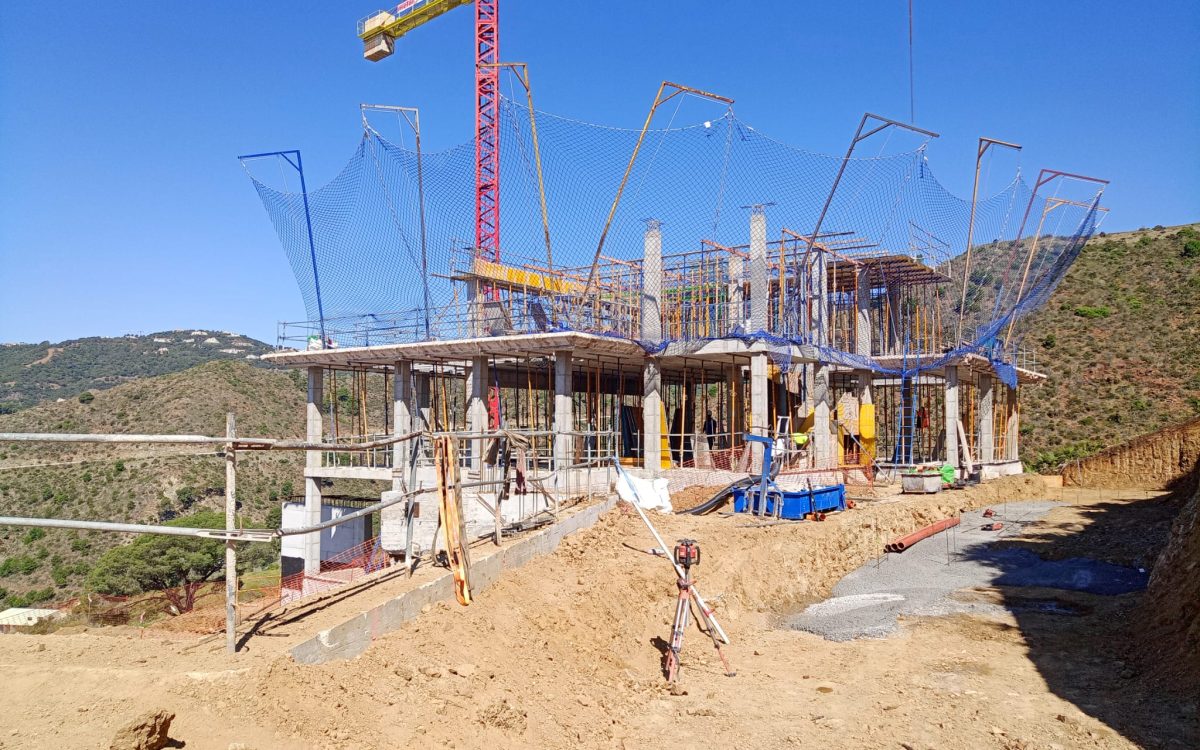
Once the Licencia de Obra Mayor is granted, construction can begin. The typical luxury villa construction timeline in Marbella is 12-18 months for a 400-700 m² villa, extending to 18-24 months for properties exceeding 1,000 m². The process follows a standard sequence: excavation and foundations (2-3 months), structure (3-4 months), roof and waterproofing (1-2 months), installations — electrical, plumbing, HVAC (2-3 months), interior finishes — walls, floors, kitchens, bathrooms (3-4 months), and exterior works — terraces, pool, landscaping (2-3 months, often overlapping with interior finishes).
Project management is essential. You need a director de obra (site architect) who supervises construction quality and ensures compliance with the approved project, and ideally a separate project manager who coordinates timelines, manages the builder relationship and reports progress to you. Budget 3-5% of construction cost for project management. This is not optional — it is the insurance that prevents your €3 million build from becoming a €4 million ordeal.
The builder selection process deserves particular attention. In Marbella, there are approximately 50-60 construction companies that regularly build luxury villas — but the quality variation between them is enormous. The best builders have waiting lists of 6-12 months, employ permanent teams rather than casual subcontractors, and will provide references from projects completed in the last 2-3 years that you can visit in person. The worst builders bid low, start enthusiastically, encounter “unexpected” costs at every stage, employ subcontractors who disappear mid-project and leave you managing a crisis rather than enjoying a creative process. Always get three quotes from established companies, always verify their references by visiting completed projects and speaking to the owners, and always resist the temptation to choose the cheapest quote — in Marbella construction, the cheapest quote is almost always the most expensive final bill.
A payment structure that protects you: never pay more than 10% upfront. Structure payments against certified completion milestones — foundation completed, structure complete, roof closed, installations finished, first fix, second fix, final handover. Each payment is released only when your project manager certifies that the corresponding milestone has been completed to the agreed standard. This milestone-based payment structure is standard in professional construction and any reputable builder will accept it. A builder who demands large upfront payments or refuses milestone-based certification is a builder to avoid.
Weather and seasonal considerations also affect your timeline. Construction in Marbella can proceed year-round thanks to the mild climate, but heavy rain periods (primarily November-February) can delay foundation work, exterior rendering and landscaping. The busiest period for construction companies is January-May (when projects approved in the previous year begin) — if you can time your construction start for September-October, you may benefit from slightly faster builder availability and better pricing on some materials. Summer (July-August) sees reduced productivity as temperatures exceed 35°C and construction workers take mandatory breaks during the hottest hours, effectively shortening the working day by 2-3 hours.
Step 7: Exterior Works — Pool, Garden, Terraces, Landscaping
Exterior works are consistently the most underbudgeted element of self-build projects. A luxury infinity pool with heating, lighting, automatic cover and surrounding terracing costs €80,000-€200,000 depending on size and specification. Mature garden landscaping — palm trees, Mediterranean planting, irrigation, artificial grass areas, perimeter hedging for privacy — costs €50,000-€150,000. Terraces, driveways, perimeter walls, lighting and outdoor kitchens add another €30,000-€100,000. Total exterior works: €160,000-€450,000 on top of the construction cost. Budget accordingly.
Step 8: Utility Connections — The Hidden Bottleneck
Connecting utilities — water, electricity, sewage — is often the final and most frustrating step in a self-build. In established urban areas with existing infrastructure, connections are straightforward (2-4 weeks, €5,000-€15,000). In hillside plots or newer developments, the situation can be significantly more complex. Water connections in the Marbella area are managed by Acosol (regional) and Hidralia (local distribution). Electricity is typically Endesa or Iberdrola. If the plot is remote from existing infrastructure, the cost and timeline for bringing connections to the site can be substantial — potentially €20,000-€50,000+ and several months of bureaucratic process.
The rule: verify utility availability and connection costs before you buy the plot. Your lawyer and architect should confirm in writing that water, electricity and sewage connections are available, permitted and priced. A plot with no utility access — regardless of how beautiful the views — is not a building plot. It is a field with potential.
The Hidden Costs Nobody Warns You About
| Hidden cost | Amount |
|---|---|
| Architect fees (6-12% of construction) | €120,000-€420,000 |
| Project management (3-5% of construction) | €60,000-€175,000 |
| Building licence fees (ICIO tax ~4% of PEM) | €40,000-€140,000 |
| Geotechnical and structural studies | €5,000-€15,000 |
| Energy certificate + technical reports | €3,000-€8,000 |
| Utility connections | €5,000-€50,000 |
| Furniture and interior design | €100,000-€500,000 |
| Plot purchase taxes (ITP 7% or IVA 21% + AJD) | 7-22% of plot price |
| Contingency (15-20% of construction budget) | €300,000-€700,000 |
Total Investment: Two Worked Examples
Example A: 400 m² high-end villa, El Madroñal (Benahavís)
| Plot (1,500 m²) | €1,200,000 |
| Plot purchase tax (7% ITP) | €84,000 |
| Construction (400 m² × €3,000) | €1,200,000 |
| Architect (8%) | €96,000 |
| Project management (4%) | €48,000 |
| Permits + taxes + studies | €80,000 |
| Pool + landscaping + exterior | €200,000 |
| Furniture + interior design | €150,000 |
| Utilities connection | €15,000 |
| Contingency (15%) | €180,000 |
| TOTAL | ~€3,253,000 |
| Estimated market value upon completion | €4,000,000-€4,500,000 |
Example B: 800 m² ultra-luxury villa, La Zagaleta
| Plot (4,000 m²) | €3,000,000 |
| Plot purchase tax | €210,000 |
| Construction (800 m² × €4,000) | €3,200,000 |
| Architect (7%) | €224,000 |
| Project management (4%) | €128,000 |
| Permits + taxes + studies | €180,000 |
| Pool + landscaping + exterior | €400,000 |
| Furniture + interior design | €400,000 |
| Utilities | €25,000 |
| Contingency (15%) | €480,000 |
| TOTAL | ~€8,247,000 |
| Estimated market value upon completion | €10,000,000-€12,000,000 |
The Realistic Timeline: Month by Month
| Phase | Duration | Cumulative |
|---|---|---|
| Plot search and purchase | 1-6 months | Month 1-6 |
| Architect selection and design | 3-6 months | Month 4-12 |
| Permit application and approval | 2-6 months | Month 10-18 |
| Construction | 12-18 months | Month 12-36 |
| Exterior works + landscaping | 2-4 months (overlaps) | Month 28-36 |
| Furnishing + interior design | 2-4 months | Month 30-38 |
| Total: plot purchase to move-in | 24-36 months (realistic) / 18-24 months (optimistic, simple build, fast permits) | |
7 Mistakes Self-Builders Make in Marbella
- Not verifying plot classification. Buying suelo urbanizable or rústico thinking it is buildable. It is not. This mistake is irreversible and total. Always verify suelo urbano with the Catastro and Town Hall
- Underbudgeting by 30-40%. Most self-builders budget for construction cost only and forget architect fees (6-12%), permits (4%+ ICIO), project management (3-5%), landscaping (€160-€450K), furniture (€100-€500K), utilities (€5-€50K) and contingency (15-20%). The total project cost is always 40-60% higher than the construction cost alone
- Choosing the cheapest builder. In Marbella, you get what you pay for. The cheapest quote is often the builder who will cut corners, use inferior materials, employ subcontractors who disappear mid-project and leave you with a building that looks right but does not function right. Get 3 quotes. Choose the middle one — then verify their references
- Not hiring a project manager. Managing a construction project from London, Stockholm or Dubai via WhatsApp messages to your builder does not work. A project manager on site, visiting weekly, verifying work quality, managing subcontractor schedules and reporting to you with photos and progress updates is essential. Budget 3-5% of construction cost
- Ignoring utility availability. Buying a plot with no confirmed water or electricity connection, assuming it will “be sorted” during construction. It may not. Verify before you buy
- Over-personalising the design. A home designed entirely around your current lifestyle may not suit a future buyer. If there is any possibility you will sell within 10-15 years, ensure the architectural design has broad appeal — not just personal appeal. Bespoke is beautiful. Eccentric is expensive to resell
- Starting construction before the Licencia de Obra Mayor is granted. Some builders offer to “begin groundwork” while the permit is being processed. This is illegal and can result in the entire project being halted, fines imposed, and potentially a demolition order. Never start work without the permit in hand
LUXO Estates
Build Your Dream — Or Find One Already Built
Whether you want to build from scratch on a prime plot or find a modern villa that delivers the new-build experience without the construction risk, LUXO Estates can help. We have build-ready plots in El Madroñal, Benahavís, Sierra Blanca and Nueva Andalucía — plus contemporary villas built within the last 5 years that offer the specifications most buyers want without the 2-3 year wait.