Marbella News · Luxury Real Estate · 29 September 2026
Marbella Luxury Property Market Joins Monaco and Miami in the Global Elite, and Its Buyers Are Getting Younger
The Marbella luxury property market now ranks fifth in the world for the ultra-wealthy, ahead of Monaco, New York and London. According to Barnes, nearly half of all €5M+ buyers are now under 30. The pensioners’ paradise of the 1990s has quietly become the playground of the next generation of wealth.

Key facts
- Ranking: Marbella is 5th in the BARNES City Index 2026, up from 35th in 2025.
- Company it keeps: Madrid, Milan, Dubai and Miami are ahead. Monaco fell to 14th.
- Buyer age: nearly 50% of €5M+ purchases now involve buyers under 30; five years ago, 90% were over 60.
- Who is buying: the US, the UK, Switzerland and Scandinavia, with fast-growing interest from the Middle East.
- Price level: prime homes in the top areas start at around €2.5 million, and prestige prices rose around 10% in a year.
For decades, the Marbella luxury property market was described as Spain’s answer to the Côte d’Azur. That comparison no longer flatters Marbella. In this year’s BARNES City Index, the annual ranking of where the world’s ultra-high-net-worth individuals want to live, Marbella climbed an extraordinary 30 places, from 35th to 5th. Monaco, meanwhile, slid from 4th to 14th.
This month, Barnes returned to the subject with a closer look at what is driving the rise. The headline is a statistic that surprises even people who work in the market: the typical buyer of a €5 million-plus home in Marbella is no longer a retiree. Almost half are now under 30.
Guilhem Gauran, who leads Barnes on the Costa del Sol, summed up the argument confidently. In his view, there is nothing Miami, Cannes, Monaco or Dubai offer that Marbella does not already have.
🏆 The Ranking: How the Marbella Luxury Property Market Reached the Top Five
The BARNES City Index looks at 50 cities through the eyes of UHNWIs, people with at least $30 million in net assets. It measures where they actually want to live, weighing lifestyle, security, culture, beauty and global connectivity. The 2026 edition, published in January, delivered a clear message: the world’s wealthiest are choosing year-round quality of life over pure tax arithmetic.
| Rank 2026 | City |
|---|---|
| 1 | Madrid |
| 2 | Milan |
| 3 | Dubai |
| 4 | Miami |
| 5 | Marbella (up from 35th) |
| 6 | Paris |
| 7 | New York |
| 8 | Rome |
| 9 | Dallas |
| 10 | Budapest |
| 11 | London |
| 14 | Monaco (down from 4th) |
Two Spanish cities in the global top five makes Spain the clear winner of this year’s index. Barnes called Marbella the big surprise of the edition and described it as a new epicentre of European luxury. It pointed to international schools, prestigious medical facilities, luxury shopping, Michelin-starred dining and a very favourable inheritance tax regime.
🔄 What the Ultra-Wealthy Want Now
The most interesting part of the 2026 index is not who went up, but why. Barnes’s analysis shows a clear change in how UHNWIs choose where to live. Tax optimisation still matters, but it is no longer enough on its own. The winners of this edition are places that combine life, culture, security and personal freedom in one location.
Another key trend is the end of the purely seasonal residence. Homes that used to be occupied for a few weeks in summer are increasingly becoming main residences. That shifts the priorities from a pretty view and a pool to the infrastructure of everyday life: international schools, top-tier healthcare, air connections, safety and a real community.
The Marbella luxury property market happens to tick every one of those boxes. It is also telling that several of this year’s new entries to the index are lifestyle-driven, sun-and-nature destinations: Majorca, Lake Como, Comporta, Palm Beach and The Hamptons. Majorca made its debut straight into 15th place, one place behind Monaco. The Mediterranean way of life is having a moment among the world’s wealthiest, and Spain is its main beneficiary.
🇪🇸 Spain’s Double Win: Madrid and Marbella
Madrid held on to first place for the second year in a row, confirming its status as a magnet for Latin American and European wealth. With Marbella at number five and Majorca at 15, Spain places three destinations in the global top 15.
The two leading Spanish cities complement each other rather than compete. Madrid is the business and cultural capital; Marbella is the lifestyle base. It is increasingly common for international families to own in both, or to base the family on the coast while the business runs from the capital, less than three hours by high-speed train from Málaga.
For a deeper dive into the wealth migration behind the ranking, read our guide Where the Billionaires Are Moving in 2026 (And Why Marbella).
👶 The Big Shift: From Retirees to Under-30s
The most striking data point from Barnes is demographic. Five years ago, around 90% of buyers of €5 million-plus homes in Marbella were over 60. Today, nearly half are under 30.
For the Marbella luxury property market, that is not a gradual evolution; it is a generational handover. Several forces are behind it:
- New fortunes: founders, investors and digital entrepreneurs who made their money early and can work from anywhere.
- Family relocations: younger families choosing Marbella as a full-time base, attracted by international schools and healthcare.
- Intergenerational wealth: parents buying for children, or families structuring assets early, helped by Andalusia’s light inheritance tax.
- A year-round city: Marbella is no longer only a summer destination. It is a place to live, work and raise children twelve months a year.
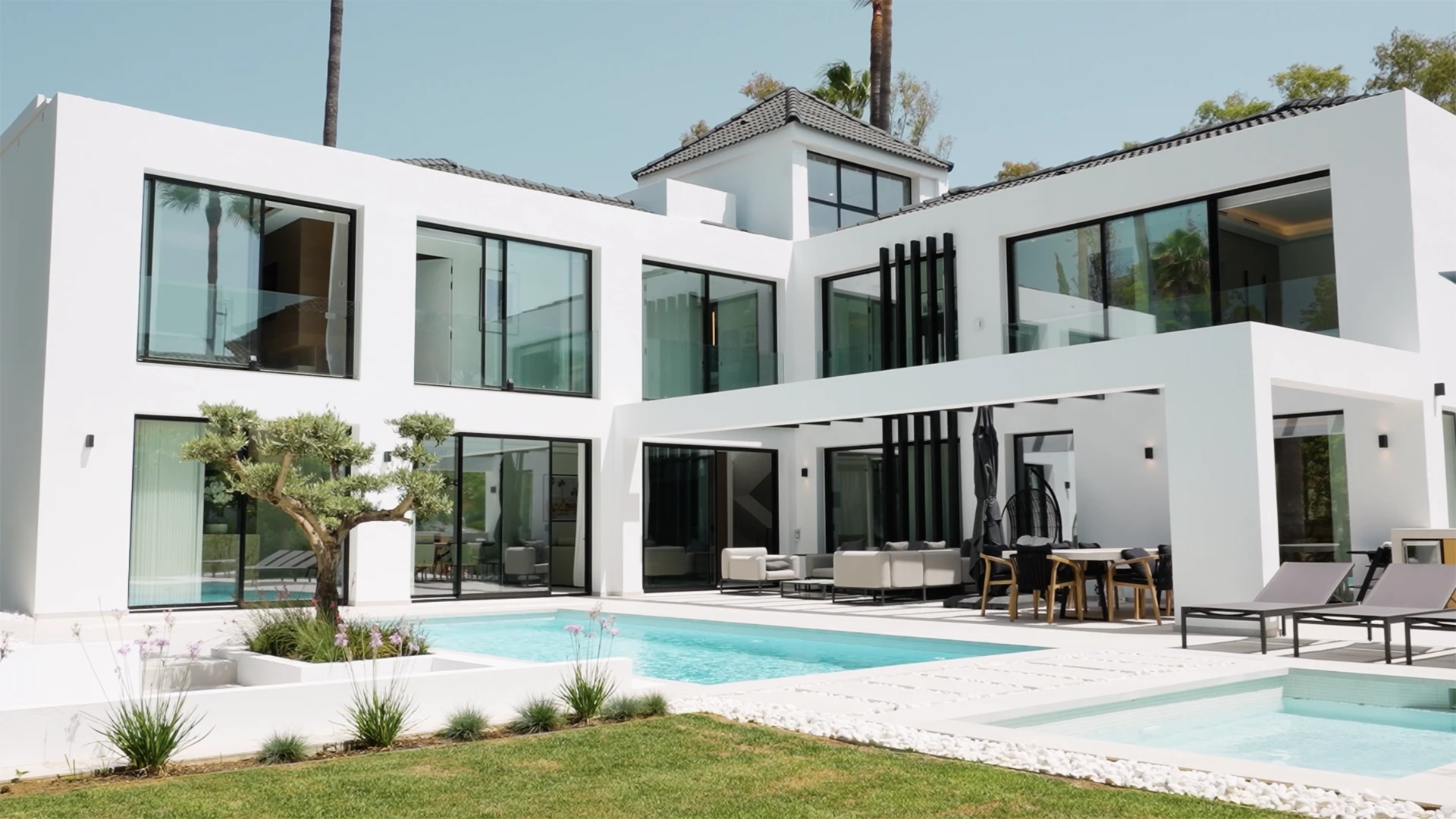
Younger buyers also want different things. Think smart, low-maintenance modern villas, wellness facilities, gyms, home offices, fast connectivity and proximity to great restaurants and beach clubs, rather than a quiet retirement hideaway.
🌍 Who Is Buying in Marbella
According to Barnes, the main nationalities in the top segment of the Marbella luxury property market are:
- United States: an increasingly visible presence in the prime market.
- United Kingdom: Marbella’s traditional core buyer, still very active.
- Switzerland: wealth seeking sun, space and value compared with home.
- Scandinavia: long-standing lovers of the Costa del Sol lifestyle.
- Middle East: a notable rise in enquiries, many channelled through Barnes’s Dubai office.
The Gulf connection is worth watching. Marbella has a long history with Middle Eastern royalty and investors, and improved connectivity and the city’s new wave of branded hotels make it an increasingly natural second base.
📍 Where the Money Goes: Marbella’s Prime Addresses
Barnes places the average luxury home in the key areas above €2.5 million, with much higher prices in the most exclusive enclaves. These are the addresses it highlights:
- La Zagaleta: the gated estate in the Benahavís hills, synonymous with privacy and Europe’s most expensive homes.
- Sierra Blanca: hillside villas above the Golden Mile, a short drive from the centre.
- The Golden Mile: the historic address between Marbella and Puerto Banús.
- Nueva Andalucía: the “Golf Valley”, popular with families and younger buyers.
- Benahavís: hillside estates with sea and mountain views.
- Estepona and Sotogrande: the western extension of the luxury corridor.
The very top of the Marbella luxury property market is also growing. Separate figures from agency Drumelia, published this week, show that more than 20 homes have sold for over €10 million on the Costa del Sol in the past five years. Together they are worth around €430 million, and La Zagaleta alone accounts for more than €250 million. Many of these deals never appear on public portals.
The average price of those €10M+ transactions is above €20 million, and Sierra Blanca has been home to a mansion priced at around €70 million. Barnes, for its part, reported a rise of roughly 10% in prestige property prices in a single year. These are figures that, until recently, belonged almost exclusively to Monaco, London or the Côte d’Azur.
🏥 The Infrastructure of a Global City
Rankings like Barnes’s reward the things that make a place liveable all year, and this is where Marbella has quietly transformed over the past decade, laying the foundations of today’s Marbella luxury property market:
- Education: the Costa del Sol has one of the densest concentrations of international schools in Spain, following British, American and International Baccalaureate curricula.
- Healthcare: Marbella has several private hospitals and specialist clinics, and new projects such as the Oakmond longevity resort show how health is becoming part of the luxury offer itself.
- Connectivity: Málaga Airport, around 45 minutes away, is one of Spain’s busiest, with direct flights across Europe and to the Middle East and North America. Gibraltar and private aviation add further options.
- Gastronomy and culture: Michelin-starred restaurants, world-class beach clubs and a growing calendar of art, music and sporting events.
- Sport and outdoors: dozens of golf courses within a short drive, marinas at Puerto Banús and Sotogrande, and the Sierra Blanca mountains for hiking and cycling.
None of this appeared overnight. What changed is that the world’s wealthiest families have started to value exactly this combination, and to compare it directly with what they get in Monaco or Miami.
⚖️ Why Marbella Beats Monaco (Now)
Monaco still has its advantages: security, a low-tax regime and an unrepeatable prestige. But the index suggests the world’s wealthiest are measuring success differently. Here is how Marbella stacks up against its traditional rivals:
| Factor | Marbella | Monaco | Miami |
|---|---|---|---|
| Space | Large villas and plots | Very limited | Good, at a premium |
| Climate | Mild all year | Mild | Hot, hurricane season |
| Nature and golf | Beaches, mountains, dozens of courses | Urban, compact | Beaches, flat terrain |
| Pace of life | Relaxed, less traffic | Dense | Big-city |
| Value per m² | Far below Monaco | Among the world’s highest | High and rising |
Barnes’s own framing sums it up well: Marbella offers the advantages of a major global city without many of the drawbacks. There is less traffic, distances are shorter and quality of life is higher. Add Andalusia’s inheritance and gift tax, with effective rates that can fall as low as 0.1% in certain cases, and the equation looks very different from a decade ago.
💶 The Tax Picture in Brief
Tax is no longer the only reason the wealthy move, but it still shapes decisions in the Marbella luxury property market. The main points for buyers are:
- Inheritance and gift tax: Andalusia offers very generous relief for transfers between close family members, with effective rates that can drop as low as 0.1% in certain cases. For families planning across generations, this is one of Marbella’s strongest arguments.
- Transfer tax (ITP): resale homes currently pay a general rate of 7% in Andalusia. From January 2027 it falls to 6.75%, and the regional government plans to keep cutting it by 0.25 points a year until it reaches 6%. New-build homes pay VAT instead, so they are not affected.
- Wealth taxation: residents’ wealth tax is regulated at both regional and national level, and the picture has become more complex in recent years. It is essential to get personalised advice before buying or becoming resident.
On a €5 million resale villa, for example, the 2027 cut alone would mean around €12,500 less in transfer tax. That is modest in the context of the purchase, but it sends a clear signal about the direction of Andalusian tax policy.
🌟 The Momentum Behind the Numbers
The ranking does not exist in a vacuum. For the Marbella luxury property market, September alone brought a series of announcements that reinforce Marbella’s new status:
- New General Plan (PGOM): Marbella finally approved a modern planning framework, the first in Andalusia under the LISTA law, replacing its 1986 plan.
- Waldorf Astoria Marbella: Spain’s first Waldorf cleared its first planning hurdle in Las Chapas. Read the story.
- Oakmond Marbella: Goldman Sachs is backing a €260M longevity resort on the historic Incosol site. Read the story.
- Lower transfer tax from 2027: Andalusia will cut the general ITP rate on resale homes from 7% to 6.75%, with further cuts planned.
Global brands, global capital and legal certainty are all arriving at the same time. That is rarely a coincidence.
🚧 What Could Slow It Down
For the Marbella luxury property market, a top-five ranking is a snapshot, not a guarantee, and Monaco’s ten-place fall shows how quickly positions can change. Several factors deserve attention:
- Limited supply at the top. Large plots in the best locations are scarce. That supports prices, but it can also limit transactions and push buyers to neighbouring areas.
- Growth pains. Following the new PGOM, thousands of new homes are planned to the east and north of the city. Infrastructure, traffic and services will need to keep pace to protect quality of life.
- Affordability for locals. Rising prices put pressure on housing for workers and families. The new plan’s 20% reserve for affordable housing is part of the response.
- Policy changes. Tax rules at national level can shift, and international buyers are sensitive to regulatory uncertainty.
None of these is new, and none appears to be slowing demand today. But they are the issues that will decide whether Marbella stays in the top five or becomes a one-year wonder.
🔭 Outlook: 2027 and Beyond
The pipeline points towards an even more international Marbella luxury property market. Between the Waldorf Astoria, Oakmond, the Four Seasons and other branded-residence projects, the city is lining up a generation of hotels and residences that did not exist five years ago, most of them due around 2029. Each one brings a global brand, a global client list and a new reason to visit.
Add a younger buyer base that plans to stay for decades rather than summers, and the demand story looks structural rather than cyclical. The question for the next edition of the BARNES City Index is not whether Marbella belongs in the conversation, but how high it can climb.
💎 What It Means for the Marbella Luxury Property Market
A top-five global ranking is not just good PR. It changes who is looking, how they search and what they expect. Three trends are worth watching:
- Competition for the best product. Truly exceptional villas in top locations are scarce, and younger international buyers are prepared to move fast.
- Design over nostalgia. Demand is shifting towards contemporary, turnkey homes with wellness, technology and flexible spaces.
- Off-market is the market. At the very top, discretion rules. The best homes often change hands through private networks before they are ever advertised.
For sellers, this is an unusually strong moment to position quality property. For buyers, preparation and the right advice matter more than ever.
🧾 Buying in Marbella’s Prime Market: A Quick Checklist
- Define the lifestyle first. Beach, golf, schools, privacy or nightlife? Each points to a different area.
- Ask for off-market access. Many of the best homes are never listed publicly.
- Check the tax picture. Transfer tax, wealth tax and inheritance planning all depend on your residency and structure.
- Verify the planning status. With the new PGOM, make sure the property’s legal situation is fully clear.
- Get independent legal advice before signing any reservation contract.
❓ Frequently Asked Questions
Where does Marbella rank in the BARNES City Index 2026?
Fifth in the world, up from 35th in 2025, behind Madrid, Milan, Dubai and Miami, and ahead of Paris, New York, London and Monaco.
Is Marbella really ahead of Monaco?
In this ranking, yes. Monaco fell from 4th to 14th in 2026, while Marbella rose to 5th.
Who is buying luxury property in Marbella?
Mainly buyers from the US, the UK, Switzerland and Scandinavia, with growing interest from the Middle East. Nearly half of €5M+ buyers are now under 30.
How much does a luxury home in Marbella cost?
In the key prime areas, luxury homes average above €2.5 million. In enclaves such as La Zagaleta and Sierra Blanca, prices can reach tens of millions.
Which are the most exclusive areas in Marbella?
La Zagaleta, Sierra Blanca, the Golden Mile, Nueva Andalucía and Benahavís, with Estepona and Sotogrande extending the luxury corridor to the west.
What is the BARNES City Index?
An annual ranking by luxury real estate firm Barnes of the 50 cities where ultra-high-net-worth individuals (with $30M+ in net assets) most want to live, based on lifestyle, security, culture and connectivity.
Why are the ultra-wealthy choosing Marbella?
For its year-round quality of life: climate, space, international schools, healthcare, connectivity and security, together with favourable inheritance tax in Andalusia.
Is property transfer tax going down in Andalusia?
Yes. The general rate on resale homes falls from 7% to 6.75% in January 2027, with further cuts planned until it reaches 6%. New-build homes pay VAT instead.
Sources: BARNES City Index 2026, Barnes Costa del Sol, idealista/news, Drumelia, Junta de Andalucía.
LUXO Estates
Top five in the world. Top of your list?
Prime villas and residences across Marbella, including the ones that never reach the portals.